

Key Takeaways
- Qualifying Malaysian SMEs pay a tiered corporate tax rate that starts at 15 percent on the first RM150,000 of chargeable income, compared with the flat 24 percent rate for larger companies.
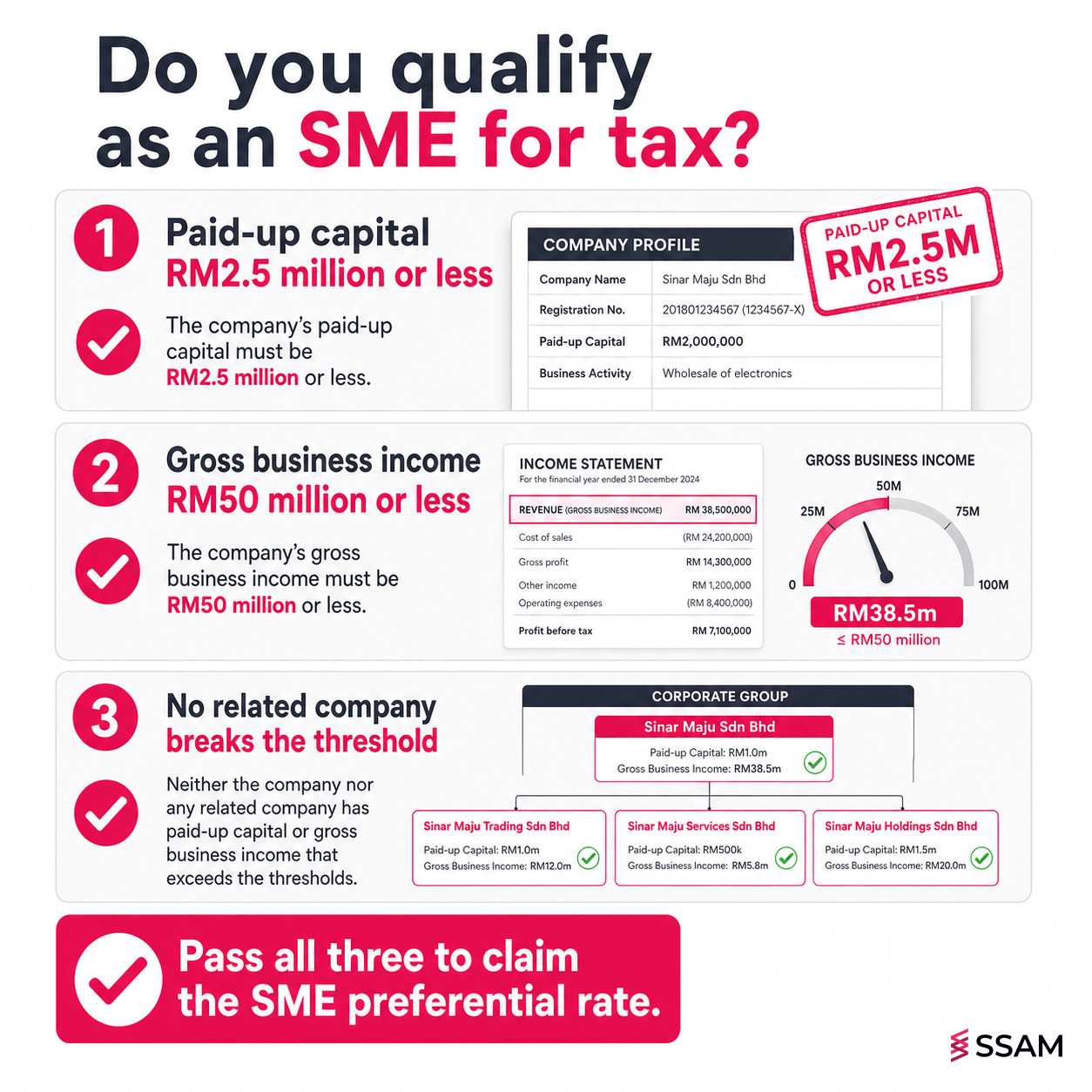
- Two thresholds, a related-company test, and a foreign ownership limit decide whether your Sdn Bhd qualifies: paid-up ordinary share capital of RM2.5 million or less and gross business income of RM50 million or less.
- The LHDN SME definition for tax purposes is not the same as the SME Corp definition used for grants and the SME Status Certificate.
- Capital allowances, double deductions, and MIDA-administered incentives like Pioneer Status and Investment Tax Allowance can stack on top of the preferential rate, but each carries its own qualifying conditions and documentation.
- Most incentives are claimed in your Form C tax computation, supported by records kept for seven years under the Income Tax Act 1967.
Introduction
Tax incentives for SMEs in Malaysia can cut your effective corporate tax bill by tens of thousands of ringgit a year, but only if you know which ones apply to your business and how to claim them properly. Many founders run their Sdn Bhd for years without realising that they qualify for a preferential rate on the first slice of profit, or that the automation machine they bought attracts an accelerated capital allowance, or that a HRD Corp training programme can be claimed at twice its cost in the tax computation.
This guide walks through every major tax incentive and deduction available to a Malaysian SME, organised so you can quickly confirm whether you qualify, decide which incentives are worth pursuing, and understand the form or approval letter needed to claim each one. It is written for SME owners, founders, and finance managers who want plain English answers, not LHDN public ruling jargon.
What are tax incentives for SMEs in Malaysia?
Tax incentives for SMEs in Malaysia are reduced tax rates, double deductions, capital allowances, and special reliefs granted by LHDN, the Ministry of Finance, and MIDA to qualifying small and medium businesses. They lower a company's effective tax rate, but each incentive carries qualifying conditions on paid-up capital, ownership, gross income, or activity type.
Three regulators do most of the work. LHDN (Lembaga Hasil Dalam Negeri) administers the SME preferential rate and most ordinary deductions claimed through the annual tax return. The Ministry of Finance sets the broader policy and gazettes new incentive orders, often through the annual Budget. MIDA (the Malaysian Investment Development Authority) administers the bigger, application-based incentives like Pioneer Status, Investment Tax Allowance, and the green technology schemes.
These incentives fall into three broad categories: reduced tax rates, deductions against income (single, double, and capital allowances), and time-limited exemptions for promoted activities. None of them are automatic. You either need to meet a clear qualifying test, or you need to apply and receive an approval letter before you can claim.
Who qualifies as an SME under Malaysian tax law
The first job is to confirm SME status, because everything else flows from there. LHDN applies a three-part test for the preferential corporate tax rate, and SMEs routinely fail one of them without realising.
Paid-up capital and gross income thresholds
Your company qualifies as an SME for the preferential rate if it has paid-up ordinary share capital of RM2.5 million or less at the beginning of the basis period for the year of assessment, and gross business income of RM50 million or less for that year of assessment. Miss either threshold and the company drops out of SME status and pays the flat 24 percent rate on all chargeable income.
Related-company ownership test
The second trap is the related-company test. If your Sdn Bhd is part of a group where one related company has paid-up capital above RM2.5 million, the SME status is denied at the group level. Two related companies are defined by a 50 percent or more direct or indirect ownership link. A small operating Sdn Bhd that sits inside a larger family group will often lose the preferential rate because of this test, even though its own balance sheet looks small.
A separate ownership condition also applies. More than 20 percent of the paid-up capital must not be held, directly or indirectly, by foreign companies or non-Malaysian individuals. Cross this 20 percent foreign ownership line and the company pays the flat 24 percent rate regardless of how small it is.
SME Corp vs LHDN SME definitions
This is the single biggest source of confusion. The SME Corp Malaysia definition (used for grants, the SME Status Certificate, and incentive applications) is a different test, built on annual sales turnover and employee headcount split by sector. A company can be an SME under SME Corp's definition (and qualify for grants) without being an SME under LHDN's definition (and therefore still pay the flat 24 percent rate). Always confirm which definition the incentive uses before applying.
SME preferential corporate tax rates explained
The preferential rate is the single biggest tax saving most qualifying SMEs unlock, and it is built into the tax computation rather than requiring a separate application. Qualifying SMEs pay a tiered rate that starts well below the standard 24 percent corporate rate.
For the current years of assessment, a qualifying SME pays 15 percent on the first RM150,000 of chargeable income, 17 percent on the next band from RM150,001 to RM600,000, and the standard 24 percent on anything above RM600,000. These bands are set by LHDN and apply only to SMEs that also pass the foreign ownership condition. They can be revised at each annual Budget, so check the figures for your year of assessment before filing.
Newly incorporated SMEs may also qualify for a start-up income tax rebate under Section 6D of the Income Tax Act 1967, worth up to RM20,000 for each of the first three years of assessment, subject to the incorporation window and conditions set by LHDN.
A worked example shows the saving clearly. Take a Sdn Bhd with RM500,000 of chargeable income in a year of assessment.
| Item | Qualifying SME | Non-SME (flat 24%) |
|---|---|---|
| First RM150,000 at 15% | RM22,500 | RM36,000 |
| Next RM350,000 at 17% | RM59,500 | RM84,000 |
| Total tax payable | RM82,000 | RM120,000 |
| Saving vs flat rate | RM38,000 | n/a |
That RM38,000 saving exists every year the company holds SME status, before you stack any further incentives on top. For a deeper view of how to use this rate as part of broader planning, see how to reduce corporate tax in Malaysia. How you then take money out of the company, whether through a director's salary, a dividend, or an advance to director, is a separate planning decision that changes your overall tax position. And when you eventually exit the business, the capital gains tax on a business sale in Malaysia becomes the final piece of the same plan.
Capital allowances every SME should claim
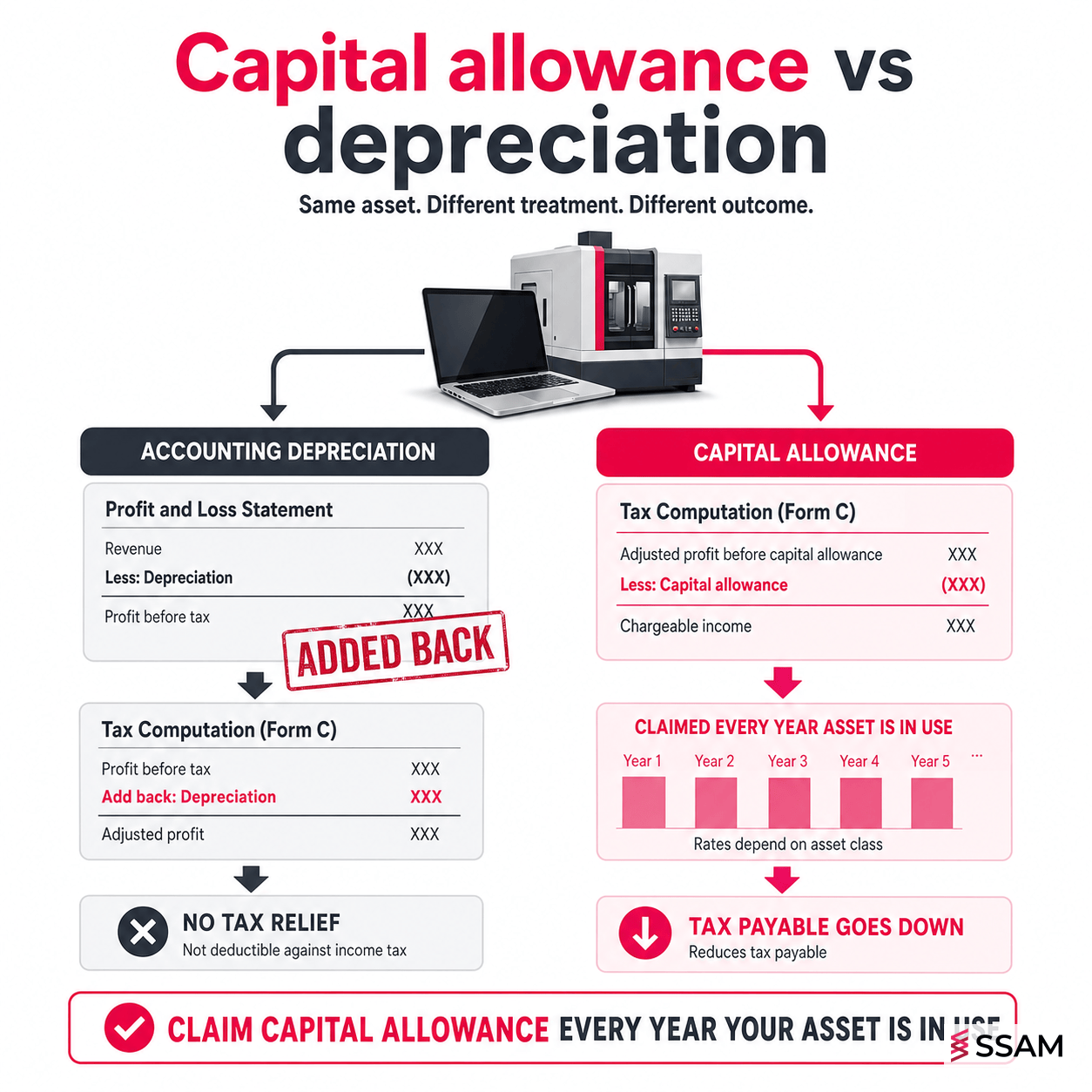
Capital allowance is the tax equivalent of depreciation. Accounting depreciation is added back in the tax computation and is not deductible. Capital allowance is the deduction LHDN actually grants for wear and tear on qualifying assets. Many SMEs lose deductions every year because the bookkeeping records depreciation but the tax computation never claims the capital allowance. For a full breakdown of the rates and asset classes, see our guide to capital allowances in Malaysia.
Initial and annual allowance basics
When your business buys a qualifying fixed asset (machinery, office equipment, motor vehicles, computers), it claims an initial allowance in the year of acquisition plus an annual allowance every year until the asset is fully written down. The rates differ by asset class, with plant and machinery typically attracting higher rates than office equipment.
Accelerated capital allowance for plant and machinery
Accelerated capital allowance (ACA) lets qualifying businesses write off eligible plant, machinery, and ICT equipment faster than the standard rate. This brings the tax deduction forward, which reduces tax payable in the year of acquisition. ACA categories are reviewed at each Budget, and the most current list should be cross-checked before claiming.
Automation capital allowance
The automation capital allowance encourages SMEs to invest in automation equipment. Qualifying expenditure on automation machinery in eligible sectors can attract a faster write-down on a higher capped amount. Manufacturers and selected service sectors benefit most.
Small value asset rule
Assets that fall below a prescribed value per item can be written off in full in the year of acquisition, up to an annual cap. This is useful for office laptops, small tools, and low-cost equipment, and it avoids the administrative cost of tracking small assets across multiple years. Special rules and capped thresholds apply to motor vehicles, which is covered in company car Sdn Bhd tax in Malaysia.
Double deductions Malaysian SMEs can claim
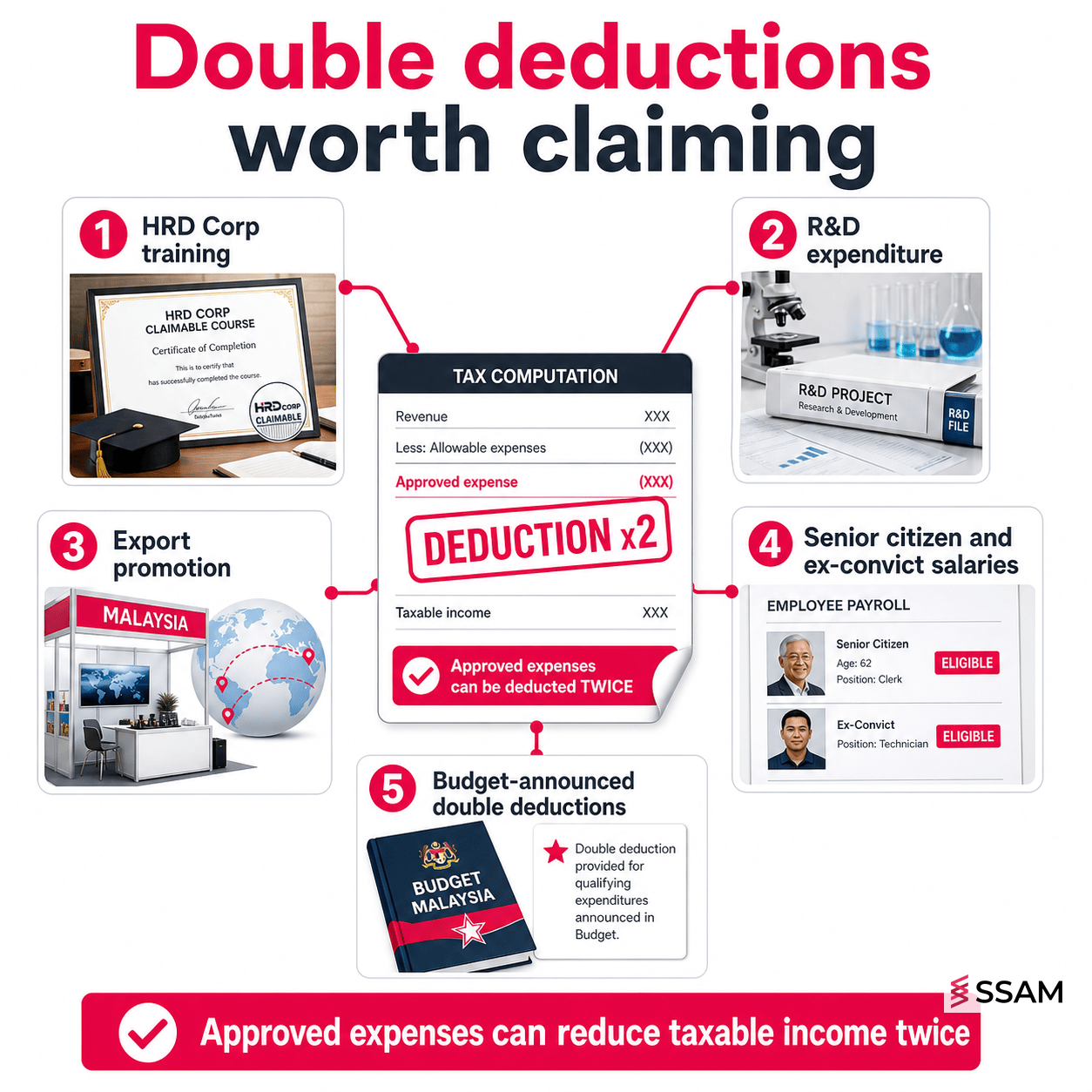
A double deduction lets you claim twice the actual cost of qualifying expenditure against your taxable income. The actual ringgit spent is not refunded, but the tax saving is meaningfully larger than a single deduction. These are some of the highest-leverage incentives available and they are routinely missed because the qualifying conditions are administrative rather than financial.
Training and HRD Corp expenditure
Approved training expenditure registered with HRD Corp can attract a double deduction. Keep the HRD Corp claim records, the training provider invoices, and proof of attendance. The administrative paperwork is the difference between claiming and not claiming.
Research and development expenditure
Qualifying R&D expenditure attracts a double deduction subject to LHDN approval. The scope of qualifying R&D is narrower than most founders assume, and routine product testing or commercial development typically does not qualify. The most defensible R&D claims involve novel scientific or technological work documented with project files, technical notes, and clear hypothesis-test records.
Export promotion expenses
SMEs developing export markets can claim a double deduction on qualifying export promotion expenses such as overseas market research, participation in approved trade fairs, and certain advertising spend in target markets. The list of qualifying expenses is gazetted and should be checked before the trip.
Other Budget-announced double deductions appear from time to time. Always review the current Budget and any year-of-assessment-specific announcements before finalising the tax computation, ideally with an approved tax agent in Malaysia.
Industry and activity-based incentives (Pioneer Status, ITA, RA)
The big-ticket incentives are administered by MIDA and require an application and approval before they can be claimed. SMEs in promoted sectors should treat the application as a project in its own right.
Pioneer Status
Pioneer Status grants a partial income tax exemption on income from a promoted activity. In its standard form, 70 percent of statutory income is exempted for five years and the remaining 30 percent is taxed at the prevailing rate. The exemption is gazetted under the Promotion of Investments Act 1986. Manufacturing, agriculture, and selected services are the main qualifying sectors.
Investment Tax Allowance
Investment Tax Allowance (ITA) is the alternative to Pioneer Status. Instead of exempting income, ITA grants an allowance of 60 percent on qualifying capital expenditure incurred over five years, which is set off against up to 70 percent of statutory income, with the balance taxed at the prevailing rate. ITA suits capital-intensive businesses making large fixed-asset investments.
Reinvestment Allowance
Reinvestment Allowance (RA) is available to manufacturing and selected agricultural businesses that have been in operation for at least 36 months and that reinvest in qualifying capital expenditure for expansion, modernisation, automation, or diversification. RA is given at 60 percent of the qualifying capital expenditure and is offset against 70 percent of statutory income for the year of assessment, rising to 100 percent if the company exceeds the productivity level set by the Ministry of Finance. Any unused allowance can be carried forward. RA is one of the most useful incentives for established SMEs scaling production capacity.
Niche incentives most SMEs overlook
Beyond the headline categories, a long list of niche incentives can apply to specific business activities or locations. Most listicles skip these, which is why they remain underclaimed.
Green technology incentives (GITA and GITE)
The Green Investment Tax Allowance (GITA) and the Green Income Tax Exemption (GITE) apply to qualifying green technology assets, projects, and services. SMEs investing in solar systems, energy-efficient equipment, or providing green services should check eligibility before installation, because the application must be filed within the timeframe set by the administering agencies.
Digital and automation incentives
A series of digital-focused incentives have been announced in recent Budgets, covering digital adoption, cloud computing investments, and qualifying automation expenditure. The Digital Ecosystem Acceleration (DESAC) framework and adjacent programmes are administered through MIDA and MDEC.
Regional and special economic zone incentives
Special regimes apply to businesses operating in or relocating to specific zones, including the East Coast Economic Region, Iskandar Malaysia, the Tun Razak Exchange (Marquee Tier status), the Forest City Special Financial Zone, and the principal hub framework for regional headquarters. Each carries its own qualifying conditions, application route, and incentive package. Industry-specific schemes also exist for the Halal industry and BioNexus-status companies. None of these are automatic and most require a formal application.
How to claim tax incentives step by step
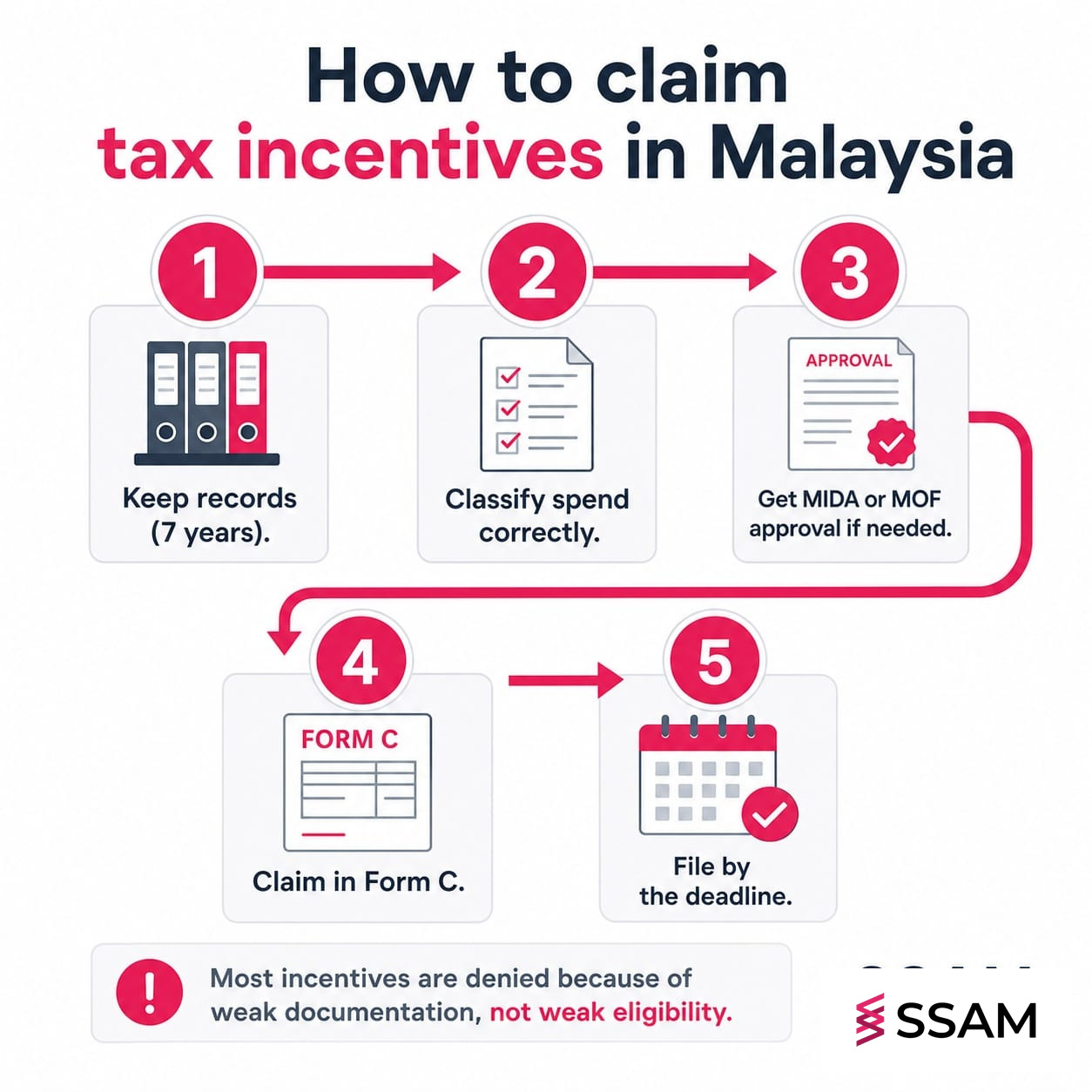
Knowing the incentive exists is only the first step. The mechanical claim path matters just as much, because LHDN denies incentives when the documentation does not support the claim.
Records and documentation you must keep
Under the Income Tax Act 1967, business records must be kept for seven years from the end of the relevant year of assessment. For incentive claims, keep the supplier invoices, asset registers, training certificates, HRD Corp approval letters, MIDA approval letters, and the workings used in the tax computation. For more on records and audit lookback risk, see LHDN's 7-year lookback.
Claim in Form C and the tax computation
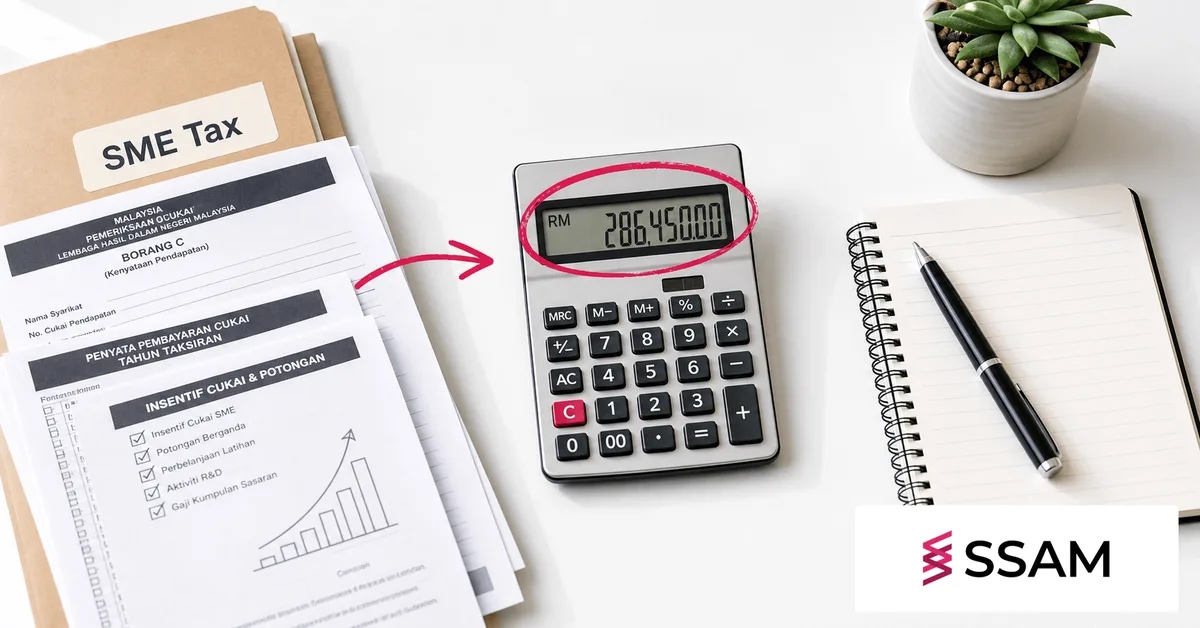
Most incentives are claimed in Form C (the company income tax return) supported by the tax computation schedule. Capital allowances appear in their own schedule, double deductions are computed in a separate line, and Pioneer Status or ITA require the MIDA approval letter to be referenced. The company must also file Form CP204 (the tax estimate) and pay monthly instalments through the year (CP204 tax estimate Malaysia). For an overview of how Form C, Form B, and Form E differ, see Form B vs Form C vs Form E.
When pre-approval is required (MIDA / MOF)
Pioneer Status, ITA, RA, GITA, GITE, principal hub status, and most zone-based incentives need a formal application and approval letter before the claim can be lodged. Some have a window from the date you commit to the qualifying investment, so timing matters. Engaging an approved tax agent or a MIDA consultant early in the planning stage usually saves missed windows.
Common mistakes SMEs make claiming tax incentives
Even SMEs that qualify for incentives lose them through avoidable mistakes. The most common are administrative, not technical.
- Mixing up the SME Corp and LHDN SME definitions, leading to wrong assumptions about which incentives apply.
- Forgetting the related-company test and claiming the preferential rate when a sister company breaks the threshold.
- Claiming depreciation instead of capital allowance in the tax computation, leaving real deductions unclaimed every year.
- Losing HRD Corp documentation for training expenditure, which kills the double deduction at audit.
- Late or under-estimated CP204 filings, which trigger penalties and can disqualify reliefs in some cases. See LHDN penalties for late tax filing for the current penalty structure.
- Missing the MIDA application window for Pioneer Status, ITA, GITA, or GITE, especially when the qualifying investment has already been committed.
- Treating tax incentives as a one-off project rather than a yearly review at year-end planning time. The smarter approach is to flag potential claims as the spend happens through the year.
For a wider audit-readiness lens on these and other mistakes, see common tax filing mistakes Malaysian SMEs make.
Frequently asked questions about SME tax incentives in Malaysia
What is the current SME tax rate in Malaysia?
Qualifying SMEs pay a tiered preferential corporate tax rate that begins at 15 percent on the first RM150,000 of chargeable income, rises to 17 percent on the band from RM150,001 to RM600,000, and reaches the standard 24 percent on the balance. The bands are reviewed at each annual Budget, so confirm the figures for your year of assessment against the latest LHDN public ruling before filing.
Does an LLP qualify for the SME preferential tax rate?
The SME preferential corporate tax rate is built for Sdn Bhd companies measured against the paid-up capital and gross income tests. An LLP is taxed under its own rules and does not use share capital, so the same SME rate logic does not apply. LLP partners should review the LLP-specific tax treatment with an approved tax agent before assuming the same savings.
Can a sole proprietor claim SME tax incentives?
A sole proprietor is taxed at personal income tax rates, not corporate rates, so the SME corporate preferential rate does not apply. Many sole props convert to a Sdn Bhd specifically to unlock the SME rate and the broader corporate incentive set. The trade-off, including running cost and compliance, is covered in sole proprietorship vs Sdn Bhd tax in Malaysia.
How much can an SME save with the 15 percent preferential rate?
On RM500,000 of chargeable income, a qualifying SME pays roughly RM82,000 in tax under the tiered preferential structure, against RM120,000 at the flat 24 percent rate. That is a saving of about RM38,000 in a single year, before any further capital allowance or double deduction claims.
Do I need a tax agent to claim tax incentives in Malaysia?
A licensed tax agent is not legally required for routine claims, but most SMEs use one because incentives are easy to miss and harder to defend at audit without proper computation papers. For larger claims such as Pioneer Status or ITA, working with a MOF-licensed tax agent through the application and the post-approval tax computation is the safer path. The signs your business needs a tax consultant guide goes deeper on when to bring one in.
Are tax incentives the same as tax exemptions?
They are related but not identical. A tax exemption removes specific income from being taxed at all (such as the income exempted under Pioneer Status). A tax incentive is the broader category and includes exemptions, reduced rates, double deductions, and capital allowances. Every exemption is an incentive, but not every incentive is an exemption.
Speak to SSAM about your SME tax incentives
If you are unsure which tax incentives apply to your Sdn Bhd, or you want a second opinion before claiming Pioneer Status, ITA, or a green technology incentive, SSAM's tax planning services in Kuala Lumpur can help. We are a 1-Stop Solution for compliance, accounting, and tax in Malaysia, with 40 years of experience and 1,000+ loyal customers. Our tax practice operates as a MOF-licensed tax agent through TSE Taxation Services Sdn. Bhd. (registration 198401012049 (124590-A)).
WhatsApp the team on +6011-6529 9879 or email tax@ssam-group.com for advice on your next year of assessment. Incentives are only one part of a tax plan that also covers how you eventually exit the business, where capital gains tax on a business sale in Malaysia comes into play. For a wider view of what a tax consultant covers, see our tax consultant services in Kuala Lumpur overview and the hidden costs of running a Sdn Bhd breakdown.
Data Sources / References
- LHDN (Lembaga Hasil Dalam Negeri): https://www.hasil.gov.my
- Ministry of Finance Malaysia: https://www.mof.gov.my
- MIDA (Malaysian Investment Development Authority): https://www.mida.gov.my
- SME Corp Malaysia: https://www.smecorp.gov.my
- HRD Corp: https://hrdcorp.gov.my
The information in this article is provided for general informational purposes only and does not constitute tax, accounting, financial or legal advice. Tax laws change frequently and may not apply to your situation. Always consult a qualified professional before acting on any information here.