


Key Takeaways
- If you have received any LHDN letter, query, or audit notice, treat it as an immediate trigger to speak to a licensed tax agent.
- Once your business outgrows a single revenue stream or crosses the SME preferential rate threshold, DIY tax filing usually stops being worth the risk.
- Missed deductions, reliefs, and capital allowances quietly cost SMEs far more than a tax consultant's fee.
- Chronic deadline stress across Form C, Form E, CP204, PCB, and SST is a clear sign your compliance load has outgrown your team.
- If your effective tax rate is higher than comparable peers with no clear reason, that gap is usually a planning problem a tax consultant can fix.
Knowing when to hire a tax consultant in Malaysia is one of the most practical calls a small business owner has to make, and getting it right can save you real money, time, and sleep. Most SMEs do not need a tax consultant from day one. What changes is growth, complexity, and your exposure to LHDN. When those shift, DIY filing and a part-time bookkeeper stop being enough, and the cost of getting things wrong begins to outweigh any saving from doing it yourself.
This guide walks you through five clear red flags that tell you it is time to bring in a professional tax consultant. None of them are scare tactics. They are simple self-checks you can run against your own inbox, bank account, and calendar before your next filing deadline.
How do you know when to hire a tax consultant in Malaysia?
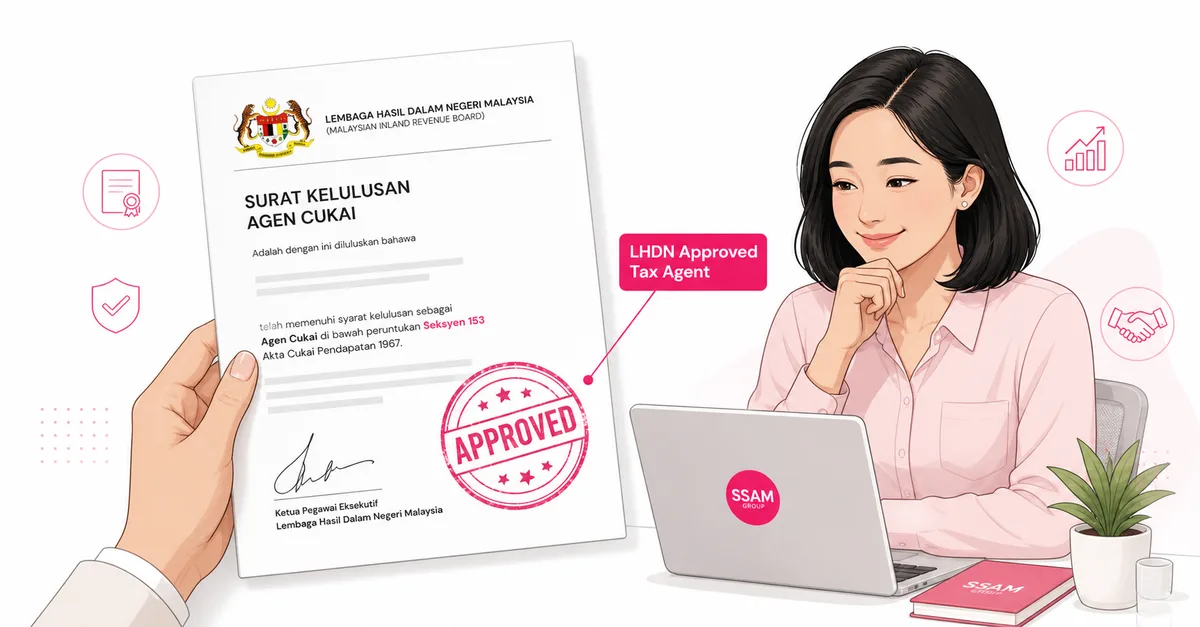
Hire a tax consultant in Malaysia the moment tax starts taking time, money, or peace of mind away from running your business. A tax consultant is a Ministry of Finance (MOF) licensed tax agent who can represent your company before LHDN, sign and submit Form C on your behalf, and advise on audits, reliefs, and tax planning.
Quick self-check
- Have you received any LHDN letter, query, or audit notice in the past 12 months?
- Has your revenue, staff count, or business structure changed in the past year?
- Are you unsure whether you are claiming all the deductions and incentives you qualify for?
- Do you scramble to meet Form C, Form E, CP204, PCB, or SST deadlines?
- Is your tax bill higher than you would expect for a business of your size and sector?
If you tick even one, it is worth speaking to a licensed tax agent.
Sign 1: You received a letter or email from LHDN
An LHDN letter in your company's name is the most direct signal that you should stop and get professional help. It might be a request for information, a query on a specific entry in your Form C, a desk audit notice, or a field audit letter tied to the new RKA CPM (Rangka Kerja Audit Cukai Pendapatan dan Majikan) tax audit framework that took effect on 15 March 2025. Whatever the form, the clock starts moving the moment it lands.
Responding well matters. An LHDN audit or query is not just about providing documents. It is about framing your position, citing the right sections of the Income Tax Act, and keeping your answers consistent with prior filings. Under Section 153 of the Income Tax Act 1967, only an approved tax agent (or the taxpayer themselves) may represent your company before LHDN, so your regular bookkeeper cannot step in here.
If you are already staring at a notice and you do not have a tax agent on record, the safest move is to engage one before you reply. Understanding what an approved tax agent Malaysia can do that an accountant cannot is a useful first step, especially around representation rights during audits.
Sign 2: Your business grew faster than your tax knowledge
Most Malaysian SMEs start simple. One revenue stream, one bank account, one director. Tax is manageable because the business is manageable. Then growth hits, and the tax profile changes faster than most owners realise.
You added revenue streams your bookkeeper has never handled
E-commerce, export sales, agency income, retainers, affiliate payouts, foreign clients, and subscription products. Each carries its own treatment for SST, withholding tax, and chargeable income. If your finance person is still booking them all the same way, there is a real risk of mis-classification that only surfaces during an audit.
You hired your first employees or took on your first company car
Payroll brings PCB, EPF, SOCSO, EIS, Form E, and Form EA. A company car brings capital allowances, private-use adjustments, and benefit-in-kind rules. These are not impossible, but they rarely come naturally to a founder who also runs sales and operations.
You crossed into the SME preferential corporate tax rate
Malaysia's SME rate is 15% on the first RM150,000 of chargeable income, scaling up to 24%, subject to qualifying conditions. The moment you approach or cross that threshold, planning around director's remuneration, dividends, and the timing of capital expenditure starts to have a real bottom-line impact.
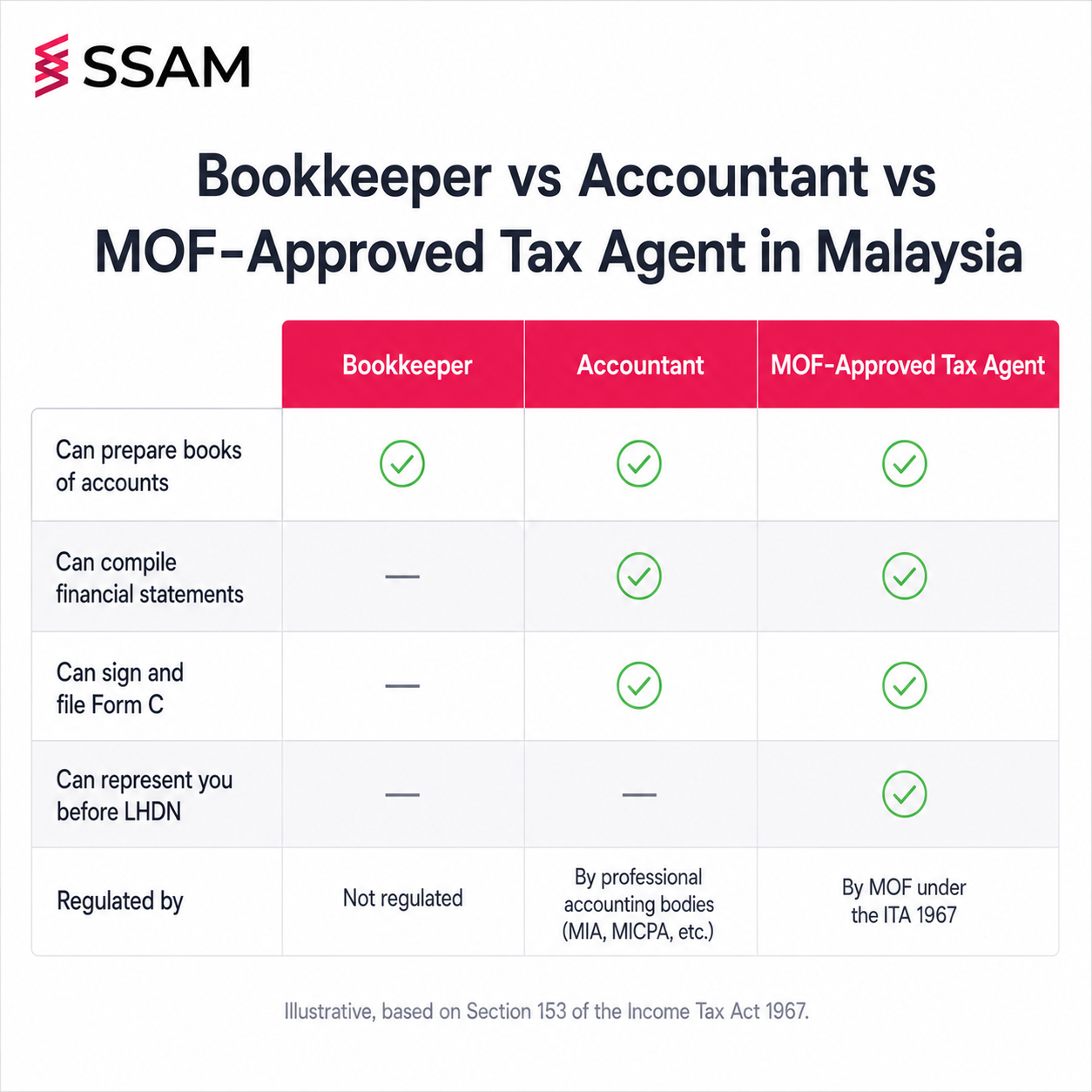
A plain-English distinction helps here. A bookkeeper records your transactions, and an accountant compiles your books and financial statements. Only an MOF-approved tax agent may sign Form C on behalf of the company and represent it before LHDN under Section 153 of the Income Tax Act 1967. That last line is what separates an ordinary finance function from one that can defend you in an audit.
Sign 3: You are unsure about deductions, reliefs, or incentives
If you cannot list, in a few sentences, the reliefs and incentives your company is claiming this year, you are almost certainly leaving money on the table. Malaysian tax law offers a surprising number of levers for SMEs, and most of them go unused because owners do not know they exist.
Capital Allowances and Automation Capital Allowance
Every laptop, printer, machine, software licence, and company vehicle has a capital allowance treatment. Getting the classifications right across initial and annual allowances, and applying the Automation Capital Allowance where it fits, changes your chargeable income directly.
Reinvestment, green, and training incentives
Reinvestment Allowance, Green Investment Tax Allowance, and double deduction for approved training are widely available but under-used. They reward investments you are likely making anyway: new equipment, energy-efficient upgrades, and staff development.
Double tax agreements and withholding tax on foreign vendors
If you pay overseas software vendors, consultants, or licensors, withholding tax rules and Malaysia's double tax agreements with their home country usually apply. Miss them, and you risk penalties on top of the payment itself.
A good tax consultant will map these against your business rather than run a generic checklist. For a wider view of what sits under tax consultant services in Kuala Lumpur, the pillar guide is the best starting point.
Sign 4: You are always scrambling for tax deadlines
There is a familiar rhythm for under-supported Malaysian SMEs. Late March arrives, Form E is due by 30 April, Form C is due within eight months of financial year-end, CP204 revisions are quietly overdue in the sixth, ninth and eleventh months, PCB has to be paid monthly, SST is bi-monthly, and e-Invoicing rollout is still finding its feet. Someone in the office ends up doing a late-night scramble every quarter.
That pattern is not a time-management problem. It is a compliance-load problem. When filings are spread across multiple forms, regulators, and deadlines, one person juggling them on top of running the business will miss things eventually. Under-estimating CP204 by more than 30% of the actual tax payable, for example, triggers a 10% penalty on the shortfall. Penalties for late or incorrect filings add up quickly, and they are a poor use of cash compared with engaging a licensed tax agent.
If year-end planning is part of what keeps slipping, it is also worth reviewing the overall Sdn Bhd running cost Malaysia picture, because tax work sits alongside audit, secretarial, and accounting in the same annual cycle.
Sign 5: Your tax bill looks higher than industry peers
This is the sign most owners miss. A business can be fully compliant, up to date with filings, and still pay far more tax than it should, simply because nobody has ever run a planning review.
The headline number to watch is your effective tax rate, calculated as corporate tax charge divided by profit before tax. If yours sits close to 24% while peers in your sector sit meaningfully lower, that gap is often down to structural choices rather than pure commercial performance. Transfer pricing between related entities, the mix of director's salary, bonus, dividend, and EPF contribution, and the timing of capital purchases all move the number.
What a planning review typically covers
A proper planning review looks across three to five years, not a single filing season. It examines entity structure, remuneration mix, capital expenditure timing, group relief opportunities, and incentive eligibility. Nothing dramatic. Just a careful mapping of what you are already doing against what the Income Tax Act 1967 actually rewards.
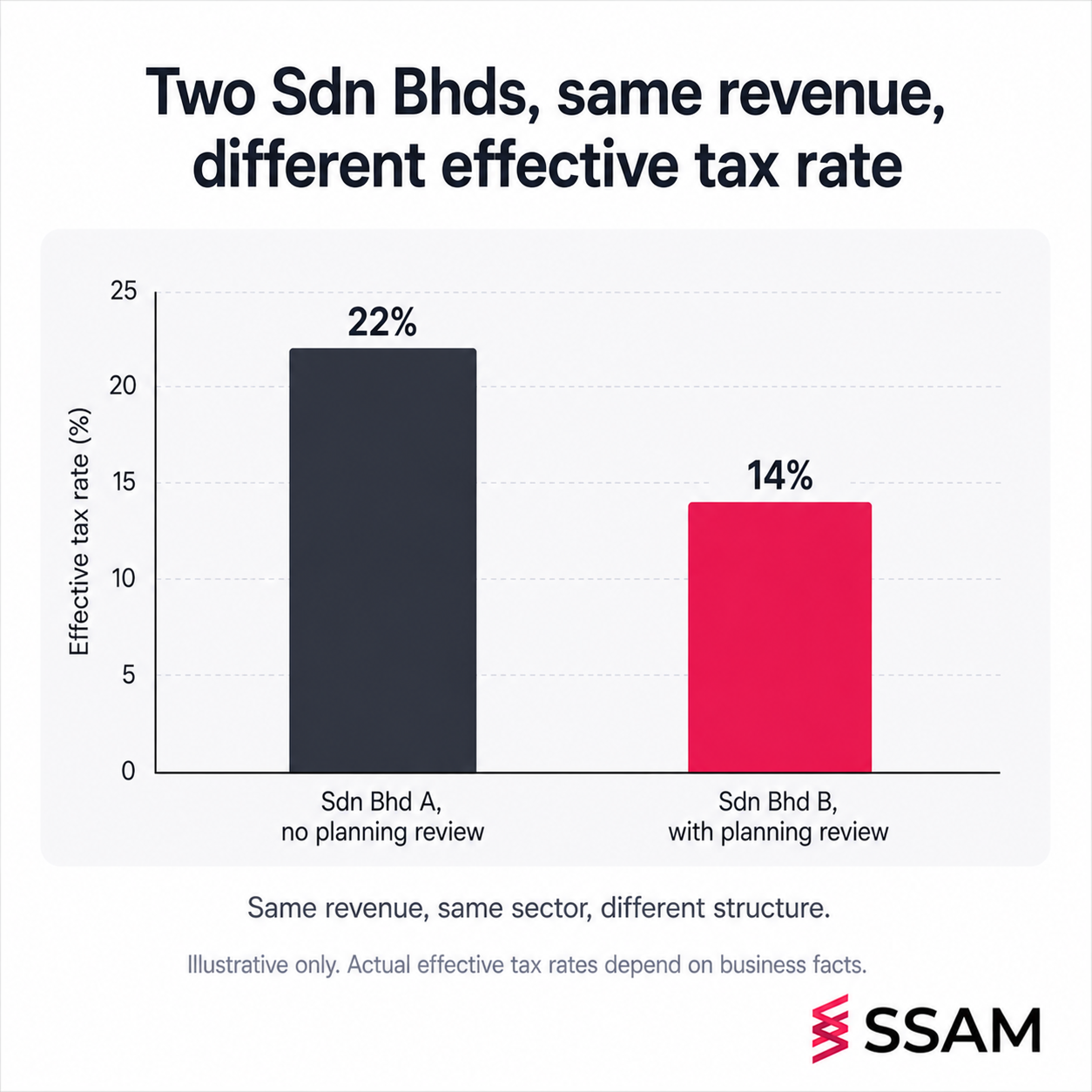
A high tax bill with no plan behind it is, in itself, a sign you need a tax consultant. The fee for a review is usually recovered many times over once the plan is in place.
Three-step action checklist before you call
- Pull together the last three years of Form C and audited accounts.
- List any open LHDN correspondence, outstanding CP204 revisions, or known under-declared items.
- Write down your biggest tax question in one sentence. The clearer the question, the shorter the first meeting.
If you would like a calm, no-pressure conversation on any of the above, speak to SSAM. You can WhatsApp the team on +6011-6529 9879, call +6011-6529 9879, or email tax@ssam-group.com. SSAM operates as an MOF-licensed tax agent through TSE Taxation Services Sdn. Bhd., with 1,000+ loyal customers, 40 years of proven excellence, and 99% client satisfaction.
Frequently asked questions
When should a small business hire a tax consultant in Malaysia?
As a rough rule, engage a tax consultant once your business has crossed one of three lines: it has received any LHDN query or audit notice, its structure has changed (incorporated as Sdn Bhd, added employees, added foreign revenue), or your effective tax rate no longer matches peers in your sector. Before any of these happen, an accountant and a bookkeeper are usually enough.
Do I legally need a tax agent to file company tax in Malaysia?
No. A company director can file Form C through e-Filing without a tax agent. What changes is who may represent the company before LHDN. Under Section 153 of the Income Tax Act 1967, only the taxpayer or an approved tax agent may appear for you during audits, queries, and appeals. Many SMEs file their own simple returns but keep a tax agent on standby for correspondence and planning.
How much does a tax consultant cost in Malaysia?
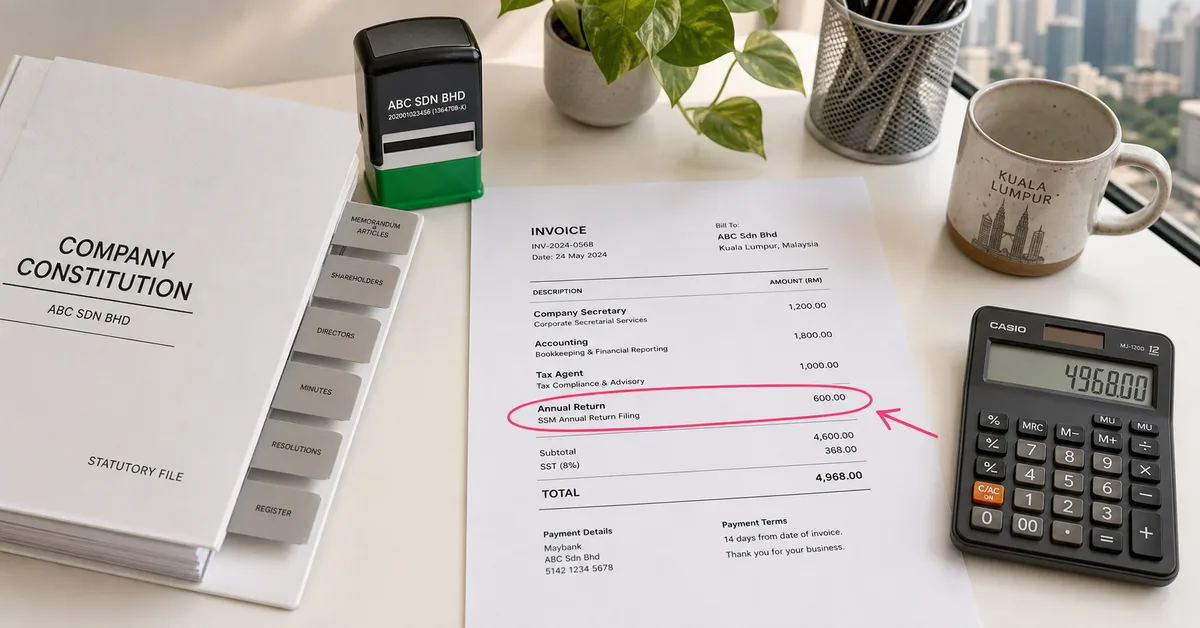
Fees vary by business complexity, turnover, number of entities, and audit exposure. A simple Sdn Bhd with one revenue stream will pay far less than a group with related-party transactions, foreign income, and SST. Rather than anchor on a number, ask for a scope of work that lists filings, advisory hours, and audit support separately, so you can see exactly what you are paying for.
What is the difference between an accountant and a tax consultant?
An accountant prepares your books and financial statements. A tax consultant, typically an MOF-licensed tax agent, focuses on tax computations, reliefs, planning, and representing you before LHDN. Good firms often house both roles, which is why most SMEs deal with a single provider for accounting and tax rather than separating them.
Can I switch from my current tax agent to a new one mid-year?
Yes. You can appoint a new tax agent at any point. The new agent will typically request your prior year Form C, audited accounts, correspondence with LHDN, and any open queries. The handover itself is straightforward, though you should aim to make the switch before your next major filing so the new agent has time to review your file.
The information in this article is provided for general informational purposes only and does not constitute tax, accounting, financial or legal advice. Tax laws change frequently and may not apply to your situation. Always consult a qualified professional before acting on any information here.