


Key Takeaways
- Most active Sdn Bhd companies in Malaysia spend roughly RM5,000 to RM15,000 per year on compliance, with larger or higher-volume businesses paying more.
- Core running costs are company secretary fees, accounting and bookkeeping, the annual return to SSM, tax agent work, and audit fees where not exempt.
- Audit exemption under SSM Practice Directive 10/2024 now runs on phased turnover, asset, and employee thresholds from 2025 to 2027, replacing the older threshold-qualifying category under PD 3/2017.
- Hidden costs to plan for include the Form CP204 under-estimation surcharge, SST obligations once turnover crosses the registration threshold, MBRS lodgement fees, and director payroll statutory contributions.
- Outsourcing to a 1-stop compliance partner usually works out cheaper than engaging a separate secretary, accountant, and tax agent.
The Sdn Bhd running cost in Malaysia catches many first-time directors by surprise, because the quotation you received at incorporation rarely reflects what the company will actually owe across a full financial year. Budgeting for a private limited company is more than the initial registration fee. It is a rolling set of statutory obligations under the Companies Act 2016 and the Income Tax Act 1967, each with its own fee schedule, deadline, and penalty risk.
This guide breaks down the real annual cost of keeping your Sdn Bhd compliant, separates the line items that providers usually quote from the ones that are quietly left out, and shows you a sensible budget for three common company profiles: dormant, small active, and growing. For a wider view of the professional services that sit around this work, see our tax consultant services in Kuala Lumpur guide.
How much does a Sdn Bhd cost yearly in Malaysia?
The annual running cost of a Sdn Bhd in Malaysia typically sits between RM5,000 and RM15,000, with most small active companies landing near RM7,000 to RM10,000. The exact amount depends on turnover, transaction volume, whether you qualify for audit exemption, and whether your compliance work is handled by a single 1-stop provider or split across multiple firms.
Dormant and newly incorporated companies can spend less, often in the RM2,500 to RM4,000 range, because several line items shrink or drop away. Growing companies that cross the SST registration threshold or start employing staff can easily spend RM12,000 to RM20,000 once statutory payroll, SST filings, and audit fees are added.
Core annual costs every Sdn Bhd must pay
These are the line items every active Sdn Bhd should budget for, and the statutory basis behind each one.
1. Company secretary retainer
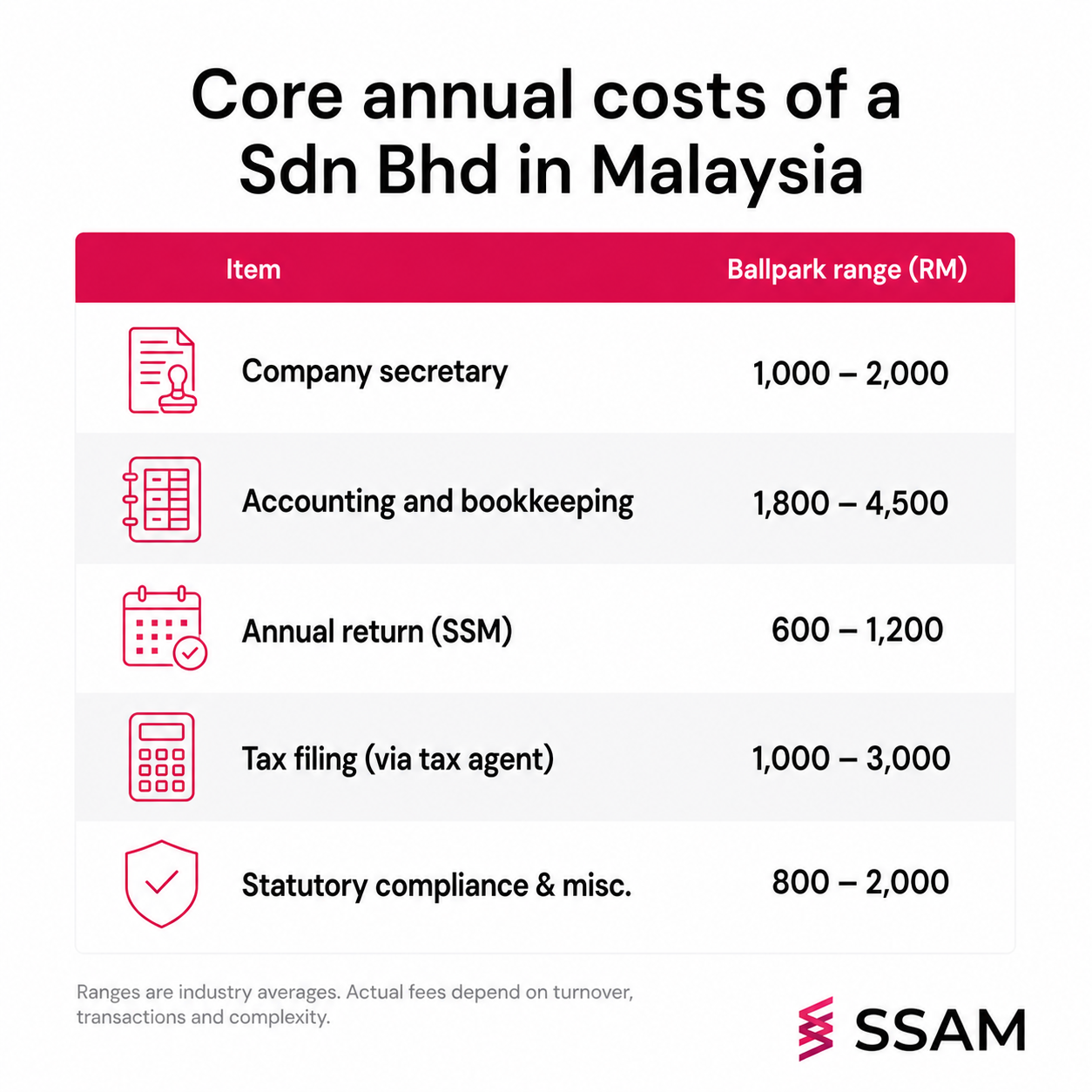
Under the Companies Act 2016, every Sdn Bhd must appoint a licensed company secretary within 30 days of incorporation. Your secretary prepares board resolutions, maintains the statutory registers, and files changes with SSM. Annual retainers generally range from RM1,000 to RM2,000, plus disbursements for statutory filings.
2. Annual return and statutory filings with SSM
Every Sdn Bhd must lodge an annual return with SSM within 30 days of the anniversary of incorporation. The SSM lodgement fee for a private company is RM150 per annual return, a non-negotiable yearly cost on top of the secretary's preparation fee. Late filing exposes the company and its officers to compounding fines under the Companies Act 2016.
3. Accounting and bookkeeping
Malaysian companies are legally required to maintain proper books of account. Outsourced accounting usually starts from around RM1,800 per year for low-volume companies and rises with transaction count, payroll complexity, and whether you need SST-ready records. The yearly compilation of financial statements is normally bundled into the quote, while the cloud accounting software is charged separately.
4. Tax agent fees
A Sdn Bhd must file Form C (corporate tax return) and Form CP204 (tax estimate). In addition, Form E must also be filed, regardless of whether the company has employees. A MOF-licensed approved tax agent in Malaysia typically charges RM1,000 to RM3,000 per year for a small company, with larger fees for more complex structures, group relief, or transfer pricing work.
5. Audit fees (where applicable)
Unless the company qualifies for audit exemption under SSM Practice Directive 10/2024, financial statements must be audited annually. Audit fees for a small Sdn Bhd commonly fall between RM1,500 and RM5,000, scaling up with turnover, revenue recognition complexity, and inventory.
Hidden costs most owners miss
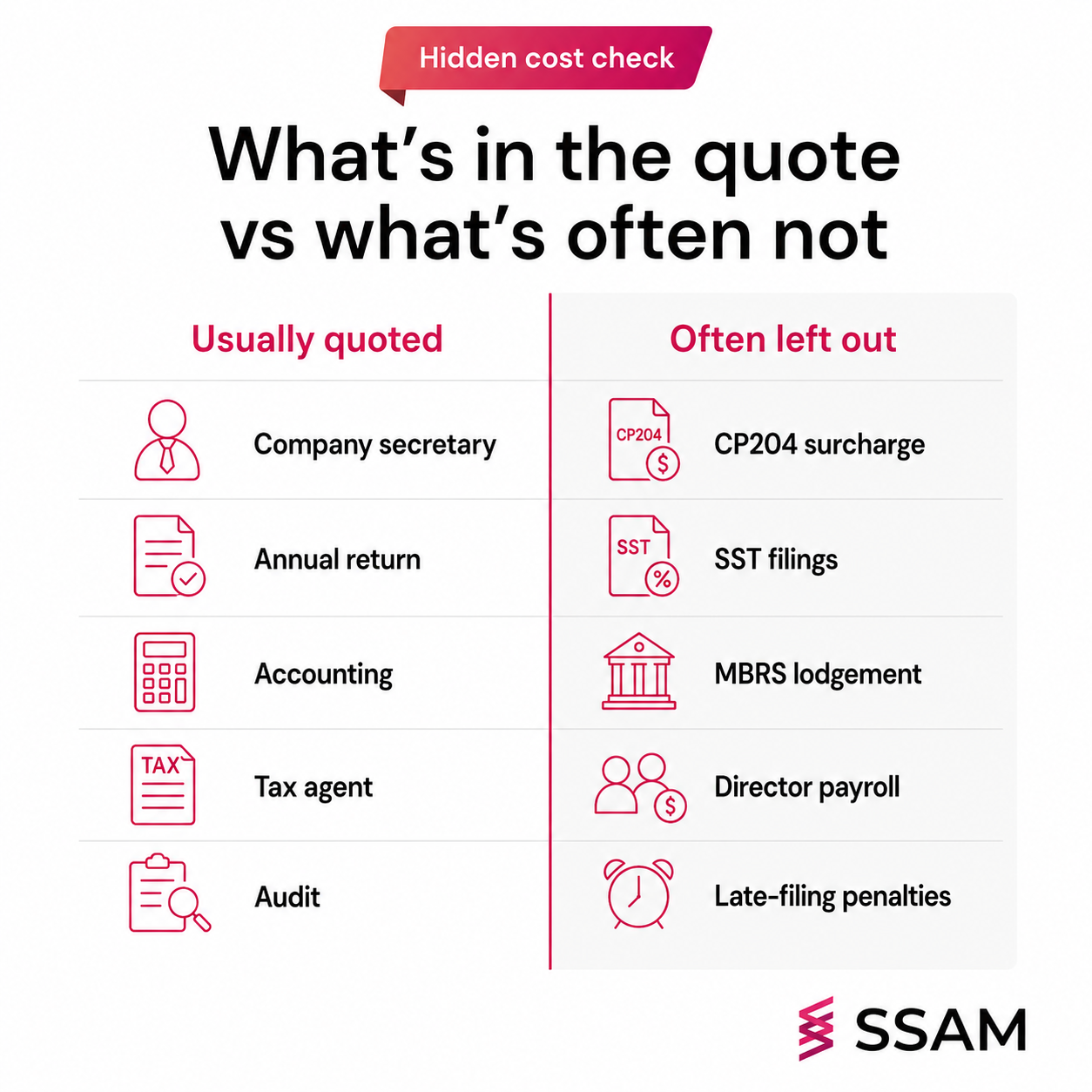
These are the items that are rarely in a standard compliance quote, yet can meaningfully change what you actually pay each year.
Form CP204 under-estimation surcharge
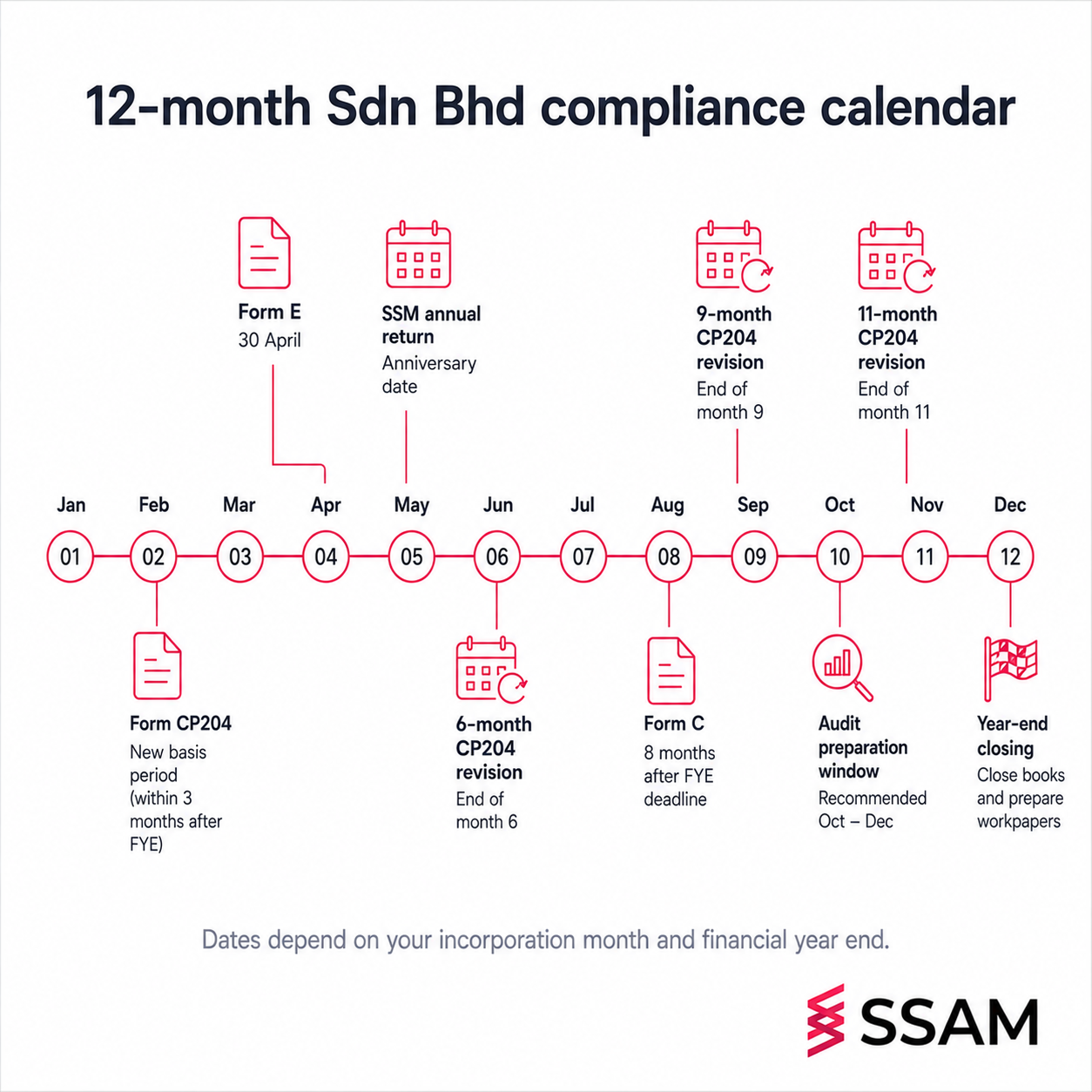
LHDN expects your company to estimate its tax payable for the year through Form CP204, and to revise it in the 6th, 9th and 11th months. If the actual tax is more than 30 percent higher than the latest revised estimate, a 10 percent surcharge applies to the shortfall under the Income Tax Act 1967. For growing companies, this can quietly add thousands of ringgit to the annual tax bill.
The 8 percent service tax on professional fees
Since 1 March 2024, the service tax rate has been 8 percent for most professional services, including accounting, legal, consulting, IT, and management services. If your secretary, tax agent, or accountant is SST-registered, expect an 8 percent line on each invoice. The expanded SST scope from 1 July 2025 also brought leasing and rental services, construction works, fee-based financial services, and private healthcare, education, and beauty services into the net, which can affect your rent and financing costs even if your own business is not SST-registered.
SST registration once turnover crosses the threshold
Service providers with taxable turnover above RM500,000 over any 12-month period must register for the service tax. Registration adds accounting complexity and either an in-house hour cost or an external compliance fee. Many growing Sdn Bhd companies cross the relevant threshold without realising it.
MBRS and XBRL lodgement
SSM has been migrating statutory filings to MBRS and XBRL format. Lodgement fees and preparation time are usually billed separately by the secretary or an accounting firm, and are easy to miss when comparing quotes.
Director and employee statutory contributions
The moment a director draws a salary, the Sdn Bhd picks up PCB, EPF, SOCSO, and EIS contributions, plus annual Form EA and Form E obligations under the Employment Act 1955 and Income Tax Act 1967. For a sole-director company paying the founder RM5,000 per month, the employer-side statutory stack alone adds roughly RM700 to RM900 per month before any tax agent work.
Penalty compounding
Late SSM filings, late annual returns, late tax estimates, and late tax returns each attract their own fines and, if left unresolved, can escalate to director compounding and in serious cases director disqualification. A single missed deadline can cost more than a year of secretary fees, which is why most owners bundle filings with a 1-stop provider. If you are not sure whether your business has outgrown a pure accountant, the guide on when to hire a tax consultant in Malaysia sets out the clearest warning signs.
Budget by company size: dormant, active, growing
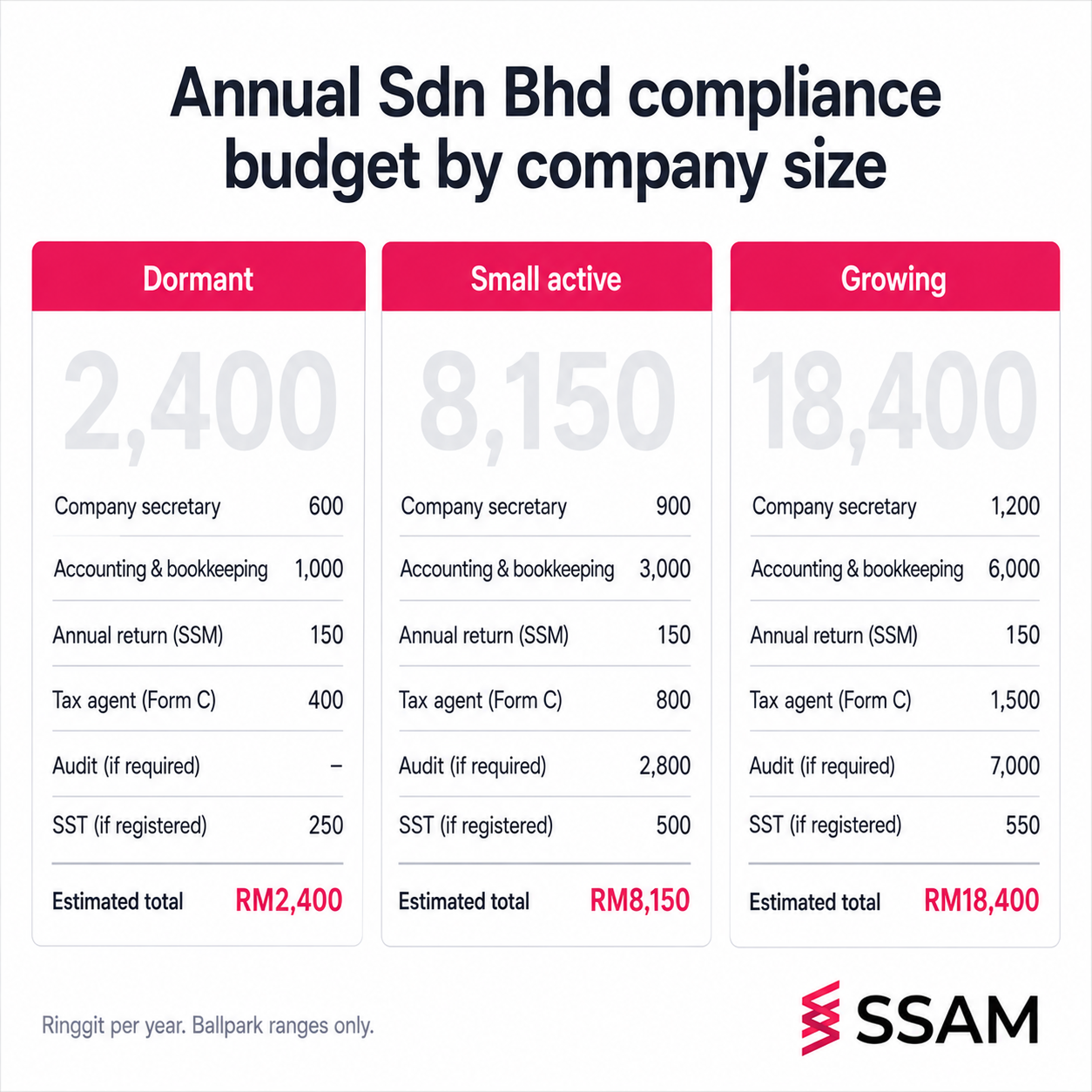
Use this table as a starting point when you plan your compliance budget. All figures are ringgit per year, rounded for simplicity.
| Line item | Dormant / zero revenue | Small active (under RM1m turnover) | Growing (RM1m to RM3m turnover) |
|---|---|---|---|
| Company secretary | 600 to 1,200 | 1,000 to 1,800 | 1,500 to 2,500 |
| Accounting and bookkeeping | 0 to 1,200 | 2,400 to 4,800 | 4,800 to 9,000 |
| Annual return (SSM lodgement fee) | 150 | 150 | 150 |
| Tax agent (Form C, CP204, Form E) | 500 to 1,000 | 1,000 to 2,000 | 2,000 to 3,500 |
| Audit | Exempt in most cases | 1,500 to 3,000 if not exempt | 3,000 to 6,000 |
| SST compliance (if registered) | Not applicable | Not applicable unless registered | 1,200 to 3,000 |
| Ballpark total | 1,250 to 3,550 | 5,550 to 12,750 | 12,650 to 24,150 |
A few patterns are worth noting. Dormant companies benefit most from the audit exemption, because the audit is usually the single largest item. Small active companies should expect to grow into higher accounting and tax fees as transaction volume rises, even if turnover stays flat. Growing companies cross thresholds quickly. SST registration, audit, and director payroll often arrive within the same 12-month window, and the compliance budget can almost double in that year.
How the new audit exemption rules change your budget
SSM Practice Directive 10/2024, issued on 16 December 2024, replaced the older PD 3/2017 for financial periods beginning on or after 1 January 2025. The new rules drop the old dormant, zero-revenue, and threshold-qualifying categories and use a single set of quantitative criteria. A private company qualifies for audit exemption when it meets at least two of three criteria in the current financial year and in each of the two preceding years, with the thresholds stepping up in three phases.
| Phase | Annual revenue | Total assets | Employees |
|---|---|---|---|
| 2025 | RM1,000,000 or less | RM1,000,000 or less | 10 or fewer |
| 2026 | RM2,000,000 or less | RM2,000,000 or less | 20 or fewer |
| 2027 onwards | RM3,000,000 or less | RM3,000,000 or less | 30 or fewer |
Even if your Sdn Bhd qualifies on paper, public companies, subsidiaries of public companies, foreign companies registered in Malaysia, and Section 260 exempt private companies remain excluded. Shareholders holding 5 percent or more of voting rights can still require an audit, and the Registrar can compel one in the public interest. Confirm your eligibility with your company secretary or tax agent before the end of each financial year, because missing the criteria in any one of the three qualifying years puts the exemption out of reach for that year.
How to keep Sdn Bhd running costs under control
Compliance is non-negotiable, but the way you structure it can legitimately reduce your annual spend.
Check your audit exemption status
Under SSM Practice Directive 10/2024, three categories of private company can qualify for audit exemption: dormant companies, zero-revenue companies, and threshold-qualifying companies. Threshold qualification is phased in across three financial years, and the company must meet at least two of the three criteria for the current financial year and the two immediately preceding financial years.
| Financial years commencing on or after | Revenue threshold | Total assets threshold | Employees threshold |
|---|---|---|---|
| 1 January 2025 | Up to RM1 million | Up to RM1 million | 10 or fewer |
| 1 January 2026 | Up to RM2 million | Up to RM2 million | 20 or fewer |
| 1 January 2027 | Up to RM3 million | Up to RM3 million | 30 or fewer |
Work through the PD 10/2024 phased thresholds for your current financial year and the two preceding years, and confirm you meet at least two of three criteria. If you qualify, lodge an audit-exempt certificate with the directors' report and remove one of the largest line items from your budget. Revisit each year because thresholds step up in 2026 and again in 2027.
Right-size your Form CP204 estimate
The 10 percent under-estimation surcharge is avoidable. If you revise your CP204 estimate in the 6th, 9th and 11th months based on realistic management accounts, you protect yourself from the surcharge and preserve cash flow for year-end tax settlement.
Plan filings against a compliance calendar
A clear 12-month compliance calendar turns scattered deadlines into a predictable cost. The anniversary date drives the SSM annual return, the financial year end drives Form C and the 8-month submission window, Form E is due 30 April, and Form CP204 has its own submission window 30 days before the new basis period.
Consolidate providers where it makes sense
A 1-stop provider that offers secretarial, accounting, tax, and advisory under one roof usually costs less than hiring three separate firms, because coordination time is built into the retainer. You also reduce the risk of fee creep from scope gaps between providers. If you are unsure whether your current set-up is still serving you, these 5 signs your business needs a professional tax consultant are a useful checkpoint.
Revisit your quote every two years
Fees drift over time and so does your business. A quick market check every two years, paired with a clear scope of what is included, keeps your Sdn Bhd running cost in Malaysia on a fair footing.
Once you have a realistic view of your annual budget and the levers you can pull, the decision becomes much calmer. You are no longer comparing one-off quotes from different firms. You are planning a predictable yearly cost that keeps the company in good standing with SSM, LHDN, and your board.
If you are unsure whether your Sdn Bhd qualifies for audit exemption under PD 10/2024, or which line items apply to your company next year, speak to SSAM. Our team handles secretarial, accounting, tax, and advisory under one roof, which usually works out more cost-effective than splitting the work across separate providers. WhatsApp the team on +6011-6529 9879 or email enquiries@ssam-group.com for a scope-based quote.
Frequently asked questions about Sdn Bhd running costs
How much does it cost to maintain a Sdn Bhd per year?
A typical small active Sdn Bhd in Malaysia spends roughly RM7,000 to RM10,000 per year on compliance when it is not yet SST-registered and has no employees. Dormant companies can run closer to RM2,500 to RM4,000. Growing companies that cross SST or payroll thresholds commonly exceed RM12,000 per year.
Do all Sdn Bhd companies need to be audited in Malaysia?
No. Under SSM Practice Directive 10/2024, a private company qualifies for audit exemption when it meets at least two of three thresholds on revenue, total assets, and employees in the current and two preceding financial years. The thresholds rise in phases from RM1,000,000 in 2025 to RM3,000,000 in 2027. You still need to prepare and file financial statements. Public companies, subsidiaries of public companies, foreign companies, and Section 260 exempt private companies are excluded.
How much is a company secretary fee in Malaysia?
Licensed company secretary retainers for a standard Sdn Bhd generally fall between RM1,000 and RM2,000 per year, with higher fees for companies that need more resolutions, share transfers, or changes of particulars. The Companies Act 2016 requires every Sdn Bhd to appoint a qualified secretary within 30 days of incorporation, so this is a non-negotiable annual cost.
What happens if I file my annual return or tax return late?
Late SSM filings attract compounding fines under the Companies Act 2016. Late tax filings with LHDN trigger penalties under the Income Tax Act 1967, including late payment surcharges and, in serious cases, compounding action. A single missed deadline can cost more than a year of secretary or tax agent fees, which is why most owners bundle filings with a 1-stop provider.
Is it cheaper to run a sole proprietorship or a Sdn Bhd?
A sole proprietorship is cheaper to run year-to-year because it does not need a company secretary, audit, or Form C filing. A Sdn Bhd costs more but offers limited liability, access to the preferential SME corporate tax rate of 15 percent on the first RM150,000 of chargeable income subject to qualifying conditions, and a more professional profile for clients and lenders. The extra running cost is often offset by tax savings and lower personal risk as turnover grows.
Data sources and references
- SSM Practice Directive 10/2024 on audit exemption for private companies: ssm.com.my/Pages/Legal_Framework/Document/PD10-2024-Qualifying-Criteria-for-Audit-Exemption-for-Certain-Categories-of-Private-Companies.pdf
- SSM Practice Directive 10/2024 on audit exemption for private companies, via ssm.com.my
- Companies Act 2016, via ssm.com.my
- Income Tax Act 1967 (Form C, Form CP204, Form E), via hasil.gov.my
- SST registration guidance via Royal Malaysian Customs Department at mysst.customs.gov.my
- Malaysian Business Reporting System (MBRS) at mbrs.ssm.com.my
The information in this article is provided for general informational purposes only and does not constitute tax, accounting, financial or legal advice. Tax laws change frequently and may not apply to your situation. Always consult a qualified professional before acting on any information here.