

Key Takeaways
- From 1 January 2024, Malaysia taxes capital gains on the disposal of unlisted shares in a Malaysian-incorporated company. The rate is 10% on the net gain, with a 2% gross-price alternative for shares acquired before 2024.
- CGT applies to companies, LLPs, trust bodies and co-operatives, not to individuals selling personally-held unlisted shares. Individuals can still face RPGT or stamp duty on what they sell.
- The single biggest tax decision in a business sale is share sale versus asset sale. The structure changes who is taxed, what is taxed, and how stamp duty, SST and balancing charges land.
- From YA 2026, the expanded "disposal" definition can pull share buy-backs, capital reductions, strike-offs and members' voluntary winding-up into the CGT net.
- File the e-CKM return and pay CGT within 60 days of each disposal. Document your original acquisition cost and engage a licensed tax agent before due diligence begins.
Selling a business in Malaysia changed in character on 1 January 2024, when the country switched on its first capital gains tax regime under the Finance (No. 2) Act 2023. A capital gains tax business sale in Malaysia now follows two main structuring routes, share sale or asset sale, and the route you choose drives most of your tax bill long before the sale and purchase agreement (SPA) is signed. This guide walks an Sdn Bhd owner through how CGT works, how it stacks with real property gains tax (RPGT) and stamp duty, and what to plan before due diligence starts. The focus is private Sdn Bhd sales by Malaysian-resident owners. Listed-share trades and pure property deals follow different rules. It also assumes you operate through a company, so if you are still at the sole proprietorship vs Sdn Bhd tax in Malaysia stage, settle that first.
Does selling a business in Malaysia trigger capital gains tax?
Yes. From 1 January 2024, Malaysia taxes gains on the disposal of unlisted shares in a Malaysian-incorporated company. The rate is 10% on the net gain, or 2% on the gross disposal price for shares acquired before that date. CGT applies to companies, LLPs, trust bodies and co-operatives. Individuals selling their own Sdn Bhd shares are still exempt today.
CGT essentials for your exit, in one minute
This guide is the planning lens on CGT in a business sale, not the rules deep-dive. For the definitive scope, rate tables, exemptions, and filing mechanics across CGT and RPGT, read the companion guide Capital Gains Tax vs RPGT in Malaysia.
Three CGT essentials drive every structuring decision below:
- Who is chargeable. Companies, LLPs, trust bodies, and co-operatives are inside the CGT net. Malaysian-resident individuals selling personally-held Sdn Bhd shares are still outside CGT today, although a YA 2026 nominee rule will treat the beneficial owner as the chargeable person.
- What is taxed. Unlisted shares of Malaysian-incorporated companies, Section 15C shares (foreign-incorporated companies that mostly hold Malaysian real property or RPC shares), and foreign capital assets remitted into Malaysia.
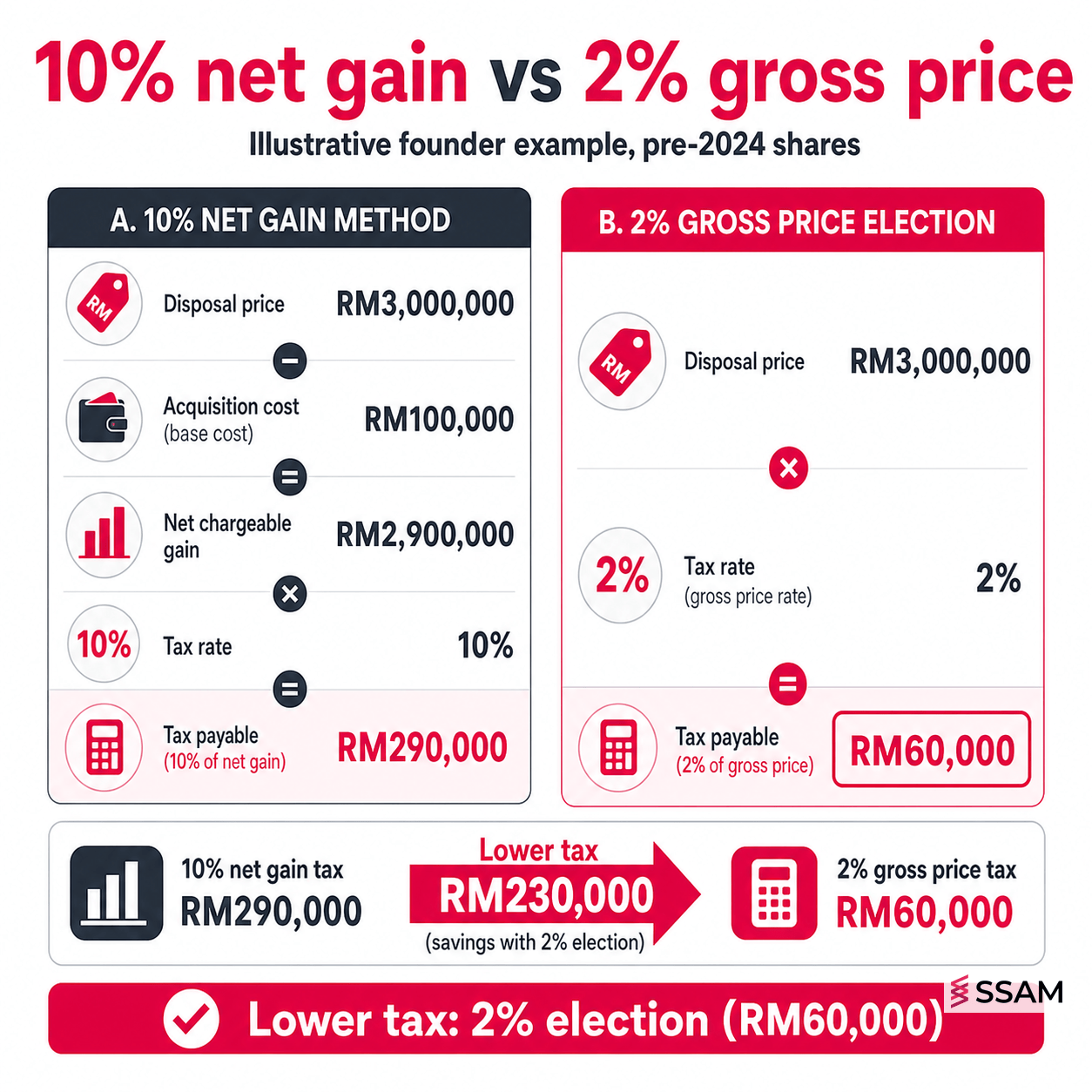
- The rate election. For shares acquired on or after 1 January 2024, the rate is a flat 10% on the net chargeable gain. For shares acquired before 1 January 2024, the disposer elects between 10% on the net gain or 2% on the gross disposal price, whichever is lower. The 2% election rewards founders sitting on very low cost bases. The 10% election rewards sellers with substantial documented costs.
With those essentials in hand, the rest of this guide is about structure, timing, and sequencing your exit.
Share sale vs asset sale: how each is taxed
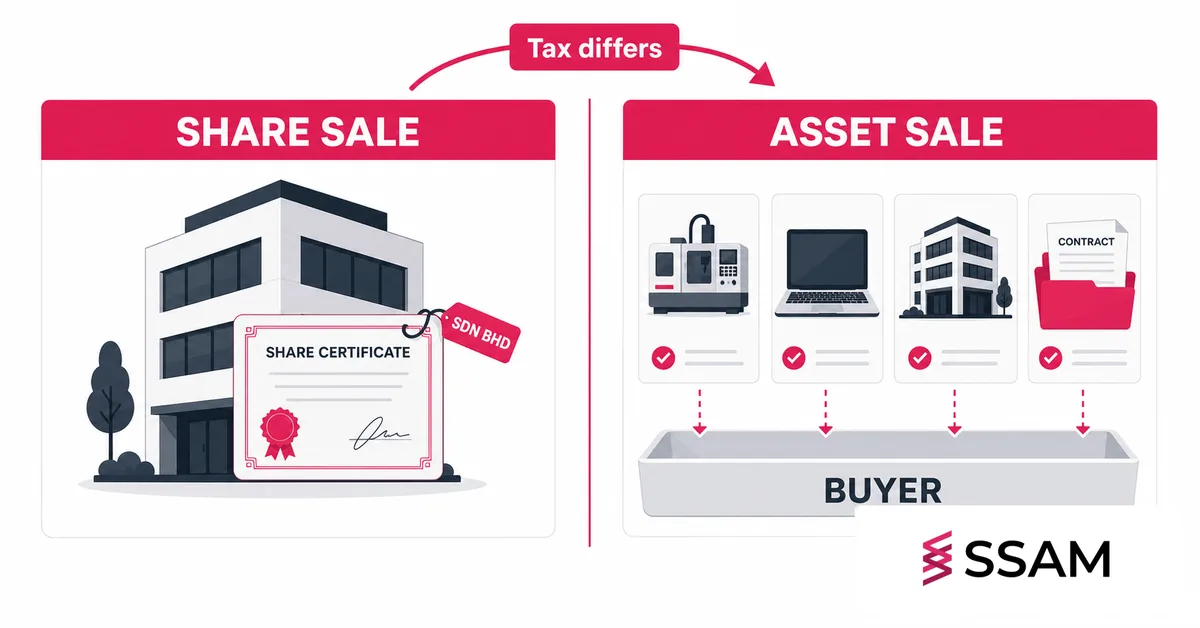
The first thing any acquirer asks is whether they want the shares of your company or only the business inside it. The answer changes who the seller is, what transfers, and how each layer of tax lands.
What changes hands in a share sale
In a share sale, the shareholders sell their shares in the company. The company keeps its contracts, licences, employees, assets and liabilities. The buyer steps into the seller's shoes. For an Sdn Bhd owned by a Malaysian-resident individual, the gain on personally-held shares falls outside CGT today. Where the seller is a company, an LLP or a trust, CGT applies on the gain.
What changes hands in an asset sale
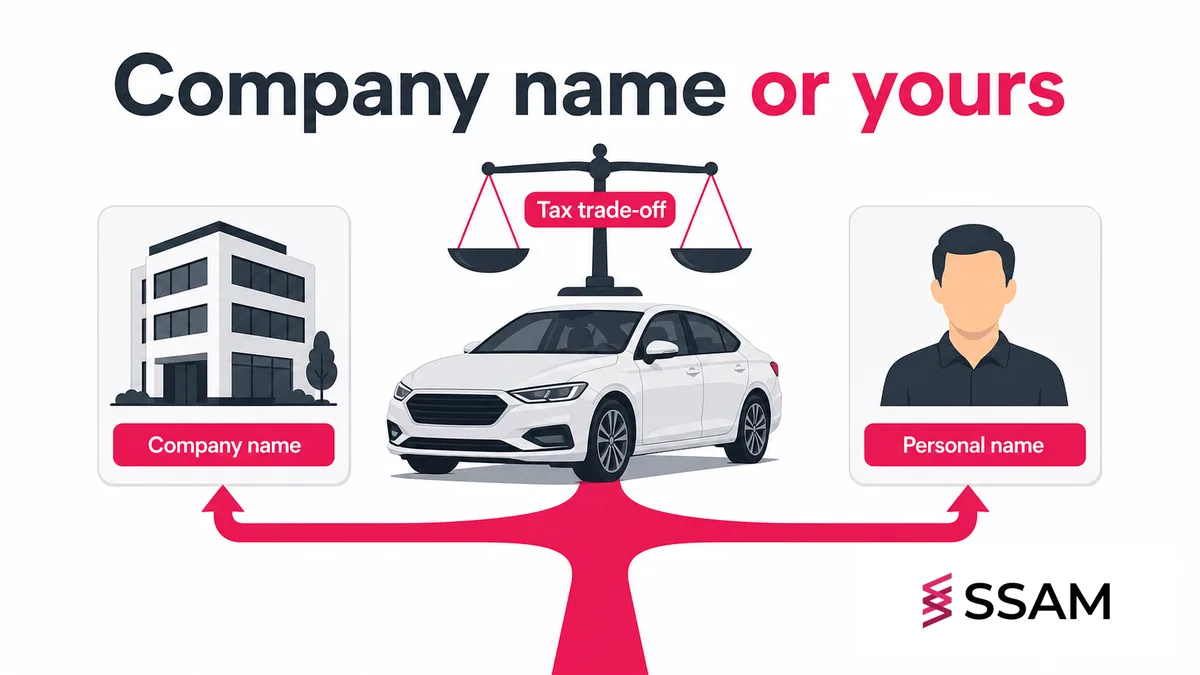
In an asset sale, the company itself sells specific assets to the buyer. The buyer cherry-picks what to take, often the goodwill, the brand, key equipment, customer contracts and inventory. Company vehicles can be part of this too, and their disposal interacts with the company car Sdn Bhd tax in Malaysia rules. Liabilities the buyer does not want stay behind. The seller of record is the company, not the shareholder, so CGT generally does not apply at this layer. The company instead deals with balancing charges on disposed fixed assets, which unwind the capital allowances in Malaysia claimed over the years, plus SST on taxable supplies, and any capital gain on real property under RPGT. Shareholders see the cash only after the company pays its taxes and distributes the proceeds, typically through dividends or a later strike-off. Director duties around solvency, distributions and reporting still apply, so review the Sdn Bhd director tax obligations before signing.
Side-by-side tax comparison
| Factor | Share sale | Asset sale |
|---|---|---|
| Seller of record | Shareholders | The company itself |
| What transfers | The whole company, including all assets, contracts and liabilities | Only the assets and liabilities specified in the SPA |
| CGT exposure | 10% net or 2% gross on unlisted shares, where the seller is a chargeable person | Usually none at company level on operating assets, except on Section 15C shares or other capital assets |
| RPGT exposure | Applies where the shares qualify as an RPC interest | Applies on Malaysian real property transferred |
| Stamp duty | 0.3% on share transfer, usually borne by the buyer | Ad valorem on real property conveyance, plus stamp on other dutiable instruments |
| SST and licences | No change at deal level. The company keeps its licences | SST may apply on taxable supplies. New operating licences often need fresh approval |
| Employees | Continue with the company | Novation or fresh contracts required |
| Deal complexity | Lower legal cost, heavier due diligence on historical liabilities | Higher legal cost, lighter exposure to historical liabilities |
How CGT, RPGT and stamp duty stack together
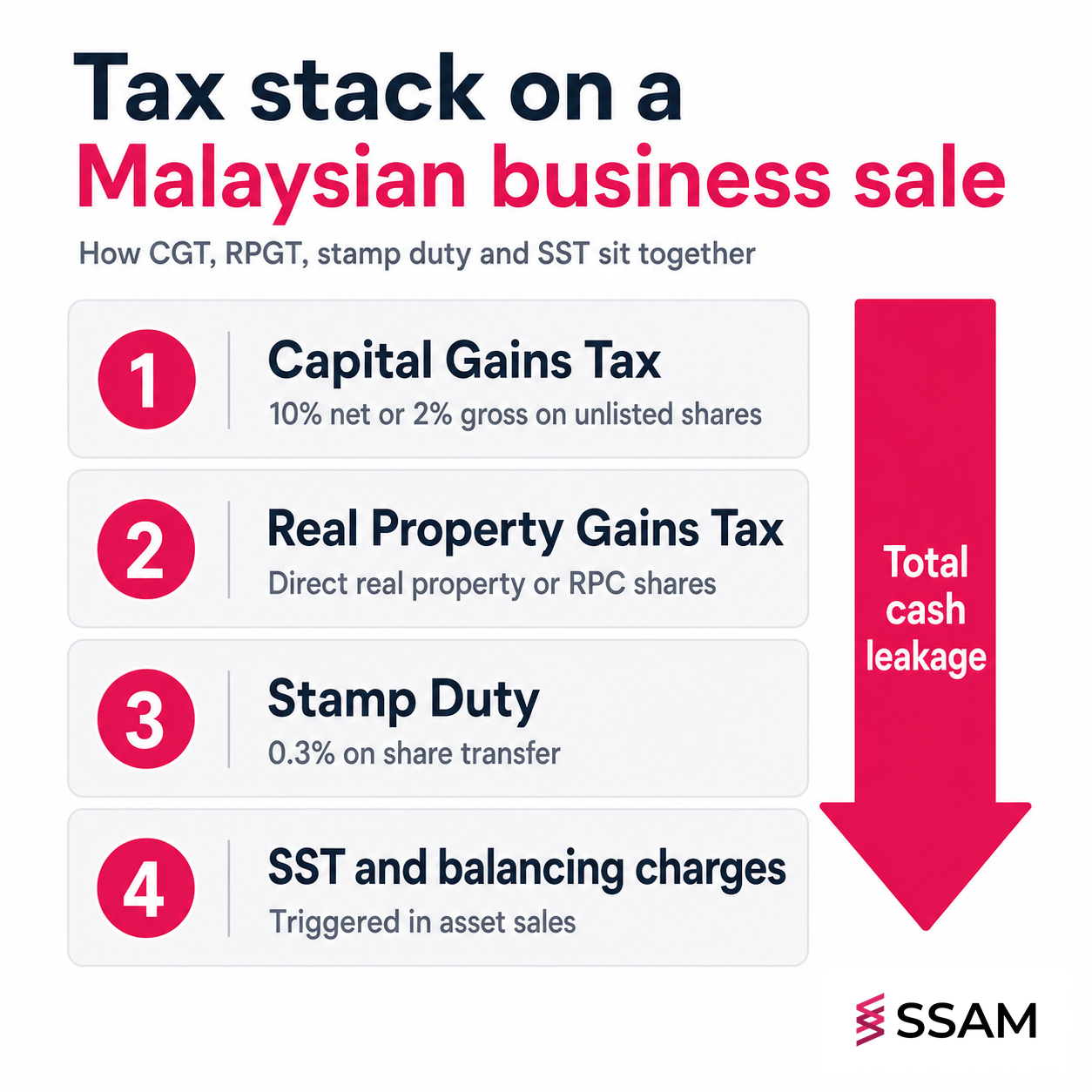
Most exit-tax surprises come from forgetting that CGT does not sit alone. RPGT and stamp duty often run alongside it, and SST can appear in asset sales.
When real property gains tax still applies
RPGT under the RPGT Act 1976 continues to apply to direct disposals of Malaysian real property and to shares that qualify as an RPC interest. A company is an RPC where its defined assets are mostly Malaysian real property at acquisition. Where shares fail the RPC test, the gain shifts under CGT. If your Sdn Bhd holds a meaningful piece of land or a factory, model both regimes before choosing a structure.
Stamp duty on share transfers and asset conveyances
Share transfers carry stamp duty at 0.3% of the higher of consideration or net tangible asset value, and the buyer typically pays. Real property conveyances follow ad valorem stamp duty bands that step up at RM100,000 and RM500,000. Confirm the bands against the current Stamp Act and the latest Budget before pricing the deal. Other dutiable instruments such as business transfer agreements and assignments of contracts carry their own stamp duty schedules.
SST, balancing charges and employee transfer costs in asset sales
When the company sells operating assets, balancing charges or allowances arise on tax-depreciated fixed assets. SST may apply on taxable supplies sold as part of the deal. Employee transfers create their own cash items, including accrued leave, gratuities and any contractual top-ups. These are not strictly tax, but they often outweigh the CGT line in an asset sale and need to be funded out of proceeds.
New rules from 2026: when restructuring or winding-up triggers CGT
The 2026 changes are the most time-sensitive part of any exit plan.
The expanded "disposal" definition under Finance Bill 2025
Finance Bill 2025, tabled in November 2025, broadens what counts as a disposal of unlisted shares for CGT purposes. The intention is to catch cessation events that do not look like a sale but still shift beneficial ownership. Confirm the gazette status of the Finance Bill before completion and adjust your planning if any provisions are deferred.
Share buy-backs, capital reductions, strike-offs and members' voluntary winding-up
Once in force, the expanded definition can treat the following as taxable disposals:
- A company buying back its own shares.
- A capital reduction that returns funds to shareholders.
- The redemption of preference shares.
- Striking off a company under the Companies Act 2016 where members receive distributions on residual assets.
- A members' voluntary winding-up where the liquidator distributes surplus to shareholders.
Owners planning to wind up, strike off or restructure should review the timing against the gazette date. What used to be a quiet shutdown can now create a chargeable disposal. If shutting down a dormant company is purely a running cost of a Sdn Bhd decision, the CGT angle still needs a check.
CGT exemptions worth planning around
Three exemptions matter most in real exits.
Group restructuring exemption (P.U.(A) 289/2024)
This covers share disposals made between 1 March 2024 and 31 December 2028 under a restructuring scheme designed to improve operational efficiency within the same group. At least 75% of the consideration must be paid in shares of the acquirer, and the acquirer must be Malaysian tax-resident. Founders consolidating brands under a holding company often use this exemption to defer tax during the reshuffle.
IPO exemption (P.U.(A) 290/2024)
Disposals of shares made in relation to an approved initial public offering are exempt. The exemption is anchored to the IPO process rather than to a private trade-sale, so this is useful for founders aiming at a Bursa listing rather than a private exit.
Foreign-sourced capital gains and economic substance
Foreign capital gains remitted into Malaysia are exempt where the company satisfies the Economic Substance Requirements. The IRB benchmark cited for manufacturing is at least 150 employees and RM1 million in operating expenditure, with lighter benchmarks applied by industry. Document substance before remitting proceeds.
How to lower your CGT bill before the SPA
Most CGT savings come from planning before due diligence, not from clever drafting after.
Document your acquisition cost early
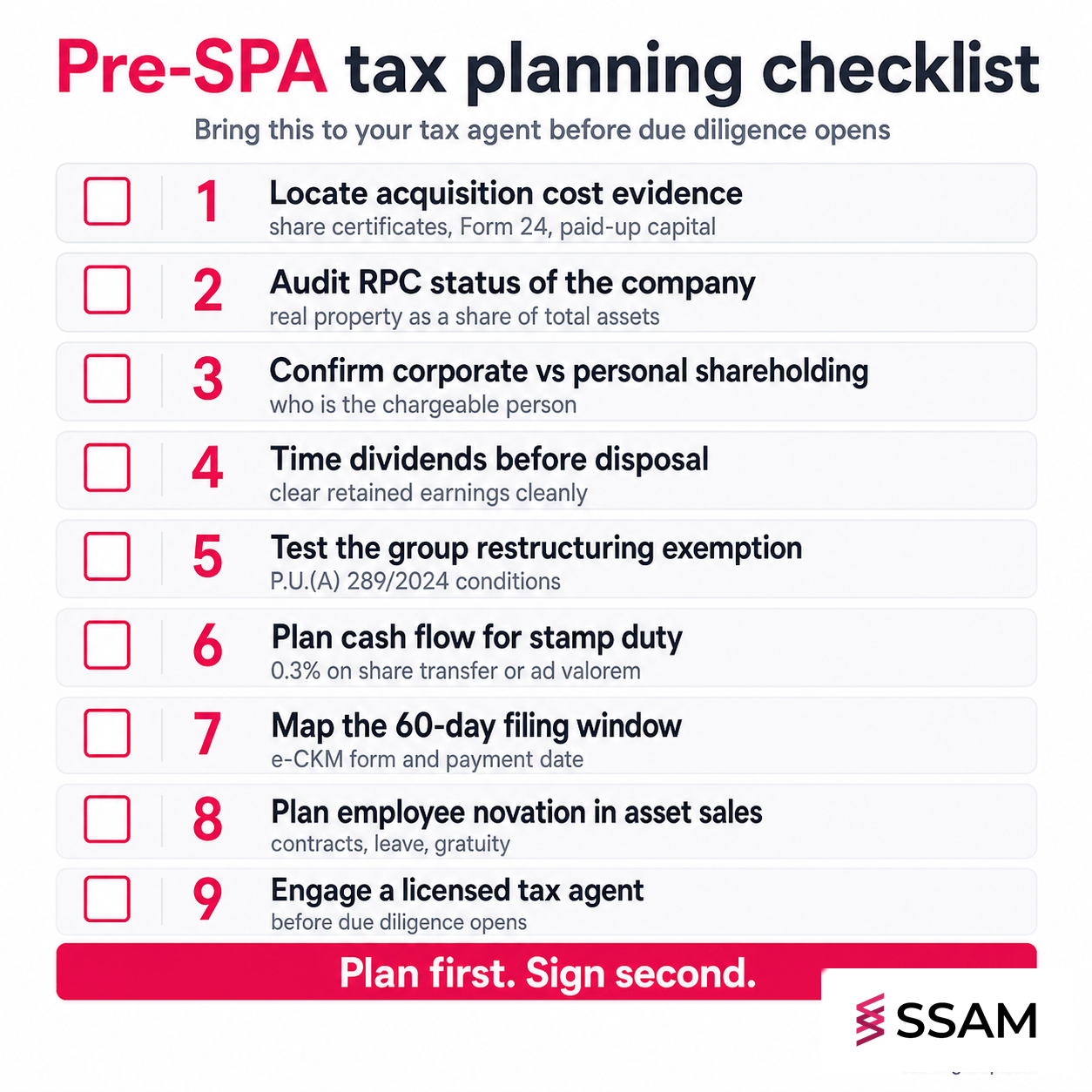
Pull together share certificates, the original CTC of Form 24, board resolutions on share issues, and bank evidence of paid-up capital. The 10% net-gain calculation depends entirely on this paper trail. Pre-2024 founders often have weak records, which forces them into the 2% gross election even when the 10% would have been cheaper.
Choose the structure that fits your buyer and your assets
A buyer who wants the brand only often prefers an asset deal. A buyer who wants the contracts and licences usually needs a share deal. Model the after-tax proceeds for both routes early, then anchor the SPA to the winning structure.
Sequence dividends, restructuring and the disposal
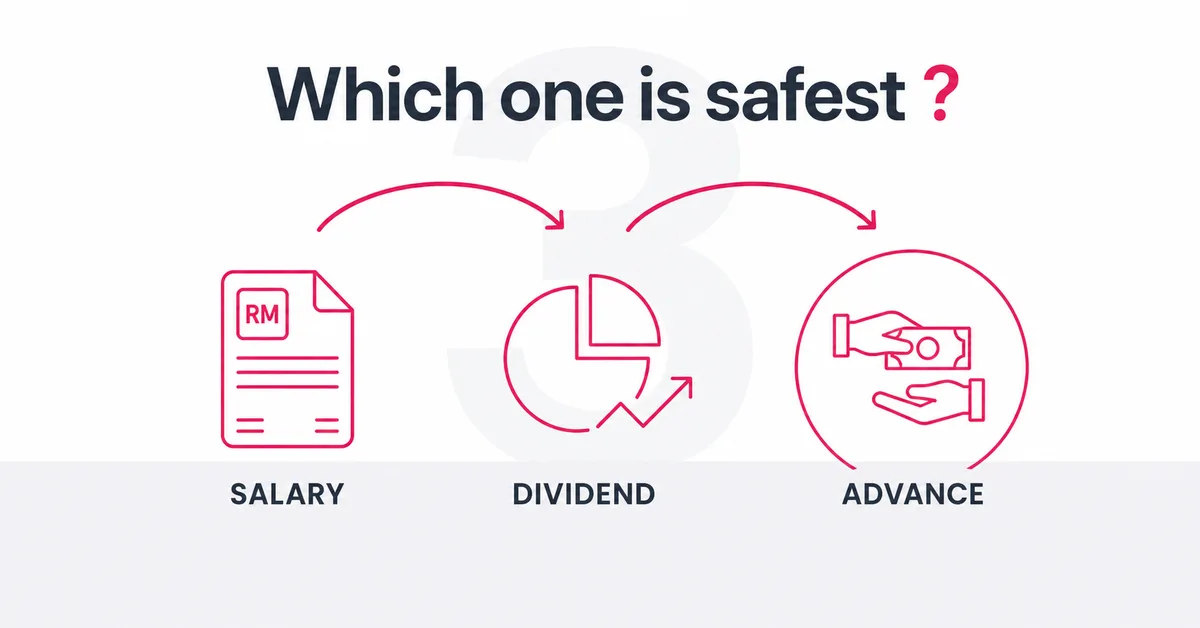
If your Sdn Bhd has retained earnings, consider distributing them before the disposal so the buyer is not paying for cash that will be paid out anyway. How you extract that cash, whether as an advance to director, salary, or dividend in Malaysia, changes your personal tax, and those retained profits were shaped over the years by the tax incentives for SMEs in Malaysia you claimed and your wider work on how to reduce corporate tax in Malaysia. If the group needs reshuffling, do that under the restructuring exemption and let the values settle before negotiating with a third party.
Engage a licensed tax agent before due diligence starts
CGT decisions are easier to fix on paper than in tax disputes. Engaging a licensed tax agent in Malaysia before you accept a non-binding offer means the worked numbers, the election choice and the documentation are ready when the buyer's adviser opens the data room.
Filing and paying CGT: your 60-day window
The compliance side is short, but the deadline is firm.
The e-CKM return and Form CKM
Disposals on or after 1 March 2024 must be filed electronically through the e-CKM portal using Form CKM. The return covers the disposal price, the acquisition cost, the allowable expenses and the rate elected. CGT is payable within 60 days of the date of disposal, which is generally the date of the SPA or the date legal title passes, whichever is earlier under the transaction. Keep a digital copy of the filing acknowledgement.
Penalties, record-keeping and the 7-year audit window
Late filing or late payment carries penalties under the Income Tax Act 1967. Treat the CGT deadline the same way you treat corporate tax instalment deadlines so it does not slip during a busy completion. For context on how the IRB approaches late submissions in general, see LHDN penalties for late tax filing. Keep your records for at least seven years. The IRB may audit a disposal long after completion, and you will need the original cost evidence to defend the return.
Frequently asked questions
Do individuals pay capital gains tax in Malaysia when they sell their company?
Individuals selling personally-held unlisted shares in their own Sdn Bhd are not chargeable persons for CGT today. RPGT or stamp duty may still apply. From YA 2026, a nominee rule treats the beneficial owner as the chargeable person, so corporate-held shares cannot be parked in an individual name purely to avoid CGT.
Is it better to sell my Sdn Bhd as a share sale or an asset sale?
It depends on what the buyer wants and what you own. Share sales transfer the whole company in one move and are usually simpler legally. Asset sales let the buyer leave unwanted liabilities behind but trigger SST, balancing charges and employee novation. Model after-tax proceeds for both before negotiating.
What is the difference between CGT and RPGT in Malaysia?
RPGT applies to disposals of Malaysian real property and shares in a real property company. CGT applies to disposals of unlisted shares that fall outside the RPGT net, plus Section 15C shares and certain remitted foreign gains. Real property exposure stays with RPGT, while corporate exits move under CGT.
When should I choose the 2% gross rate instead of the 10% net rate?
The 2% gross rate is only available for shares acquired before 1 January 2024. It works in your favour where the acquisition cost was very low and most of the disposal price is gain, since 2% of the price is less than 10% of nearly the whole price. Run both numbers before electing.
Will winding up my company trigger capital gains tax from 2026?
Under Finance Bill 2025, distributions to shareholders during a members' voluntary winding-up or a strike-off can be treated as a disposal of shares for CGT purposes. Check the gazette status and the company's specific facts before initiating the wind-down. Reserves, retained earnings and group structure all change the answer.
Plan your business exit with SSAM Group
SSAM Group is a Kuala Lumpur-based corporate services firm with 40 years of experience helping Malaysian SME owners on exits, restructurings and the day-to-day compliance that sits behind them. Our tax planning and CGT advisory work runs through TSE Taxation Services Sdn. Bhd. (124590-A), a Ministry of Finance licensed tax agent. If you are sizing up a sale and want a calm view of the numbers before you commit, SSAM's tax planning in Kuala Lumpur can give you that view. You can also read our wider guide on tax consultant services in Kuala Lumpur to see how exit planning sits inside the rest of your tax workflow.
Data sources and reference list
- Inland Revenue Board of Malaysia (LHDN), Guidelines on Capital Gains Tax for Unlisted Shares, 21 July 2025. https://www.hasil.gov.my/media/rgndkcuh/20250721-guidelines-on-capital-gains-tax-for-unlisted-shares.pdf
- PwC Malaysia, Capital Gains Tax overview, rates and compliance. https://www.pwc.com/my/en/issues/capital-gains-tax.html
- EY Malaysia, Malaysia's new capital gains tax regime, your questions answered. https://www.ey.com/en_my/technical/tax-alerts/malaysias-new-capital-gains-tax-regime-your-questions-answered
- EY Malaysia, CGT exemptions for IPO and group restructuring. https://www.ey.com/en_my/technical/tax-alerts/capital-gains-tax-exemptions-for-initial-public-offerings-and-group-restructuring-exercises
- KPMG Malaysia, Capital Gains Tax: What do you need to consider?, April 2024. https://assets.kpmg.com/content/dam/kpmg/my/pdf/capital-gains-tax-what-do-you-need-to-consider-updated-in-april-2024.pdf
- Alvarez & Marsal, Malaysia widens capital gains tax "disposal" definition. https://www.alvarezandmarsal.com/insights/malaysia-widens-capital-gains-tax-disposal-definition-impact-ma-corporate-restructuring
- KTP & Company, Winding-up a company and the CGT impact from 1 January 2026. https://www.ktp.com.my/blog/capital-gain-tax-malaysia/17mar2026
- Baker McKenzie, Global Private M&A Guide: Malaysia. https://resourcehub.bakermckenzie.com/en/resources/global-private-ma-guide-limited/asia-pacific/malaysia/topics/quick-reference-guide
- Donovan & Ho, Selling a Malaysian business: share sale vs asset sale. https://dnh.com.my/selling-a-malaysian-business-share-sale-vs-asset-sale/
The information in this article is provided for general informational purposes only and does not constitute tax, accounting, financial or legal advice. Tax laws change frequently and may not apply to your situation. Always consult a qualified professional before acting on any information here.