

Key Takeaways
- For most Sdn Bhd owners, a properly documented director's salary remains the safest baseline. It is tax-deductible for the company, reportable on Form E and Form EA, and supports EPF, SOCSO, and loan applications.
- Dividends are tax-efficient when there are audited distributable profits and the shareholder stays below the YA 2025 RM100,000 individual dividend threshold. Above that, a 2% dividend surcharge applies.
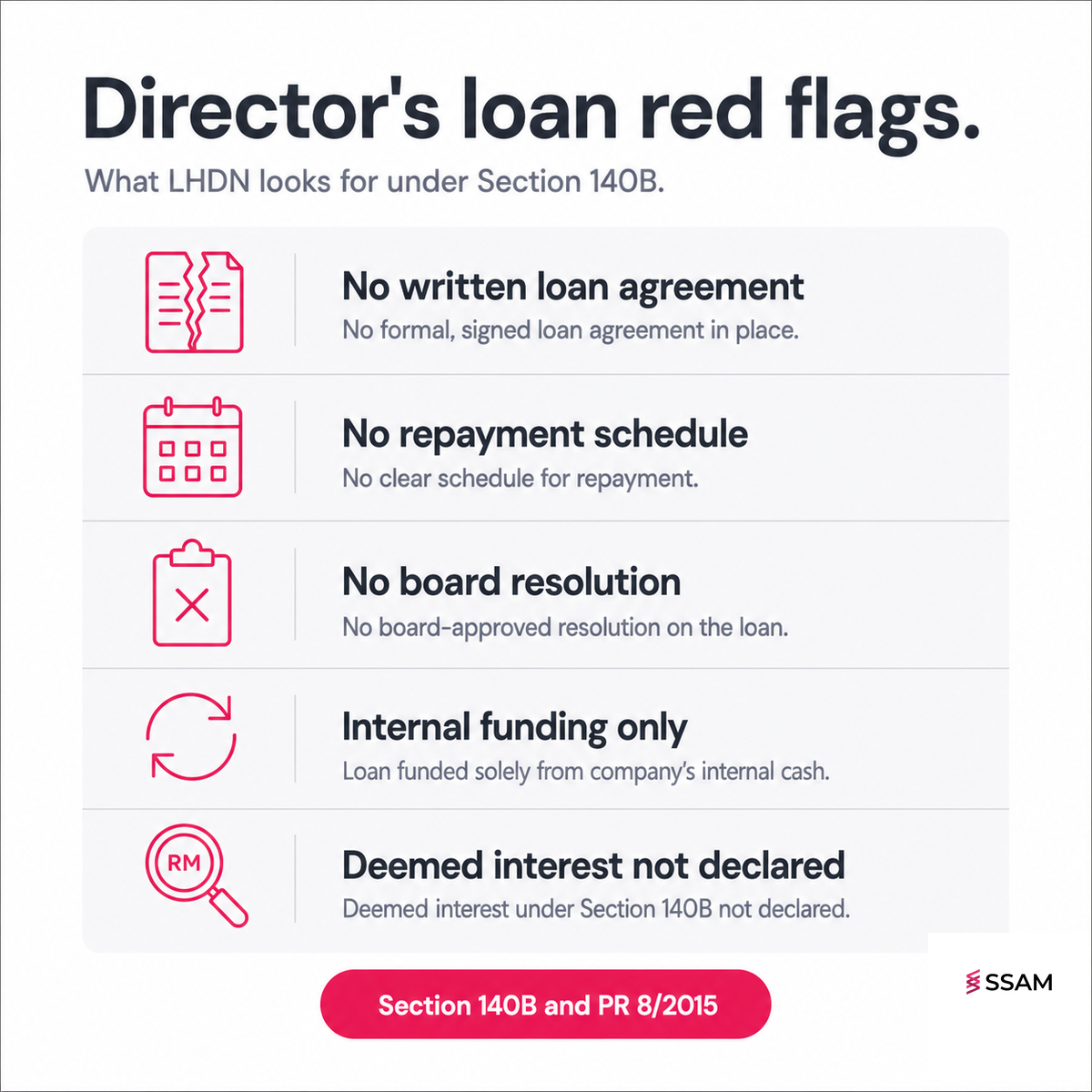
- An advance to director is legal but the most scrutinised option. Internal-funded advances trigger deemed interest income on the company under Section 140B of the Income Tax Act 1967 and LHDN Public Ruling 8/2015, even if no interest was actually charged.
- The right mix often combines a modest salary with periodic dividends, plus advances only when strictly documented with a written loan agreement and a repayment schedule.
- Documentation is what protects you. Board resolutions, employment contracts, loan agreements, monthly PCB, and timely Form E and Form C filings turn each option from a risk into a defendable position.
If you run a Sdn Bhd in Malaysia, the decision between an advance to director, a director's salary, and a dividend is rarely about which one saves the most tax. It is about which one keeps you out of trouble when LHDN comes asking. These three options only exist once you operate through a company, so if you are still weighing sole proprietorship vs Sdn Bhd tax in Malaysia, settle that question first. Many owner-directors quietly use a mix of all three without realising that each has a very different compliance footprint, a different cost on the company side, and a different personal tax outcome. This guide compares all three options head to head, names the most common trap, and gives you a short test you can run tonight to decide which mix fits your situation. It draws on the Sdn Bhd director tax obligations framework, the Income Tax Act 1967, LHDN Public Ruling 8/2015, and the YA 2025 changes to individual dividend tax.
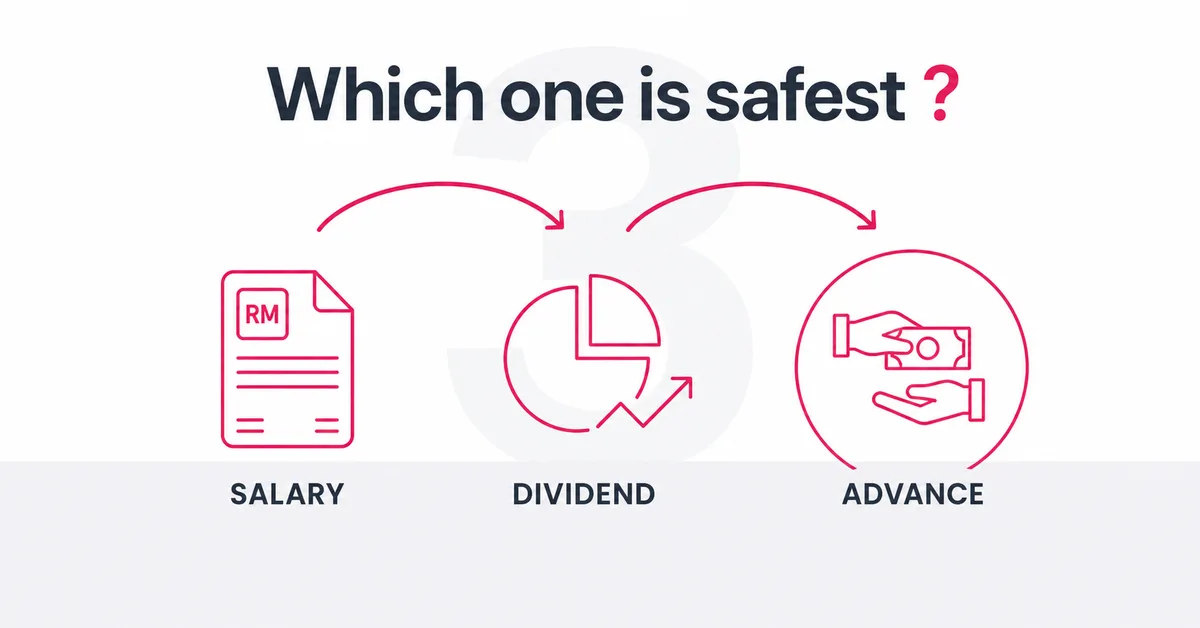
Which is safest, an advance, a salary, or a dividend?
For most Sdn Bhd owners in Malaysia, a properly documented director's salary is the safest baseline. Dividends are also safe when the company has audited distributable profits and the shareholder stays under the YA 2025 RM100,000 individual dividend threshold. An undocumented advance to director is the riskiest, because internal-funded advances can trigger deemed interest on the company under Section 140B.
The right answer is rarely a single option. It is usually a mix, calibrated to your company's profit level, your personal tax bracket, your EPF goals, and the documentation you can realistically maintain.
Three ways to take money out of your Sdn Bhd
Before comparing the tax treatment, it helps to agree on what each option actually is. The terms get used loosely in casual conversation, and the differences matter for both LHDN and the auditor.
What is a director's salary in Malaysia?
A director's salary is employment income paid by the Sdn Bhd to the director in their capacity as an employee. It is subject to monthly PCB (Potongan Cukai Berjadual), EPF, SOCSO, and EIS deductions, and it is reported on Form EA for the director and Form E for the employer. Salaries are deductible against the company's chargeable income, provided they are reasonable and tied to genuine services rendered.
A director's fee is similar but distinct. It is paid for services as a board member rather than as an executive employee. Fees are usually approved at the annual general meeting and become taxable to the director at the point of approval.
What is a dividend from a Sdn Bhd?
A dividend is a distribution of after-tax profits to shareholders. Malaysia operates a single-tier dividend system, which means the company has already paid corporate tax on the underlying profit and the dividend is paid out without further withholding. There is no tax credit for the recipient because there is no tax to credit back.
From YA 2025, a 2% dividend tax applies to individual dividend income that exceeds RM100,000 in a year. Several sources are excluded, including EPF dividends, unit trust distributions, cooperative dividends, and certain foreign-sourced dividends.
What is an advance to director?
An advance to director is money the company lends to the director, typically with the expectation of repayment. In the books, it sits as a receivable, not as an expense, so it is not deductible against company profits. Internally funded advances also create a deemed-interest charge for the company under Section 140B and Public Ruling 8/2015. The full rules, audit triggers, and cleanup playbook live in the companion guide What Is an Advance to Director in Malaysia? Tax Risks Every Sdn Bhd Owner Must Know. The summary in this article is enough for the planning comparison that follows.
Tax treatment compared, company side vs personal side
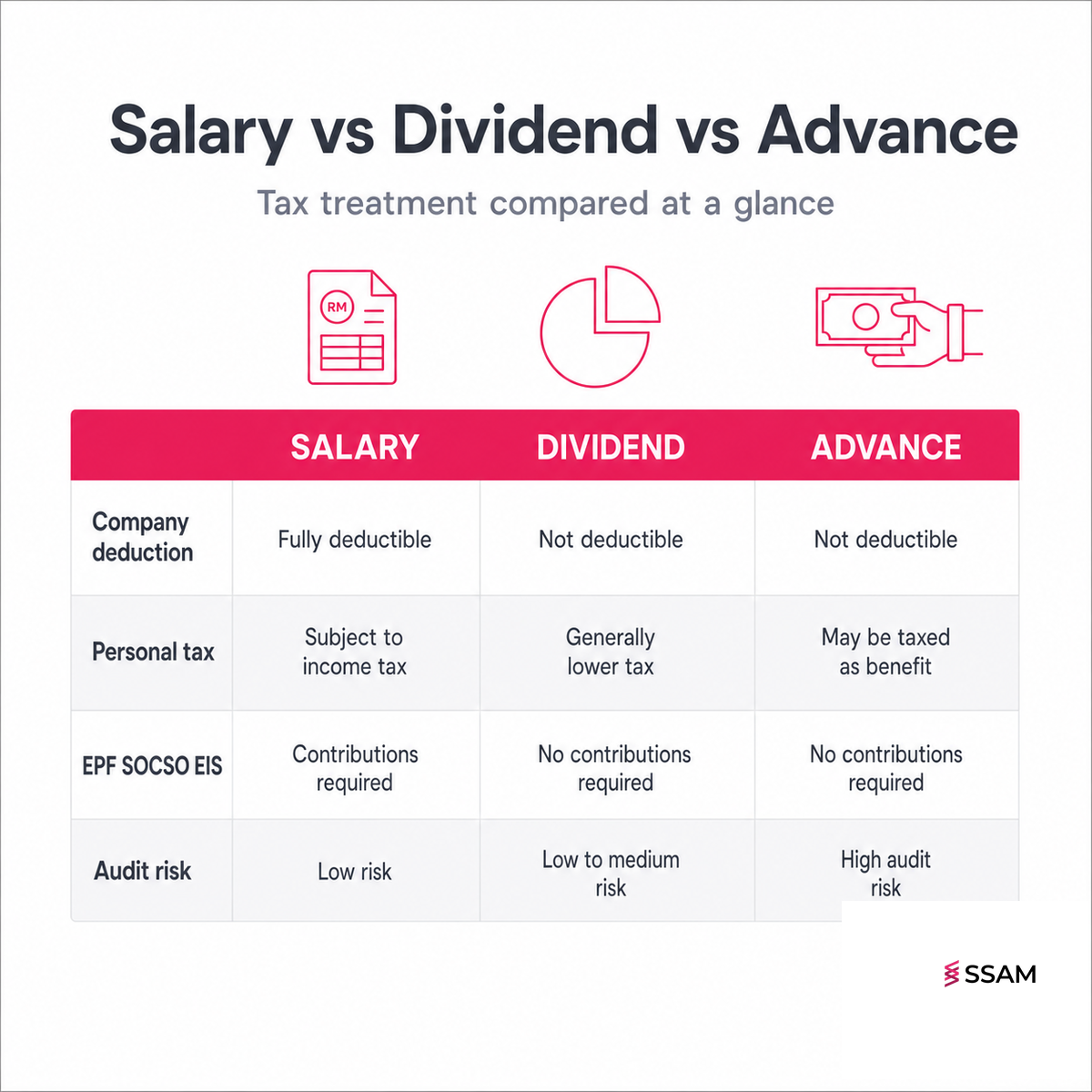
The table below summarises the three options across the dimensions that matter most to an owner-director.
| Factor | Director's salary | Dividend | Advance to director |
|---|---|---|---|
| Deductible at company level | Yes, if reasonable and tied to services | No, paid from after-tax profits | No, it is a balance-sheet item, not an expense |
| Personal tax | Employment income under progressive rates | Generally tax-exempt up to RM100,000 a year, 2% surcharge above (YA 2025) | Not income, but creates deemed interest exposure for the company |
| EPF, SOCSO, EIS | Required for the director-employee | Not applicable | Not applicable |
| Timing | Monthly, predictable | Periodic, after profits are determined and approved | Whenever cash is taken, but reconciliation is needed |
| Documentation needed | Employment contract, payroll records, Form E, Form EA | Board resolution, audited distributable reserves, dividend voucher | Written loan agreement, repayment schedule, board approval |
| LHDN audit risk | Low if documentation is in order | Low if profits and approval are clean | High if undocumented or internally funded |
How the advance option fits the planning mix
The advance route looks cheap because no personal income tax hits the director at the moment cash leaves the company. The planning catch is that the cost reappears on the company side, in the form of a deemed-interest charge that is added to chargeable income whether or not real interest is paid. Under LHDN Public Ruling 8/2015, that deemed interest is computed monthly using a prescribed formula tied to the outstanding loan balance and the average lending rate of commercial banks in Malaysia published by Bank Negara Malaysia. For an owner-director running a profitable Sdn Bhd, the so-called tax-free draw is really a deferred and reshuffled cost, not an elimination of it.
Two planning implications matter for the salary vs dividend vs advance comparison:
- An advance is rarely the cheapest extraction route over a full year once the deemed-interest cost is added back at the company level.
- An advance only earns its place in the mix when it is short-term, fully documented, and supported by a clear repayment plan that closes within the same financial year.
The deep mechanics of Section 140B, internal versus external funding, audit triggers, and how to clean up a long-running director's loan account sit in the compliance companion guide on advance to director Malaysia tax risks. Late or missing supporting documents can also compound the problem under the standard LHDN penalties for late tax filing framework.
When a director's salary is the safest choice
Pay yourself a director's salary when you want predictability, EPF accumulation, and clean records. This is the default for owner-directors who treat their Sdn Bhd as a long-term operating company rather than a short-term holding vehicle. It also supports your personal financial life, because lenders are far more comfortable with consistent salaried income than with sporadic dividend statements when assessing mortgages or car loans.
A salary works particularly well in three situations. First, when your personal marginal tax rate is lower than the company's effective rate, paying salary moves the income to the lower bracket. Second, when you want to build EPF for retirement, salary is the only one of the three options that contributes. Third, when the company is still investing in growth and has limited distributable reserves, salary remains payable while dividends may not be.
The trade-off is the statutory contribution layer. Employer EPF, SOCSO, and EIS, plus monthly PCB, mean more administrative work. A capable secretary or accountant can automate most of this and reduce the chance of late submissions or missed deductions. Beyond cash pay, some owner-directors also take part of their reward as a non-cash benefit such as a company car under Sdn Bhd tax in Malaysia, which carries its own tax treatment.
When a dividend is the most tax-efficient
Dividends shine when the company is consistently profitable, the audited financial statements show distributable reserves, and the shareholder's total dividend income is below RM100,000 per year. Under the single-tier system, those dividends are received free of further personal tax. Above RM100,000, the YA 2025 2% surcharge applies to the excess, which still leaves dividends competitive compared with higher personal tax brackets on salary. For an SME Sdn Bhd that meets the paid-up capital and gross income thresholds, the corporate tax cost behind that dividend follows the preferential ladder of 15% on the first RM150,000 of chargeable income, 17% up to RM600,000, and 24% above that, so the combined corporate-plus-2% impact is often lighter than the top personal brackets on salary.
Three practical conditions are worth respecting. The company must have audited profits available for distribution. The board must approve the dividend formally, with a written resolution and a dividend voucher. The dividend cannot be used to substitute for genuine employment income that should be paid as salary. LHDN can recharacterise a salary disguised as a dividend if there is no plausible employment substance.
Dividends offer no EPF contribution, no SOCSO, and limited usefulness for personal loan applications. For owner-directors who already have separate retirement savings and stable financing arrangements, this trade-off is often acceptable.
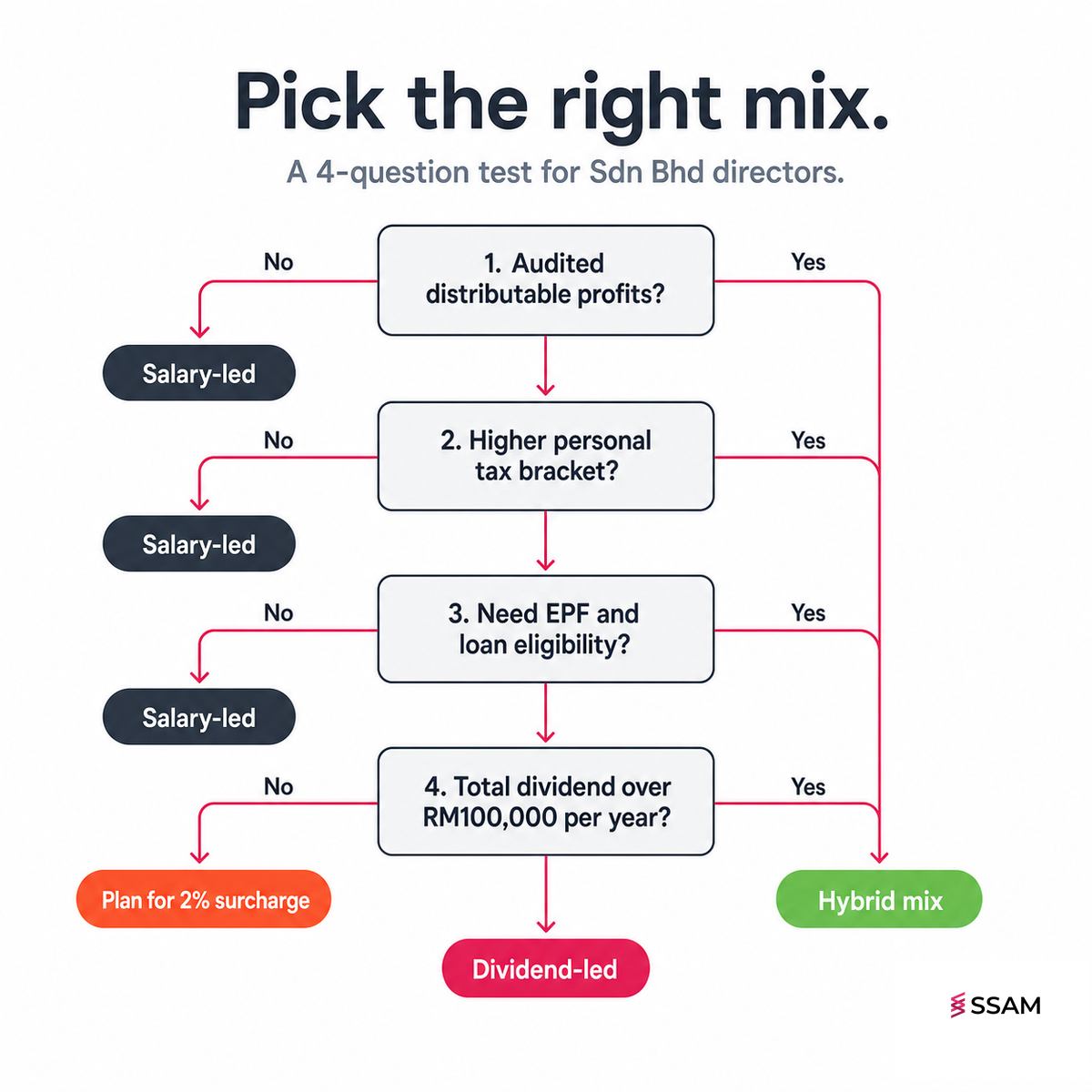
A simple 4-question test to pick the right mix
If you only have ten minutes, run this short test. The answers point you to the right primary method for the year.
Does your Sdn Bhd have audited distributable profits?
If yes, dividends are a real option. If no, focus on salary and limit any advance to a strictly documented short-term arrangement. Without audited profits, a dividend declaration can be challenged.
What is your personal marginal tax bracket?
If you are already in the top personal brackets, dividends become more attractive up to the RM100,000 ceiling. If your personal bracket is lower than the company's effective rate, more salary may be the better choice.
Do you need EPF, SOCSO, and loan eligibility?
If yes, salary is essential. EPF accumulation is meaningful only through employment income, and banks consistently weight salaried income higher than dividend statements when underwriting personal loans.
Will your total dividend income exceed RM100,000 this year?
If yes, plan for the 2% surcharge on the excess. Modelling a balanced salary plus dividend approach often reduces total tax. If no, you can take more of your draw as dividend without worrying about the new surcharge.
Documentation and compliance checklist by option
Whichever combination you choose, the paperwork is what makes the position defendable. Use this checklist as a baseline.
For a director's salary:
- A written employment contract that names the role, duties, and remuneration
- Monthly payroll with PCB, EPF, SOCSO, and EIS
- Form E filed by the employer by 30 April each year and Form EA issued to the director
- Board approval where the director is also a shareholder receiving above-market remuneration
For a dividend:
- Audited financial statements that show distributable reserves
- A board resolution approving the dividend with date and amount
- A dividend voucher issued to each shareholder
- Confirmation that no statutory restriction prevents the distribution
For an advance to director:
- A written loan agreement with principal, interest, repayment schedule, and security if any
- A board resolution authorising the advance
- A documented funding source, to address Section 140B exposure
- A year-end reconciliation of the director's loan account in the audited accounts
These slot into the broader compliance calendar covered in Malaysia tax filing deadlines, and the form-by-form distinctions are explained in which tax forms your Sdn Bhd needs (Form B, C, E). If you also want a feel for the wider operating costs of compliance, our breakdown of Sdn Bhd running costs in Malaysia gives a realistic picture.
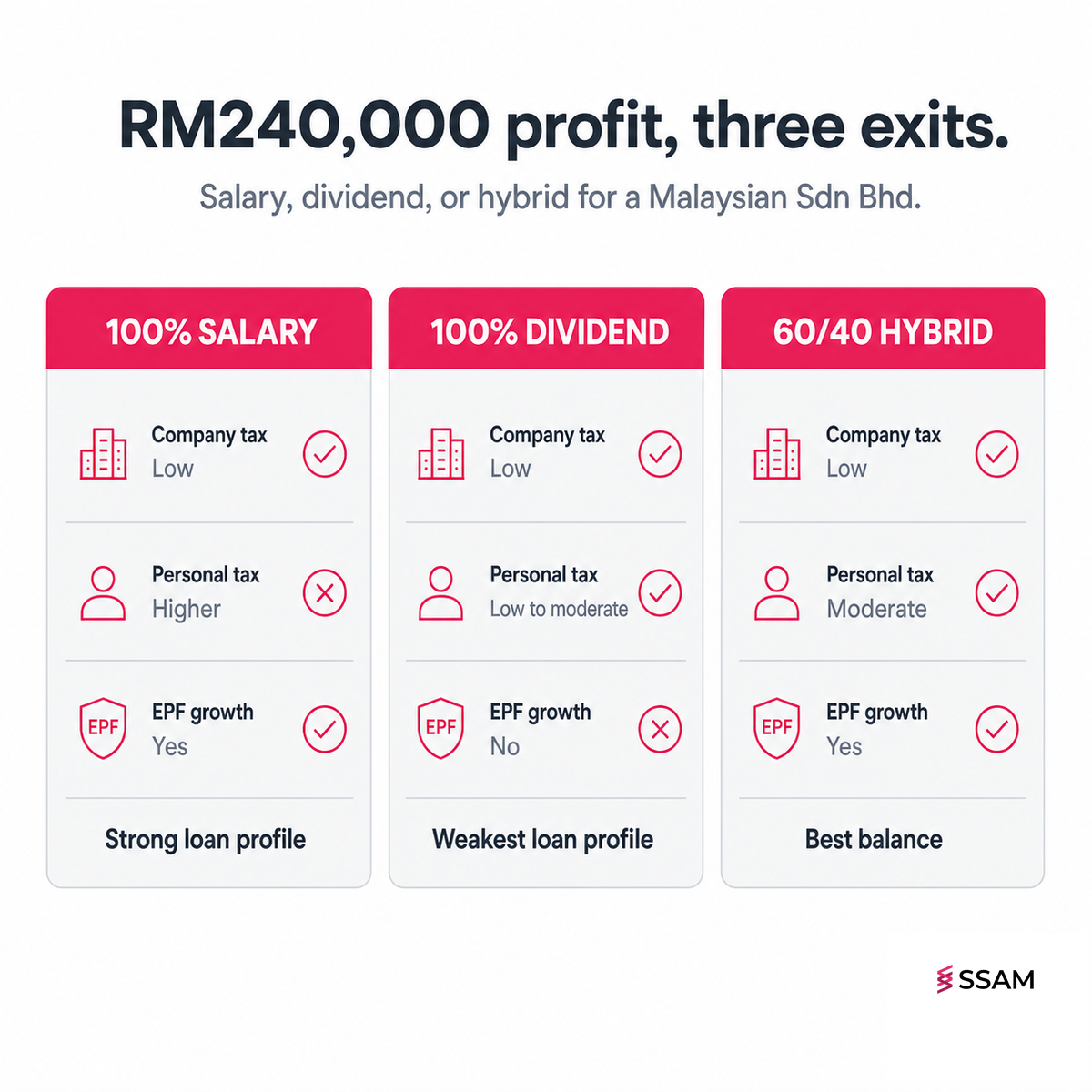
A worked example: RM240,000 profit, three different exit strategies
Picture a Sdn Bhd with RM240,000 of pre-extraction chargeable profit, owned and run by a single owner-director who qualifies as an SME for corporate tax purposes. The scenarios below are directional, intended to show the shape of the decision rather than to replace a full tax computation.
Scenario A, 100% as salary. The full RM240,000 is paid as salary across the year. The company has near-zero chargeable profit after the deduction, so corporate tax is minimal. In a fuller computation, capital allowances in Malaysia would also shape the chargeable profit before the salary deduction is applied. The director pays personal income tax on RM240,000 at progressive rates and contributes EPF, SOCSO, and EIS. PCB is deducted monthly. The retirement balance grows, and the director's loan and credit-card profile strengthens.
Scenario B, 100% as dividend. No salary is paid. The company pays corporate tax on RM240,000 at the preferential SME rates available through the various tax incentives for SMEs in Malaysia, and distributes the after-tax balance as a single dividend. Up to RM100,000 of that dividend is received by the individual free of further tax. The portion above RM100,000 is subject to the YA 2025 2% surcharge. No EPF, SOCSO, or EIS is paid. The director has a weaker personal loan profile because there is no salaried income on record.
Scenario C, 60/40 hybrid (salary plus dividend). RM144,000 is paid as salary and the remaining profit is taxed at corporate rates and distributed as dividend. Salary deductions reduce corporate tax. The director's personal tax bracket on the salary portion is moderate, EPF accumulates, and the dividend portion stays under the RM100,000 threshold for the surcharge.
For many Malaysian owner-directors with consistent annual profits and an active operating business, Scenario C produces a strong combination of compliance, tax efficiency, and personal financial health. The extraction mix is only one lever, so it works best alongside a broader plan for how to reduce corporate tax in Malaysia. The CP204 estimate matters here too. A balanced scenario keeps corporate tax estimates manageable, and our guide to CP204 tax estimate in Malaysia covers how to set yours without overpaying or attracting penalties.
Frequently asked questions
Can I take a director's advance and pay it back later?
Yes, but only with proper documentation. A written loan agreement, a board resolution, and a repayment schedule are the minimum. Without them, an internal-funded advance can trigger deemed interest on the company under Section 140B, regardless of your repayment intention.
Is a director's fee the same as a director's salary?
No. A director's fee is paid for services as a board member and is typically approved at the AGM. A salary is paid for executive duties under an employment contract. Both are taxable to the director, but the timing of taxability and the statutory contribution treatment differ.
Do I have to pay EPF on my own director's salary?
If you are a director-employee under an employment contract, EPF, SOCSO, and EIS generally apply in the normal way. If you are a non-executive director receiving fees only, statutory contributions usually do not apply. Many owner-directors structure themselves as employees specifically to build EPF.
When does the 2% dividend tax in Malaysia apply?
From YA 2025, a 2% tax applies to an individual's chargeable dividend income that exceeds RM100,000 in a year. Several sources are excluded, including EPF dividends, unit trust distributions, cooperatives, and certain foreign-sourced dividends. Corporate shareholders are not subject to this 2% surcharge.
What happens if LHDN audits my director's loan account?
Expect requests for the written loan agreement, the board approval, the repayment schedule, and the year-end reconciliation. If the advance was funded from internal company funds and no interest was charged, LHDN will compute deemed interest under Public Ruling 8/2015 and add it to the company's chargeable income.
Can a dormant Sdn Bhd still advance money to its director?
Technically yes, if the company has cash and the directors approve. Practically, it is rarely advisable. A dormant company has limited business reasons to lend money to a director, and the Section 140B exposure remains. Closing the company or formally distributing reserves is usually cleaner. If closure or a sale is on the table, factor in the capital gains tax on a business sale in Malaysia as well.
When to bring in a licensed tax agent
There is no universal safest option, only the option that fits your profit profile, your personal tax bracket, your EPF goals, and the paperwork you can sustain. Run the 4-question test, pick a primary method, and document everything. If you are unsure how to size the salary-to-dividend split, or you suspect a director's advance may already be on your books without proper documentation, an approved tax agent in Malaysia can review your position before LHDN does. For a broader walk-through of how a Kuala Lumpur tax practice supports owner-directors, our tax consultant services in Kuala Lumpur guide is a useful starting point. SSAM Group is a MOF-licensed tax agent whose tax planning in Kuala Lumpur has supported more than 1,000 Malaysian businesses across 40 years of practice. Speak to the team if you would like a calm, second pair of eyes on your numbers before year-end.
Data sources and references
- LHDN Public Ruling No. 8/2015, Loan or Advances to Director by a Company (Section 140B): https://phl.hasil.gov.my/pdf/pdfam/LOAN_OR_ADVANCES_TO_DIRECTOR.pdf
- Inland Revenue Board of Malaysia (LHDN / IRBM): https://www.hasil.gov.my/
- PwC Tax Summaries, Malaysia, Corporate income determination (single-tier dividend, YA 2025 2% dividend tax): https://taxsummaries.pwc.com/malaysia/corporate/income-determination
- PwC Tax Summaries, Malaysia, Individual income determination: https://taxsummaries.pwc.com/malaysia/individual/income-determination
- Income Tax Act 1967, Section 140B
- Companies Act 2016, board approval, dividends, and director duties
- Employees Provident Fund (KWSP): https://www.kwsp.gov.my/
- Social Security Organisation (PERKESO): https://www.perkeso.gov.my/
The information in this article is provided for general informational purposes only and does not constitute tax, accounting, financial or legal advice. Tax laws change frequently and may not apply to your situation. Always consult a qualified professional before acting on any information here.