

Key Takeaways
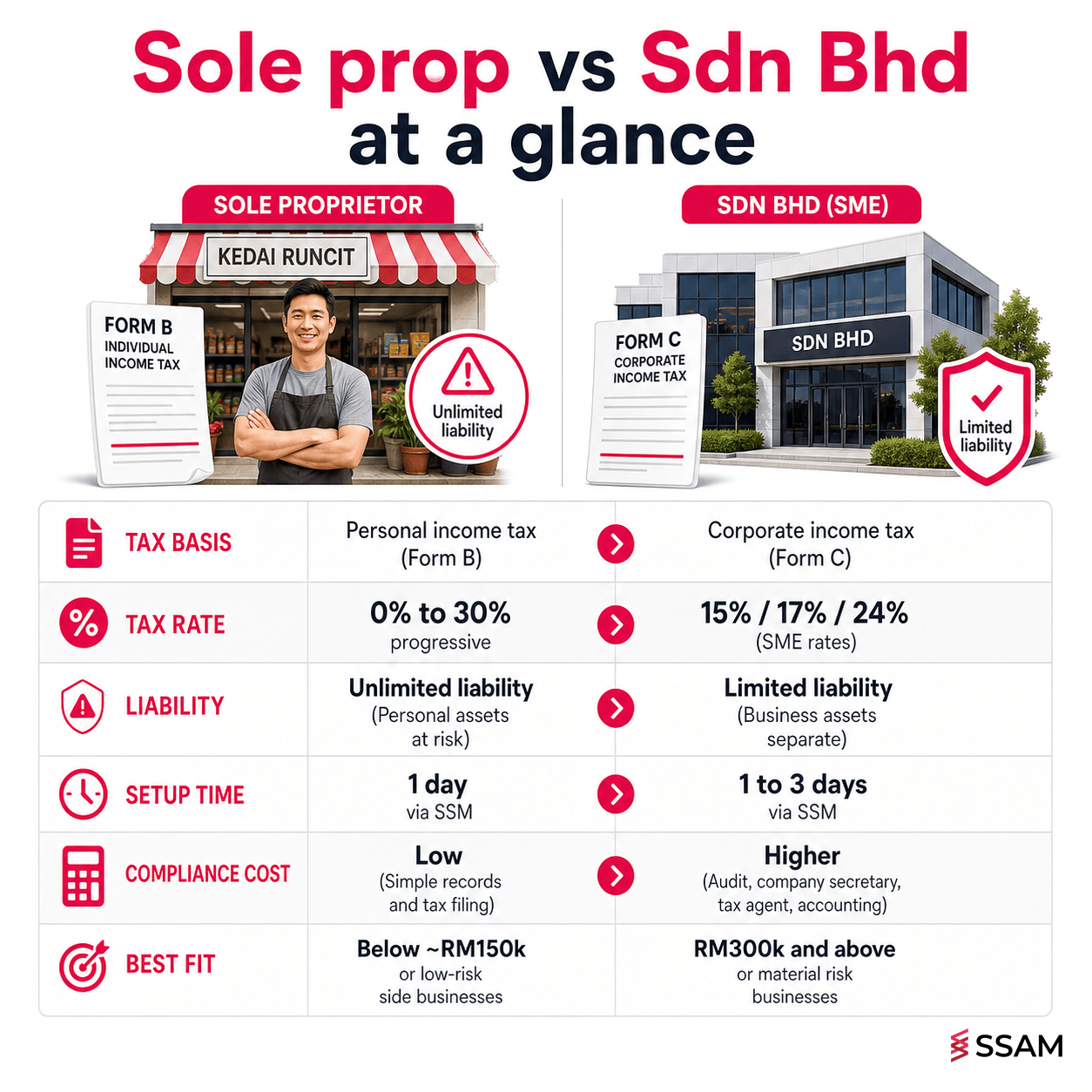
- Sole proprietorships are taxed under personal income tax of 0 to 30%, while a qualifying SME Sdn Bhd pays 15% on the first RM150,000, 17% on the next RM450,000 and 24% above RM600,000.
- For most service-line SMEs, converting only starts to save real money once annual chargeable income reaches roughly RM150,000 to RM200,000.
- At RM100,000 profit a sole prop usually wins. At RM300,000 it is roughly even. At RM600,000 a well-run Sdn Bhd pulls ahead clearly.
- Sdn Bhd running costs (audit, licensed company secretary, tax agent, accounting, EPF, SOCSO and EIS once you draw a salary) can wipe out the headline saving if you convert too early.
- Tax is only one driver. Limited liability under the Companies Act 2016, contracts with corporate and government clients, and easier funding often matter just as much.
Sole prop vs Sdn Bhd tax Malaysia in one minute
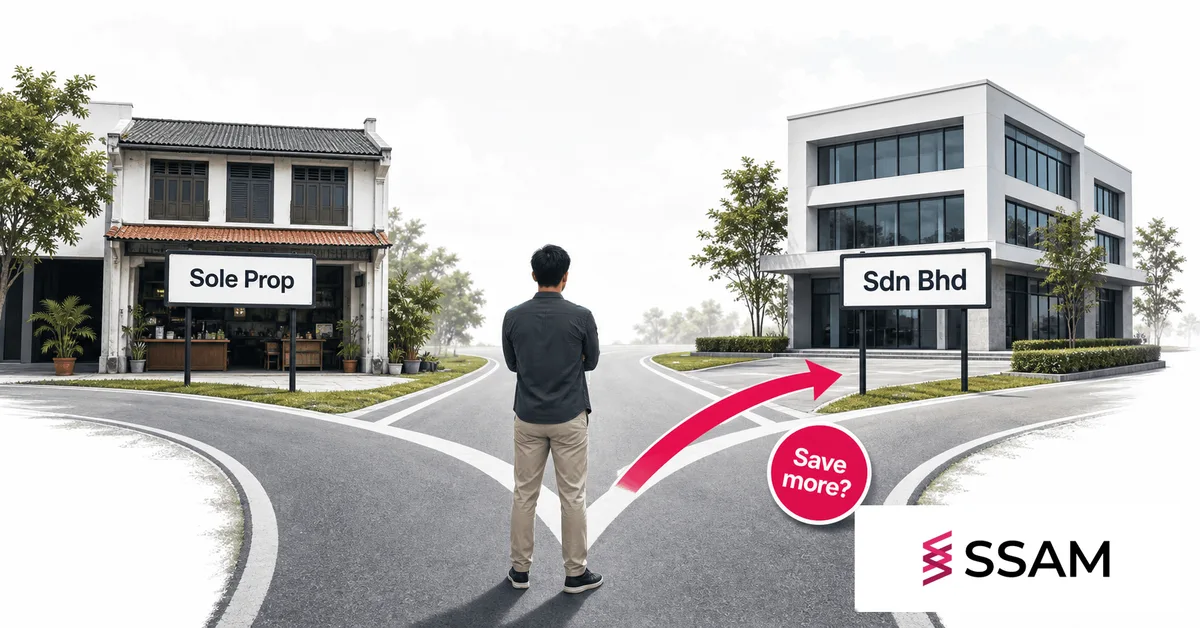
If you are running a sole prop in Malaysia and watching personal tax climb every year, a Sdn Bhd may now save you more than it costs. Sole prop profits flow to you personally and are taxed at progressive resident rates of 0 to 30% on Form B. A qualifying SME Sdn Bhd is taxed separately on Form C at 15% on the first RM150,000, 17% on the next RM450,000 and 24% above RM600,000. For most service-line SMEs, the breakeven point where converting starts to save real money sits between RM150,000 and RM200,000 of chargeable income, before you factor in compliance costs.
How each structure is taxed in Malaysia
Before any decision, it helps to see where the tax actually comes from in each structure. The mechanics are very different even when the underlying business profit is the same.
Sole proprietorship: personal income tax on Form B
A sole prop is not a separate legal person. Your business profit is added to your other personal income, then taxed at Malaysia's resident individual rates of 0 to 30%. Annual filing is on Form B, due 30 June each year. There is no statutory audit and no separate company accounts. You sign one return and keep whatever is left after personal tax.
Sdn Bhd: corporate tax on Form C
A Sdn Bhd is a separate legal person. It files Form C and pays corporate income tax on its own chargeable income. SMEs that meet the qualifying conditions (paid-up ordinary share capital of not more than RM2.5 million at the start of the basis period, and gross business income of not more than RM50 million for the year) get the preferential rates: 15% on the first RM150,000, 17% on the next RM450,000 and 24% above RM600,000. Companies that do not meet those conditions pay a flat 24%. For a deeper view of how the business structures in Malaysia compare on tax, accounting and liability, it is worth reading before you decide.
Other taxes that change once you convert
Tax treatment does not end at the headline rate. A few things shift once your business becomes its own legal entity:
- Director's salary and PCB: if you pay yourself a salary out of your Sdn Bhd, the company deducts monthly PCB and contributes EPF, SOCSO and EIS, just like for any employee. The salary is deductible in the company and taxable in your personal return.
- Dividends: Malaysia operates a single-tier dividend system. Once the company pays its 15 to 24% corporate tax, dividends paid out to shareholders are not taxed again at the personal level.
- Tax estimates: a Sdn Bhd must submit Form CP204 before the basis period begins and pay monthly instalments. See CP204 tax estimate in Malaysia for how to avoid the 10% underestimation penalty.
- SST and e-invoicing: SST registration thresholds apply by activity, regardless of structure, and your Sdn Bhd sits inside LHDN's e-invoicing rollout from incorporation.
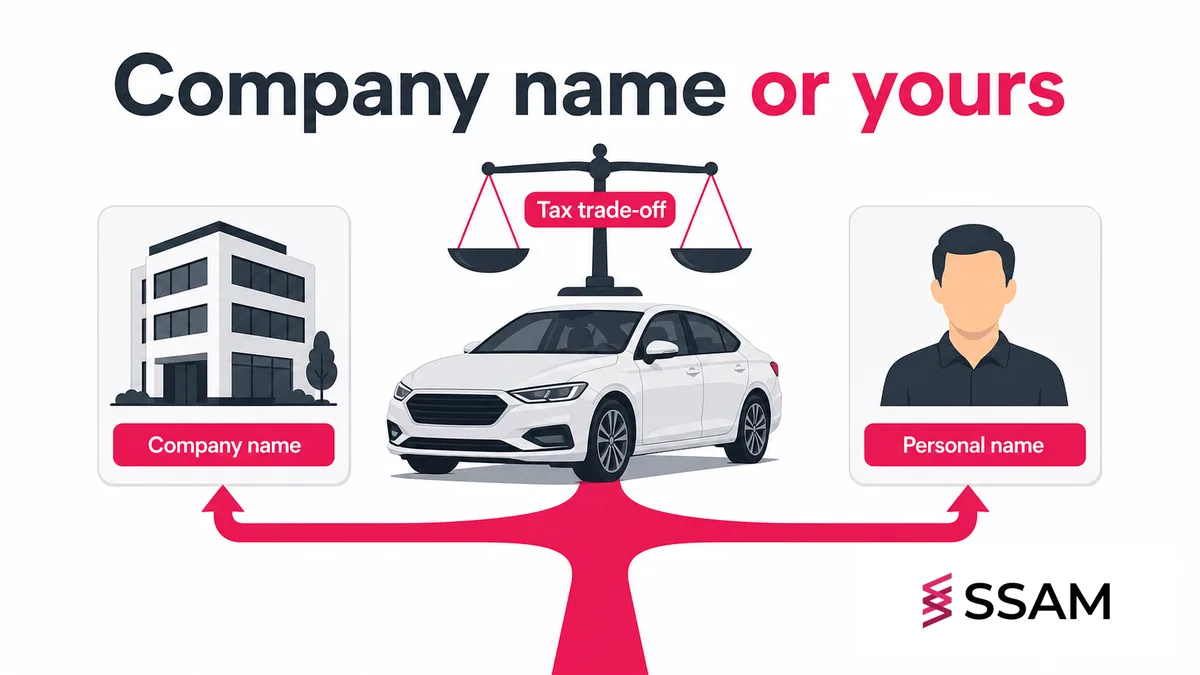
- Company-owned assets: vehicles, equipment and laptops bought through the company unlock capital allowances and other deductions you cannot claim as cleanly in a sole prop. The trade-off, especially on motor vehicles, is covered in our guide on company car Sdn Bhd tax Malaysia.
When does converting actually save tax?
For most Malaysian service-line SMEs, converting starts to save tax once your annual chargeable income reaches roughly RM150,000 to RM200,000, and the savings become meaningful at around RM300,000 and above. Below that band, personal tax brackets are still mild and the extra Sdn Bhd running costs (audit, secretary, tax agent, accounting) often wipe out the headline saving. The exact crossover depends on how much you draw as salary versus retain in the company, and your other personal income.
Real numbers: three SME profit scenarios compared
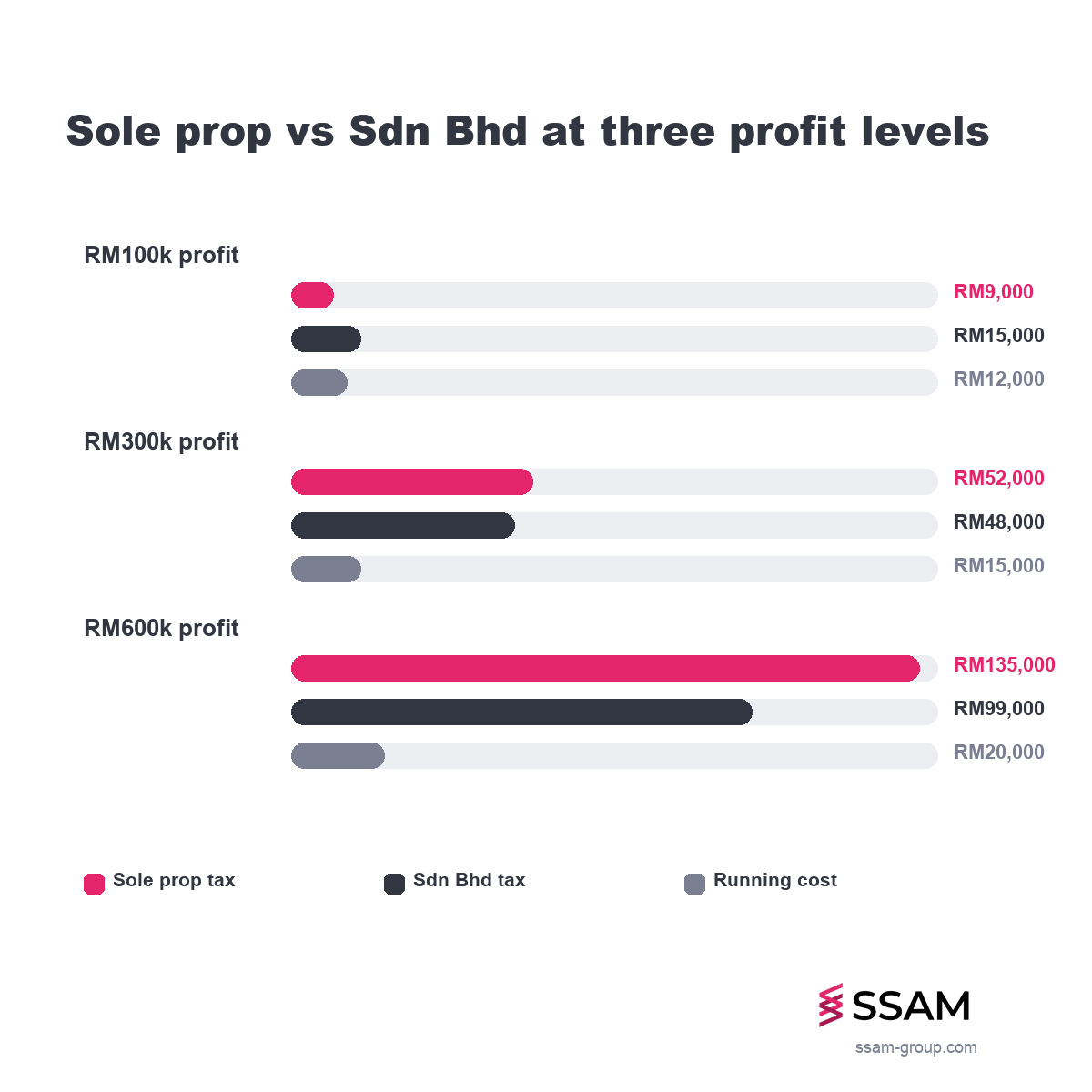
Headline rates only tell half the story. The table below estimates the all-in position for a single resident owner taking the full profit either as personal income (sole prop) or as a qualifying SME Sdn Bhd that retains profit after corporate tax. Figures are illustrative only and assume no other personal income and just the RM9,000 personal relief.
| Annual chargeable income | Sole prop tax (Form B) | SME Sdn Bhd tax (Form C) | Sdn Bhd running cost (est. annual) | Net position vs sole prop |
|---|---|---|---|---|
| RM100,000 | ~RM9,000 | RM15,000 | RM10,000 to RM14,000 | Sole prop wins by ~RM16,000 |
| RM300,000 | ~RM52,000 | RM48,000 | RM12,000 to RM18,000 | Roughly even or slightly worse |
| RM600,000 | ~RM135,000 | RM99,000 | RM15,000 to RM25,000 | Sdn Bhd saves ~RM11,000 to RM21,000 |
Profit at RM100,000: why a sole prop usually wins
At this level your personal tax is still gentle, with most of the income sitting in the 1 to 11% brackets. The SME Sdn Bhd's flat 15% rate on the first RM150,000 already looks higher than what you would pay personally. Add audit, secretary, tax agent and accounting fees and the gap widens. Unless you are converting for non-tax reasons (limited liability, big-client contracts, raising capital), staying as a sole prop is usually the cleaner move at this profit level.
Profit at RM300,000: the crossover zone
This is where most SSAM clients start asking the question. At RM300,000, your personal marginal rate climbs into the 24 to 25% bands while a qualifying Sdn Bhd pays a blended rate of roughly 16%. On paper, the Sdn Bhd saves around RM4,000 to RM5,000 in income tax. Once you layer on the running costs, you usually end up flat or slightly worse off. The case for converting here is often non-tax: cleaner liability separation, easier hiring, and contracts that require an incorporated entity. To plan around government incentives, the guide on tax incentives for SMEs in Malaysia is worth scanning.
Profit at RM600,000: where Sdn Bhd pulls ahead clearly
At RM600,000, your personal marginal rate runs into the 26 to 28% band while a qualifying Sdn Bhd still pays 15% on the first RM150,000 and 17% on the next RM450,000. The headline saving is roughly RM35,000 before compliance costs, which leaves real money on the table even after audit and secretary fees. At this profit level the question is less "should I convert" and more "what should I have done sooner". Capital expenditure planning becomes important too, and the guide on capital allowances in Malaysia covers how to plan the deductions a Sdn Bhd can claim on plant, machinery and motor vehicles.
Compliance costs you must add to the maths
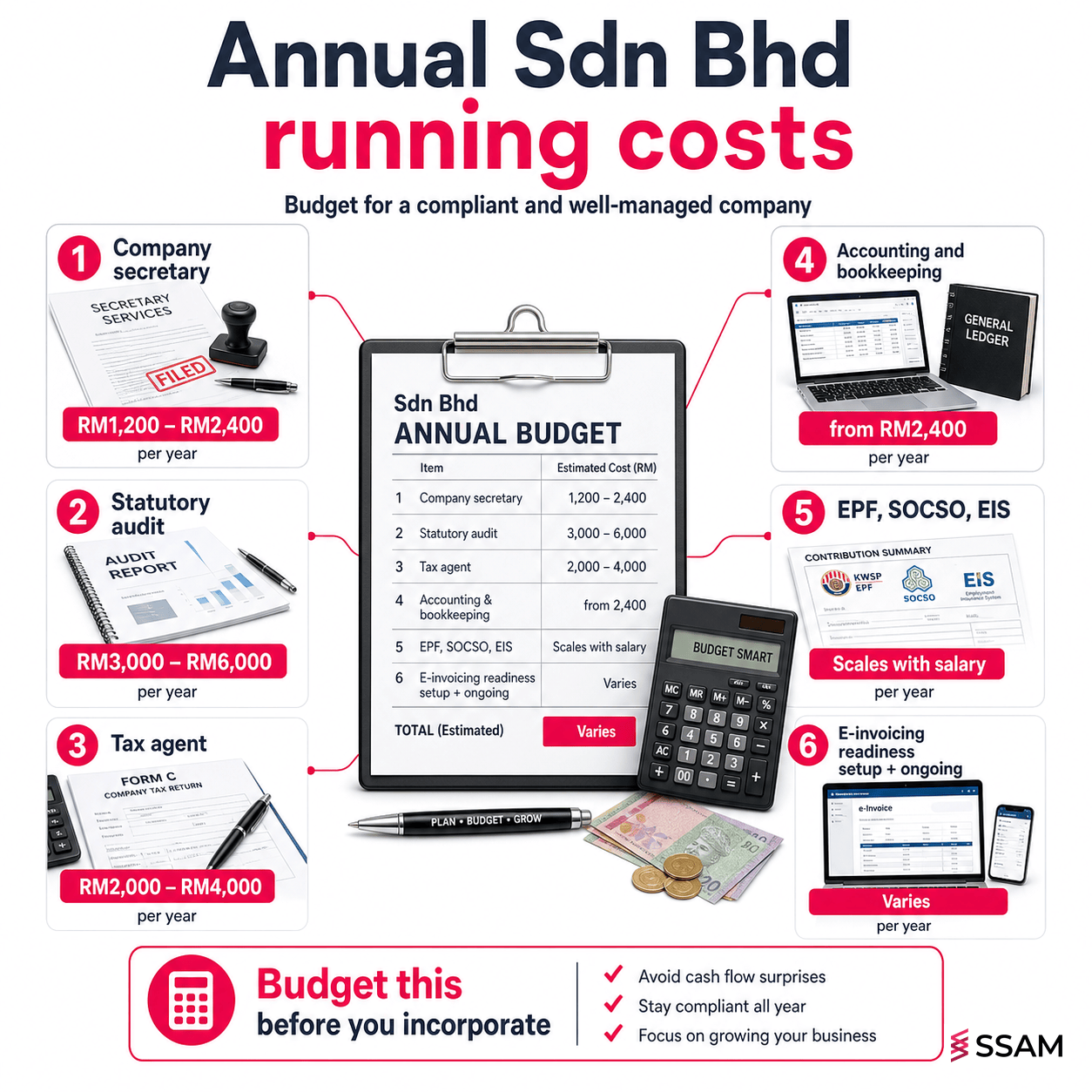
Sdn Bhd running costs are not optional. They are also the single biggest reason early conversions backfire. Build a realistic annual budget before you incorporate.
| Cost line | Typical annual range | Notes |
|---|---|---|
| Licensed company secretary | RM1,200 to RM2,400 | Mandatory under the Companies Act 2016. Must be appointed within 30 days of incorporation. |
| Statutory audit | RM3,000 to RM6,000 | Required unless the company qualifies for audit exemption. |
| Tax agent (Form C, CP204, CP204A) | RM2,000 to RM4,000 | Best handled by a MOF-licensed tax agent. |
| Accounting and bookkeeping | From RM2,400 per year | SSAM accounting starts at RM2,400 per year. |
| EPF, SOCSO, EIS | Scales with salary | Triggered once you draw a director's salary or hire staff. |
| E-invoicing readiness | Setup plus ongoing | System changes for invoice issuance and submission to LHDN. |
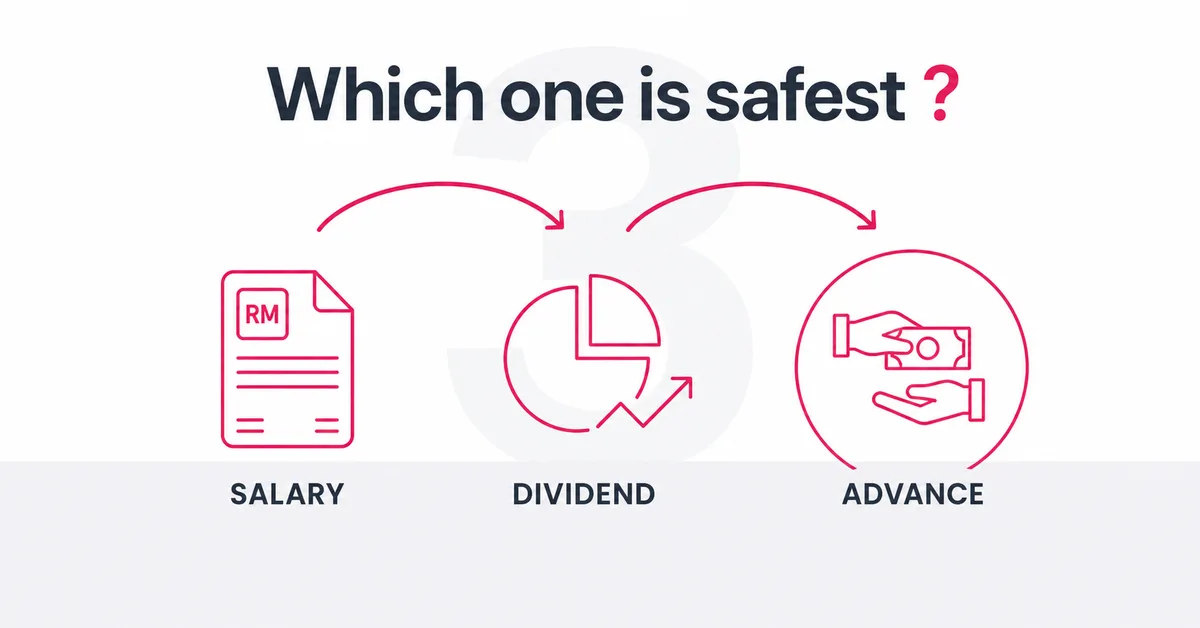
For a full line-by-line walkthrough, see Sdn Bhd running cost in Malaysia. If you plan to pay yourself out of the company, the comparison on advance to director vs salary vs dividend explains why structure matters as much as rate. Once the Sdn Bhd is up and running, the question shifts from "should I convert" to "how do I keep the tax bill down". Our deeper guide on how to reduce corporate tax Malaysia walks through the main legal levers, from reliefs and timing to capital allowance planning.
Beyond tax: limited liability and credibility
Most owners ask "how much tax will I save". The more strategic question is "what other risks and opportunities change when I convert". The Companies Act 2016 gives a Sdn Bhd its own legal identity, and that shift creates a few things you cannot replicate as a sole prop.
- Limited liability: as a sole prop, your business debts are your personal debts. A defaulted supplier invoice, a contract dispute or a workplace claim can reach your house, your car and your savings. A Sdn Bhd ringfences business risk inside the company, except where you have signed personal guarantees or breached director duties.
- Bigger contracts: many corporates, GLCs and government agencies will only contract with registered companies. If your buyers are moving up-market, your structure needs to keep up.
- Funding and shareholding: banks, investors and grant bodies are easier to engage with when you have audited accounts and a clean shareholding structure. The same applies when you bring in a partner.
- Succession: a Sdn Bhd survives the owner. A sole prop closes with you.
- Professional credibility: a registered Sdn Bhd often signals stability to clients, even when the business behind both structures is identical.
When unlimited liability becomes a real risk
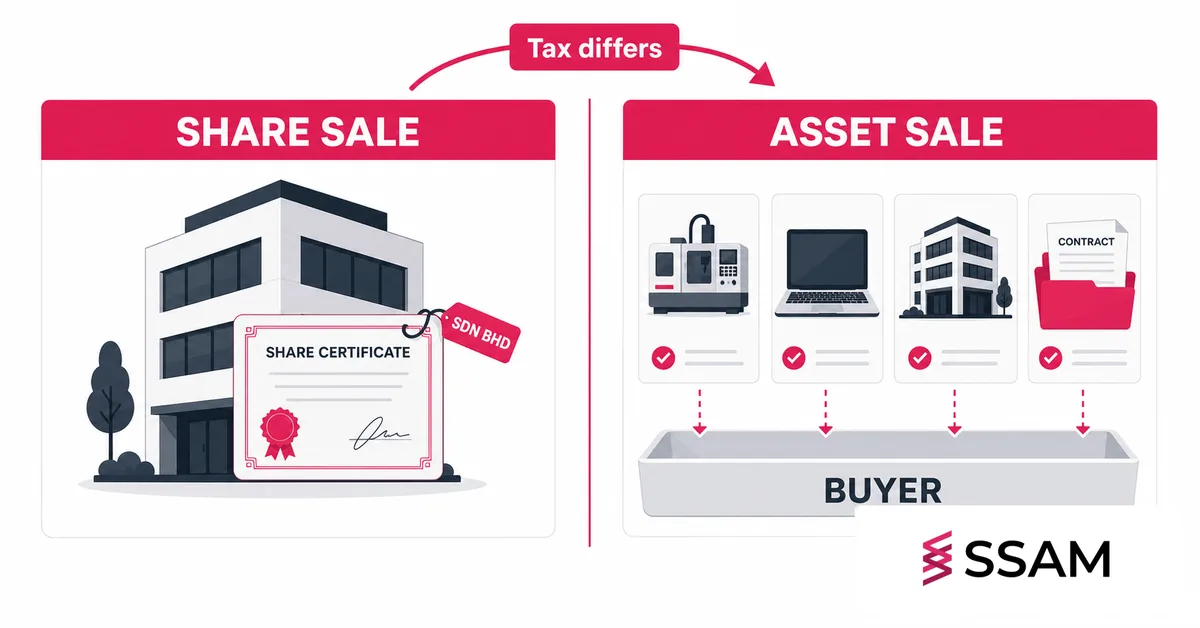
If your business signs material contracts, takes deposits from clients, hires staff, holds inventory or provides advice that could be challenged, unlimited liability is no longer a theoretical issue. Even one bad year can wipe out personal savings. At that point, converting is less about saving tax and more about protecting what you have already built. If selling the business is on the horizon, the way you exit also changes by structure. See capital gains tax on business sale in Malaysia for the post-CGT treatment, which became relevant for unlisted share disposals from 2024.
How to convert from sole prop to Sdn Bhd step by step
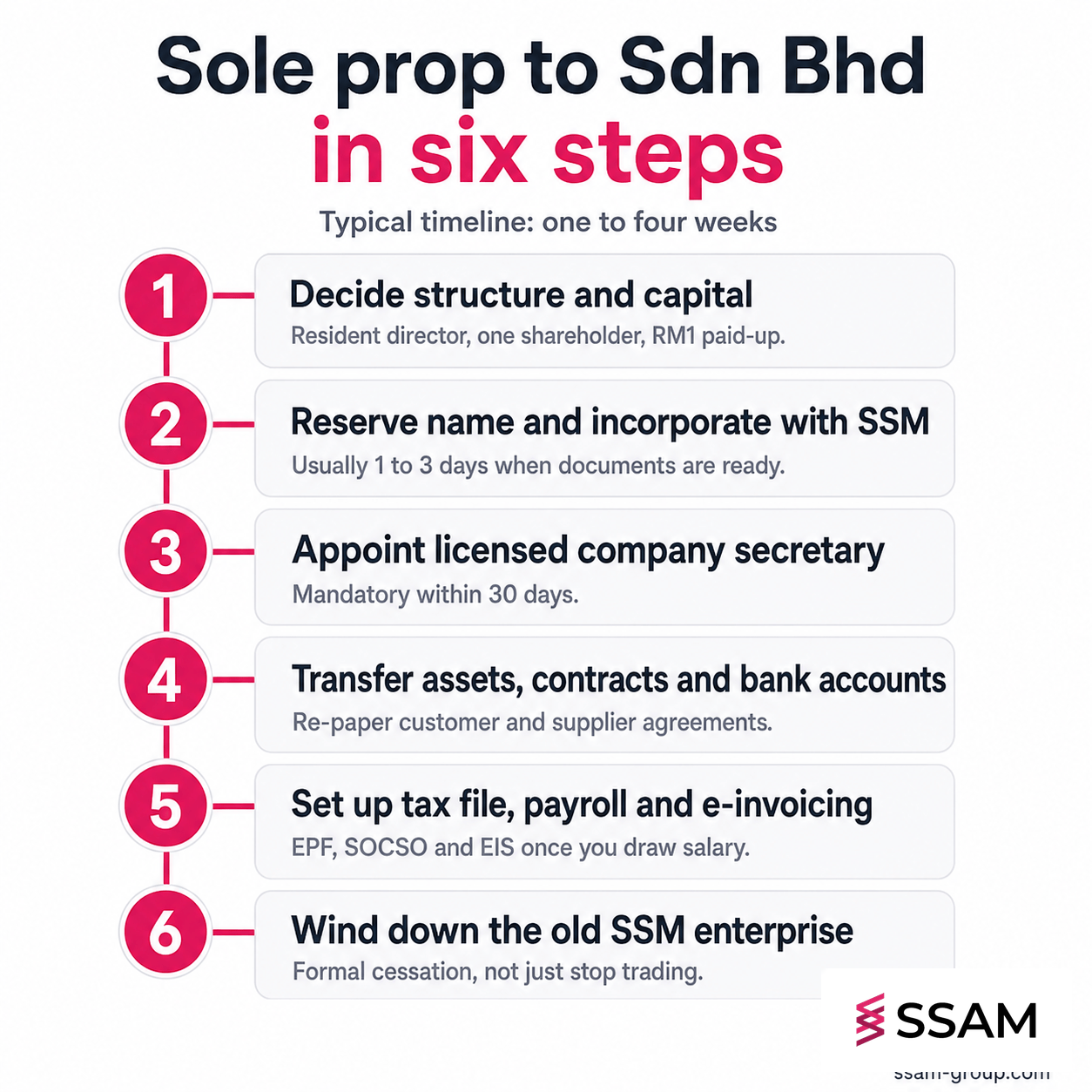
The mechanics are straightforward when documents are in order. End-to-end, the full sequence usually takes one to four weeks, depending on bank account setup and contract transfers.
Step 1: Decide structure and capital
You need at least one director with a principal place of residence in Malaysia (18 years or older, not disqualified under Section 198 of the Companies Act 2016), one shareholder (you can be both), one licensed company secretary, a Malaysia registered office, and minimum paid-up capital of RM1.
Step 2: Reserve name and incorporate via SSM
Lodge the name search and the incorporation form digitally with SSM. Registration typically takes 1 to 3 days once your documents are clean. See SSM registration in Malaysia for a fuller walkthrough of what to prepare.
Step 3: Appoint a licensed company secretary within 30 days
This is a statutory deadline under the Companies Act 2016. Missing it can trigger penalties. The secretary will set up your statutory registers, board resolutions and annual return calendar.
Step 4: Transfer assets, contracts and bank accounts
Open the Sdn Bhd's bank account, then re-paper your customer contracts, supplier agreements, software subscriptions and recurring payments in the company's name. Transfer plant and equipment at an agreed value. Keep the documentation tidy because LHDN will examine it during any future audit.
Step 5: Set up tax file, payroll and e-invoicing
Apply for the company's tax file, register as an employer for EPF, SOCSO and EIS once you draw a salary, set up PCB, and configure e-invoicing. First-year directors should also read up on their Sdn Bhd director tax obligations in Malaysia before the first filing window. Mark the Malaysia tax filing deadlines on your calendar so you do not miss CP204 or Form C dates.
Step 6: Wind down the old enterprise
Formally cease the old SSM sole prop registration. Do not just stop trading under the old name. A live but inactive SSM enterprise can create LHDN file confusion and renewal liabilities you no longer want.
Common mistakes Malaysian owners make when converting
Some patterns turn up again and again in real cases:
- Converting too early. Owners read about the 15% SME rate, forget the running costs, and end up with a higher all-in cost than they had as a sole prop.
- Paying themselves only via dividend. This leaves no EPF, no SOCSO and no clean salary trail for housing or hire-purchase loans. A balanced mix of director's salary and dividend is usually safer.
- Missing the 30-day company secretary deadline. One of the most common compliance breaches in newly incorporated SMEs.
- Forgetting to close the old SSM enterprise. It stays alive in the background, accruing renewal obligations and confusing LHDN's records.
- Mixing personal and company spending. Sole prop habits do not work in a Sdn Bhd. Personal use of company money becomes an advance to director, and that has its own tax risks.
- Skipping CP204 in year one. New directors often miss the first tax estimate window. The common tax filing mistakes Malaysian SMEs make covers most of these traps in detail.
What this means for you
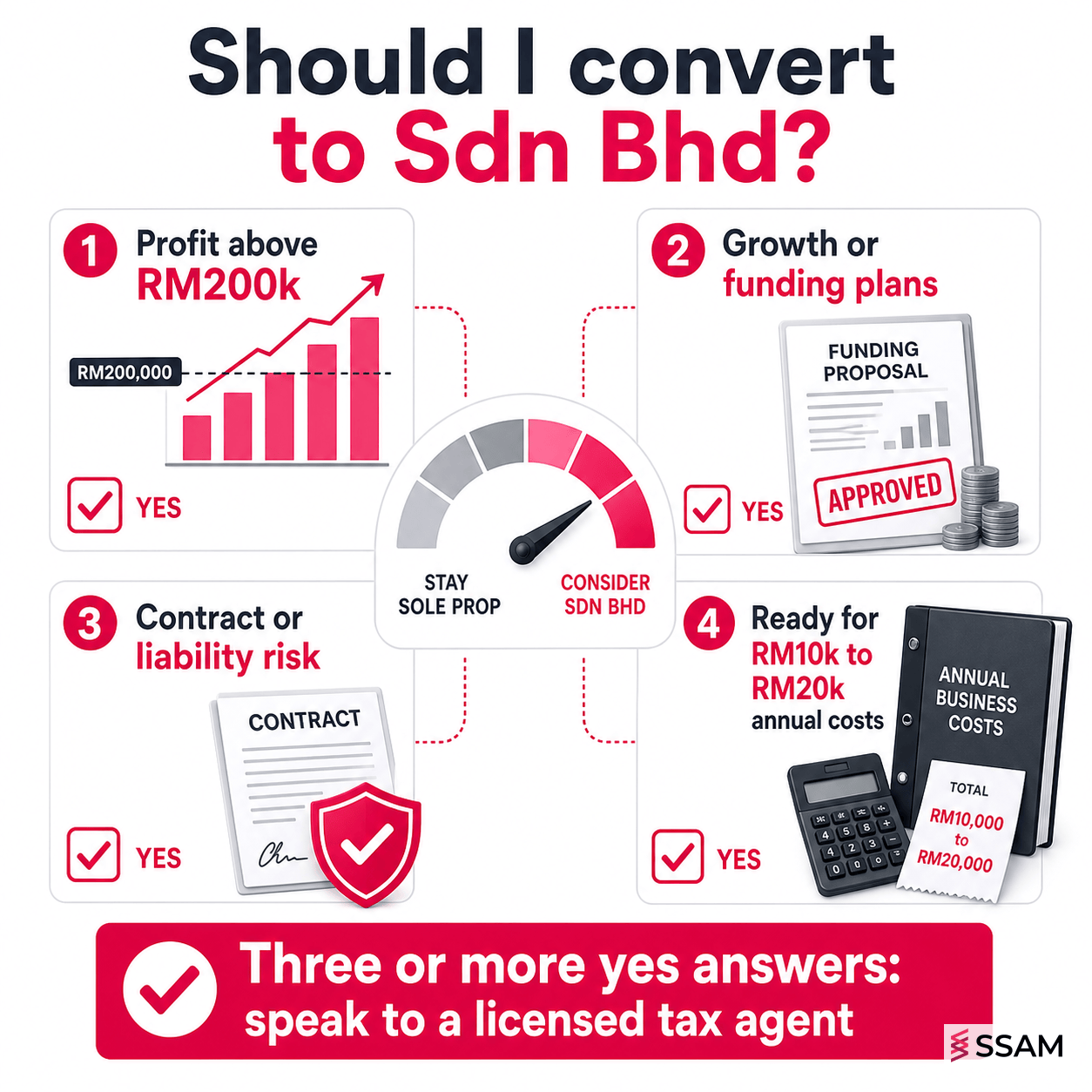
The conversion question is really three smaller questions stacked together. First, does the maths work at your current and expected profit level. Second, can you absorb the compliance costs without strain. Third, are there non-tax reasons (liability, contracts, succession) that already make the case on their own. If two of the three say yes, converting is usually the right move. If only one says yes, wait twelve months and reassess. Also keep an eye on policy. The 15%, 17% and 24% SME bands and the personal tax brackets can shift from one budget to the next, so review your breakeven number whenever new budget measures are announced.
If you would like an unbiased view on your specific numbers, SSAM Group's tax planning services in Kuala Lumpur has worked through this exact decision with 1,000+ Malaysian business owners across 40 years of practice. Speak to SSAM, or WhatsApp the team on +6011-6529 9879, for a straight, no-pitch review of your position. The wider picture of what professional support looks like is covered in our guide to tax consultant services in Kuala Lumpur.
Frequently asked questions
At what profit should I convert from sole proprietorship to Sdn Bhd in Malaysia?
For most service-line SMEs, the conversion starts to pay for itself once your annual chargeable income consistently reaches RM150,000 to RM200,000, and the savings become meaningful at around RM300,000 and above. Below that band, Sdn Bhd running costs usually erase the headline tax saving.
How much tax does a Sdn Bhd pay vs a sole proprietor in Malaysia?
A qualifying SME Sdn Bhd pays 15% on the first RM150,000 of chargeable income, 17% on the next RM450,000, and 24% above RM600,000. A sole proprietor pays personal income tax of 0 to 30% based on Malaysia's resident individual brackets, on top of any other personal income.
Can I convert my sole proprietorship to a Sdn Bhd without closing it first?
Not quite. Technically there is no "convert" function. You incorporate a new Sdn Bhd, move the assets, contracts and bank accounts over, then formally cease the old SSM enterprise. Skipping the cessation step is a common mistake.
Do I still need to file Form B after I convert to a Sdn Bhd?
You still file Form B as an individual for any personal income, including the salary or director's fee you take from the new Sdn Bhd. The company files Form C separately for its own corporate tax.
How long does it take to register a Sdn Bhd in Malaysia?
Incorporation via SSM usually takes 1 to 3 days once your documents are clean. The full setup, including bank account, secretary, tax file, EPF, SOCSO, EIS and contract transfers, often runs one to four weeks end to end.
Is a Sdn Bhd worth the extra compliance cost for a small business?
It depends on your profit level, your liability exposure and your growth plans. A profitable services business with corporate clients and staff will almost always benefit. A side business with low margins and no employee risk is often better off staying as a sole prop until the numbers shift.
Data sources and references
- LHDN, Tax Rate of Company: https://www.hasil.gov.my/en/company/tax-rate-of-company/
- LHDN, Individual Tax Rate: https://www.hasil.gov.my/en/individual/individual-life-cycle/income-declaration/tax-rate/
- PwC Worldwide Tax Summaries, Malaysia, Taxes on corporate income: https://taxsummaries.pwc.com/malaysia/corporate/taxes-on-corporate-income
- SSM Malaysia: https://www.ssm.com.my/
- KWSP (EPF): https://www.kwsp.gov.my/
- PERKESO (SOCSO): https://www.perkeso.gov.my/
The information in this article is provided for general informational purposes only and does not constitute tax, accounting, financial or legal advice. Tax laws change frequently and may not apply to your situation. Always consult a qualified professional before acting on any information here.