

Key Takeaways
- There is no single right answer. Buying a car under your Sdn Bhd pays off for some owners and costs more for others, depending on the price of the car and how much it is used for business.
- A company can claim capital allowances on a vehicle, but qualifying expenditure on most cars is capped at RM100,000, and at only RM50,000 for cars costing more than RM150,000.
- The cost most owners forget is benefit-in-kind. If you use a company car privately, a taxable benefit is added to your personal income, which can erase the company saving.
- Commercial vehicles such as pickups, lorries and vans are treated more generously, with no qualifying expenditure cap.
- For an expensive car with heavy personal use, personal ownership is often simpler and cheaper once you count benefit-in-kind, financing and insurance.
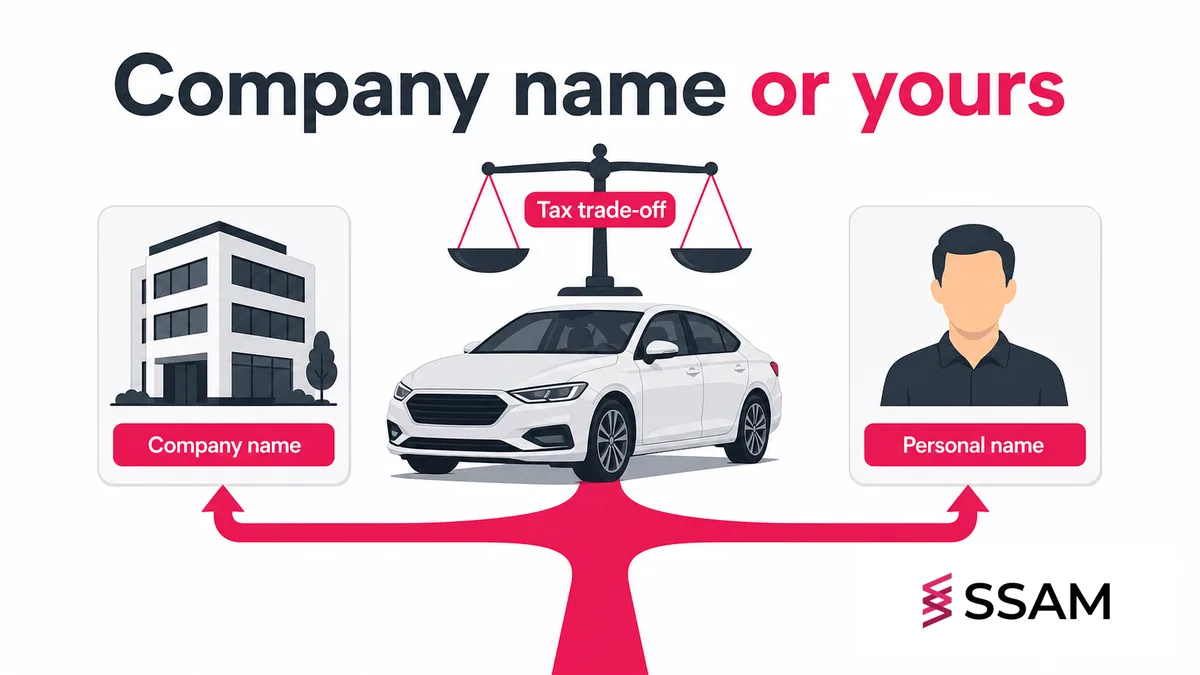
Working out the company car Sdn Bhd tax position in Malaysia comes down to one question: who should own the vehicle for the best after-tax result, your company or you. It is one of the most common questions SME owners ask near financial year end, and the popular answer of always buy under the company is too simple. The right choice depends on the price of the car, how much you use it for business, and whether it is a commercial vehicle.
This guide gives you the full picture, including the benefit-in-kind charge that many guides leave out. Read it before you sign a hire-purchase agreement, because the registration decision is hard to undo later. Confirm the current rates for your own numbers before you file.
Company Car vs Personal Car: The Tax Difference
When your Sdn Bhd owns a car, the company can claim capital allowances on the cost and deduct running costs that relate to business use, which lowers its chargeable income. In return, any private use of that car creates a taxable benefit for you as the director, and the company carries the financing, insurance and record-keeping.
When you own the car personally, none of those company deductions apply, but there is no benefit-in-kind, financing is usually cheaper, and the admin is far lighter. The tax difference, then, is a trade-off. You are weighing the company's deductions against the personal tax and higher costs that come with company ownership. The size of that trade-off changes with the value of the car.
Should You Buy a Car Under Your Company?
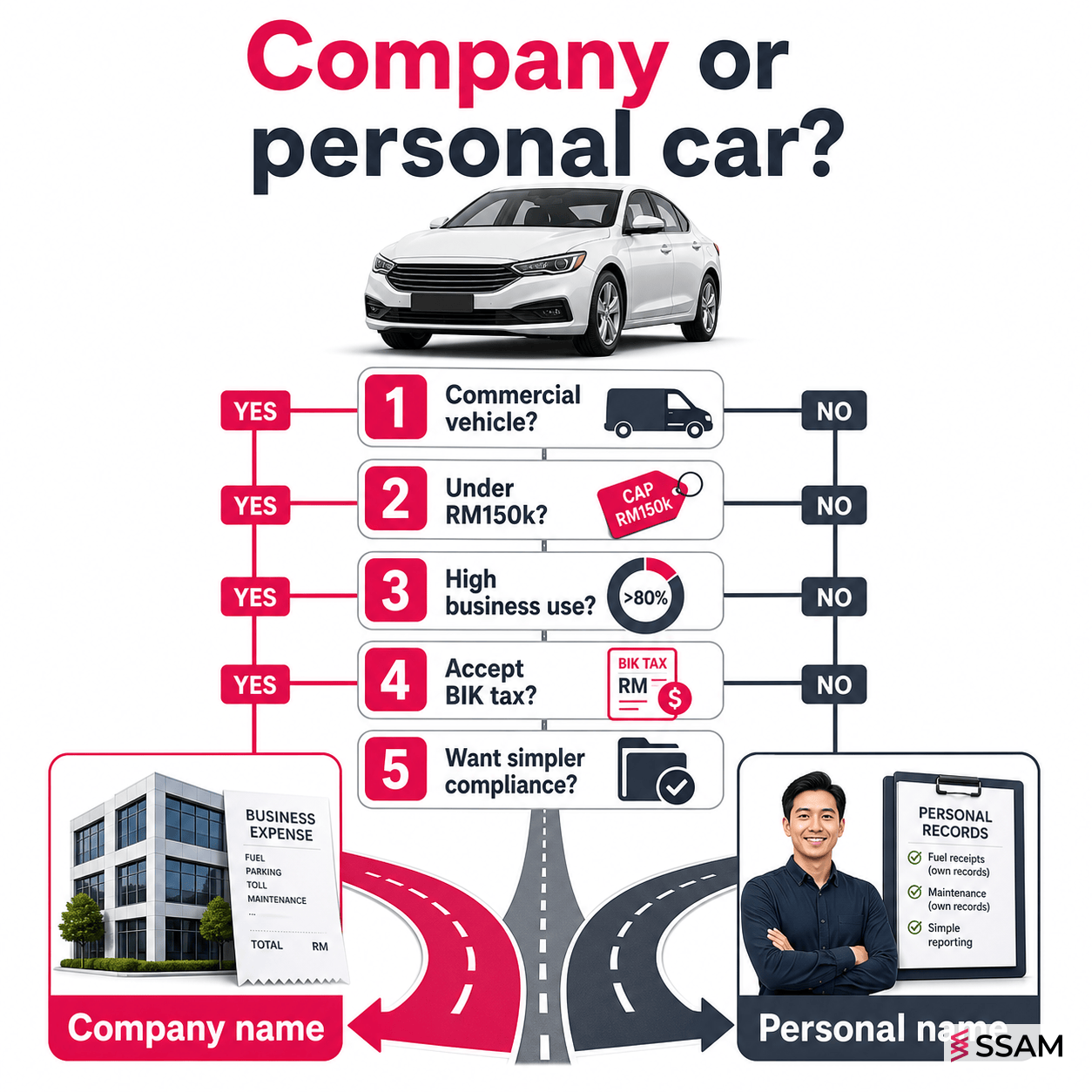
Buy a car under your Sdn Bhd when it is a genuine business vehicle, when the price is at or below RM150,000, and when business use is high. Company ownership lets you claim capital allowances and running costs. It works against you on expensive cars, because qualifying expenditure is capped, and on cars with heavy private use, because the benefit-in-kind charge falls on you personally.
Capital Allowances on Company Vehicles
A car is a capital asset, so the company cannot deduct the purchase price in one go and cannot deduct accounting depreciation. Instead it claims capital allowances, the same mechanism that applies to other qualifying business assets. For motor vehicles this is typically an initial allowance of 20 percent in the year of purchase and an annual allowance of 20 percent in the following years, spreading the relief over several years.
Qualifying Expenditure Limits (RM50k / RM100k)
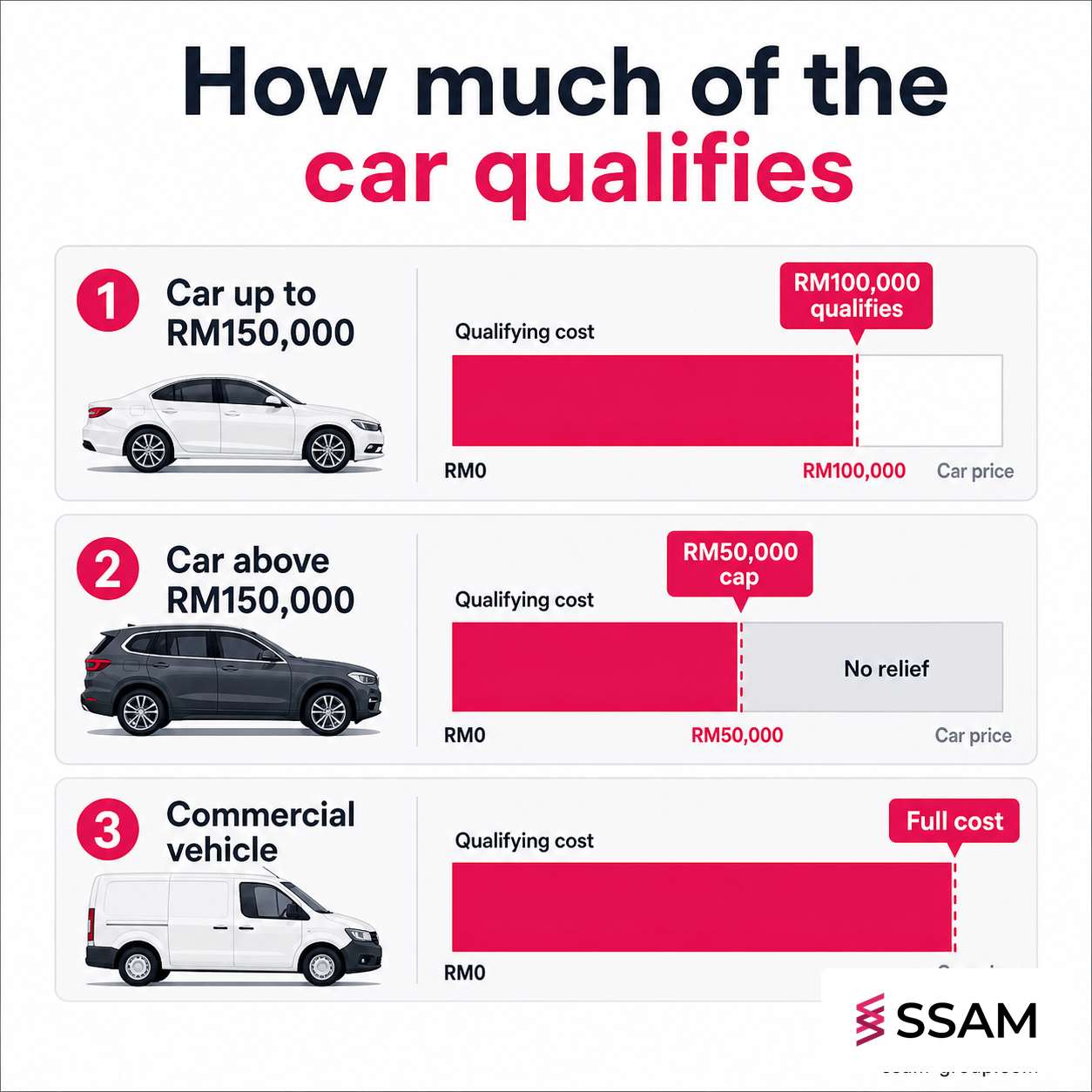
The catch is that capital allowances on most passenger cars are not based on the full price. They are based on qualifying expenditure, which is capped.
| Vehicle | Qualifying expenditure for capital allowances |
|---|---|
| New car costing RM150,000 or less | Up to RM100,000 |
| New car costing more than RM150,000 | Capped at RM50,000 |
| Used car costing under RM50,000 | Full cost |
| Commercial vehicle (pickup, lorry, van) | Full cost, no cap |
So a RM250,000 luxury car only gives your company capital allowances on RM50,000 of cost. The other RM200,000 never produces tax relief. That single rule is why expensive cars often make poor company purchases.
Commercial vs Non-Commercial Vehicles
Commercial vehicles are treated far more generously. A pickup, lorry or van used in the business qualifies for capital allowances on its full cost with no cap, and it does not attract the same benefit-in-kind treatment as a private passenger car. If your work genuinely needs a commercial vehicle, the maths usually favours company ownership comfortably.
Benefit-in-Kind: The Hidden Tax Cost
This is the part most online advice skips, and it changes the decision. When a company provides a car that you also use privately, the value of that private use is a benefit-in-kind. It is added to your gross employment income, reported in your EA form, and it increases your personal tax and monthly tax deduction. In other words, the company saves tax through capital allowances while you pay more personal tax on the benefit. For high private use, the personal cost can cancel out much of the company gain.
Prescribed Value vs Formula Method
LHDN allows two ways to value the car benefit. The prescribed value method uses a fixed annual amount based on the car's cost, plus a separate value for fuel provided. The formula method takes the cost of the car divided by eight years, multiplied by 80 percent.
| Cost of car (RM) | Prescribed annual benefit value (RM) |
|---|---|
| Up to 50,000 | 1,200 |
| 100,001 to 150,000 | 5,000 |
| 250,001 to 350,000 | 15,000 |
| 500,001 and above | 25,000 |
The table above is a representative extract. A separate value applies where the company also pays for fuel. Confirm the full band table and fuel values in the current LHDN public ruling before you rely on them.
Running Costs You Can and Cannot Claim
If the company owns the car and uses it for business, it can generally deduct running costs such as fuel, road tax, insurance, servicing and repairs, in proportion to business use. Private-use portions are not deductible and feed into the benefit-in-kind instead.
Financing is where another cap appears. Where a car costs more than the qualifying expenditure limit, the deduction for hire-purchase interest is restricted in the same proportion, so part of your interest cost gives no relief. Company registration also tends to bring higher hire-purchase interest rates and commercial insurance premiums than personal ownership, which are real cash costs even when partly deductible. Our guide to Sdn Bhd running costs puts these alongside the other costs of running a company.
When Personal Ownership Makes More Sense
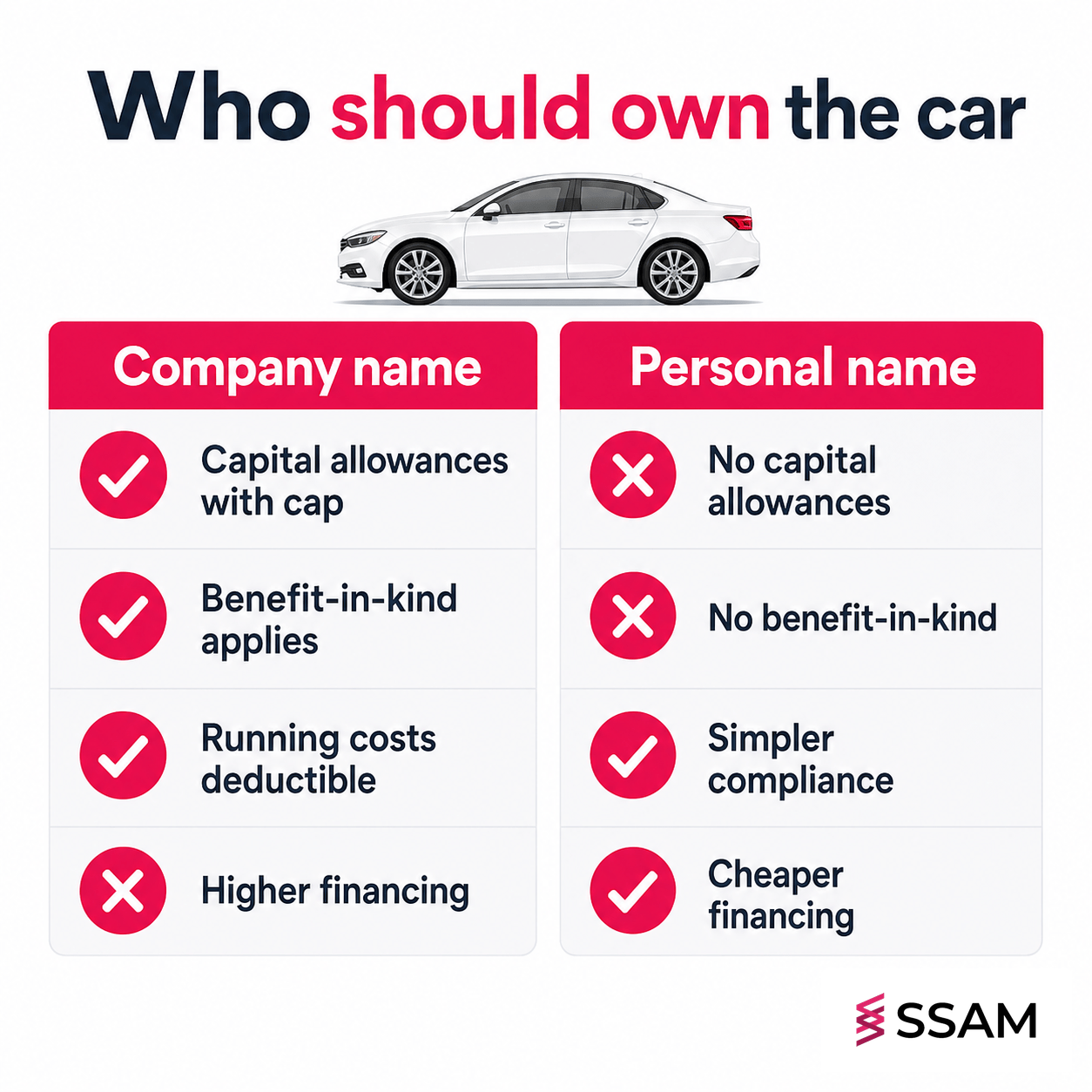
Personal ownership often wins in three situations. The first is an expensive car, because qualifying expenditure is capped at RM50,000 once the price passes RM150,000, so most of the cost gives no company relief. The second is heavy private use, because the benefit-in-kind charge on you can outweigh the company's allowance. The third is when you simply value simplicity, since personal ownership avoids EA reporting, balance-sheet entries and the extra compliance that comes with a company asset. This personal-versus-company question runs through many tax decisions, including the larger choice between a sole proprietorship and a Sdn Bhd.
A quick way to decide is to compare the company's capital allowance and running-cost savings against your extra personal tax on the benefit-in-kind plus the higher financing and insurance. If the car is modest, business use is high, or it is a commercial vehicle, the company usually wins. If the car is a costly passenger vehicle used mainly for personal driving, your own name is often the cheaper home for it. Because the benefit-in-kind sits on the director, this decision links closely to your wider Sdn Bhd director tax obligations. It also interacts with how you pay yourself overall, which we cover in our guide to taking an advance to a director versus salary and dividend.
Speak to SSAM Before a Year-End Purchase
The vehicle decision is easy to get wrong because the headline saving from capital allowances is visible while the benefit-in-kind cost is hidden until your personal assessment. Before you buy, run both sides of the comparison for your actual car price and business-use level, and remember that commercial vehicles follow friendlier rules.
If you are planning a purchase before your financial year end, this is a good moment to get a quick second opinion. A company vehicle is just one lever in a wider plan to reduce corporate tax legally and to claim the tax incentives for SMEs you qualify for, and if a sale is ever on the horizon it pays to understand the capital gains tax on a business sale too. SSAM Group is a licensed tax agent whose tax planning in Kuala Lumpur helps Malaysian SME owners weigh decisions like this in plain numbers. Speak to SSAM before you sign, and you can register the car the right way the first time.
Frequently Asked Questions
Should I buy a car under my company or personal name in Malaysia?
It depends on the car and how you use it. Company ownership suits genuine business vehicles priced at or below RM150,000 with high business use, because you claim capital allowances and running costs. Personal ownership often wins for expensive cars or heavy private use, once benefit-in-kind and higher financing are counted.
Can my Sdn Bhd claim the full cost of a car?
Usually not for passenger cars. Capital allowances are based on qualifying expenditure, which is capped at RM100,000 for cars costing up to RM150,000 and at RM50,000 for cars above that. Commercial vehicles such as pickups and vans qualify on their full cost with no cap.
How is benefit-in-kind on a company car calculated?
LHDN allows a prescribed value based on the car's cost band, plus a separate fuel value, or a formula of cost divided by eight years multiplied by 80 percent. The resulting amount is added to your employment income in the EA form and taxed personally.
Are pickups and commercial vehicles treated differently?
Yes. Commercial vehicles used in the business qualify for capital allowances on their full cost without the RM50,000 or RM100,000 cap, and they do not carry the same passenger-car benefit-in-kind. This often makes company ownership clearly worthwhile for genuine work vehicles.
Can I claim petrol, insurance, and road tax on a company car?
If the company owns the car and uses it for business, fuel, insurance, road tax, servicing and repairs are generally deductible in proportion to business use. The private-use share is not deductible and is reflected in the benefit-in-kind instead.
Data Sources and References
- LHDN Public Ruling on Benefits in Kind (prescribed values and formula method): https://www.hasil.gov.my
- PwC Worldwide Tax Summaries, Malaysia (capital allowances and motor vehicle limits): https://taxsummaries.pwc.com/malaysia
The information in this article is provided for general informational purposes only and does not constitute tax, accounting, financial or legal advice. Tax laws change frequently and may not apply to your situation. Always consult a qualified professional before acting on any information here.