

Key Takeaways
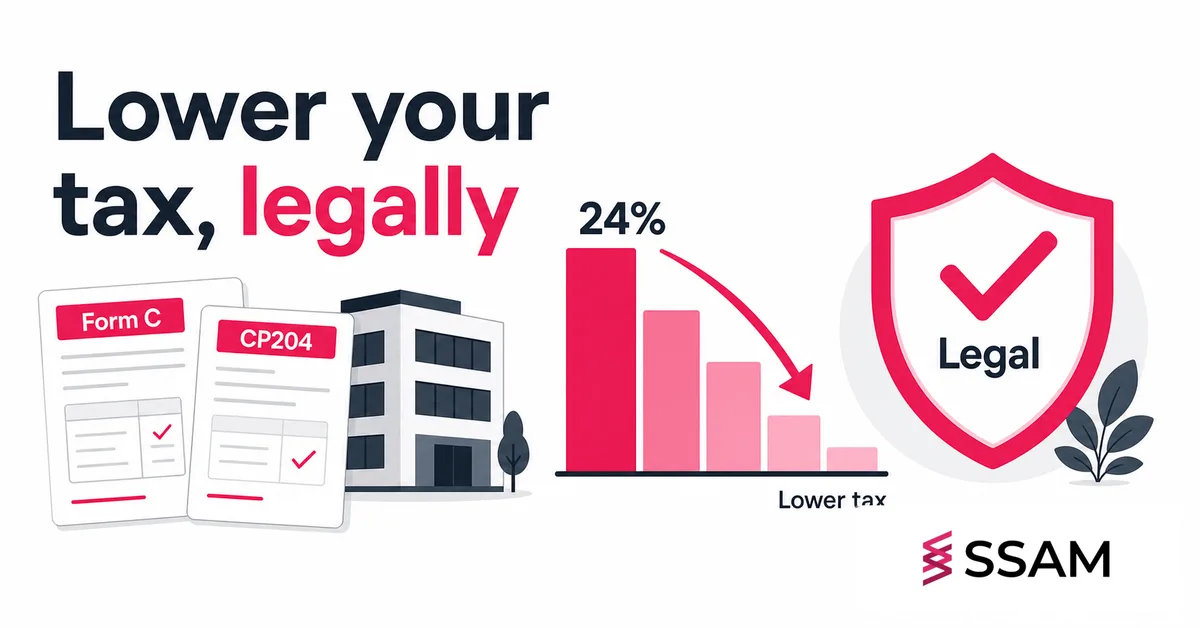
- Reducing corporate tax in Malaysia is legal when you use the deductions, capital allowances and incentives the law provides. The line you must never cross is hiding income or inventing expenses.
- Most savings come from three levers: claiming every allowable expense, maximising capital allowances on assets, and matching your company to the right incentive.
- Qualifying SMEs pay a lower rate on their first slices of chargeable income, so accurate accounts and correct classification matter more than aggressive schemes.
- Timing helps. Bringing forward qualifying asset purchases before your financial year end and filing an accurate CP204 estimate can both reduce and smooth your tax.
- The 2026 Budget added an accelerated capital allowance window and a new tax on large individual dividends, both of which change the planning maths for owners.
If you run a Sdn Bhd and feel your tax bill is heavier than it should be, understanding how to reduce corporate tax in Malaysia legally is one of the most useful skills you can build as a business owner. Many profitable Malaysian SMEs overpay every year, not because they are careless, but because nobody showed them which deductions, allowances and incentives they were entitled to claim.
This guide walks through the highest-impact, LHDN-compliant ways to lower what your company pays. It also draws a clear line between legal tax planning and illegal tax evasion, so you can act with confidence rather than worry about triggering an audit. The figures below reflect current Malaysian rules, but tax law changes often, so treat this as a planning map and confirm the specifics for your own accounts before you file.
How Corporate Tax Works for Malaysian Companies
Before you can lower your tax, you need to know what you are actually taxed on. Malaysian companies are taxed on their chargeable income, not their revenue. Chargeable income is what remains after you subtract allowable expenses, capital allowances and any incentives from your gross income. Two companies with the same sales can pay very different tax simply because one claims everything it is entitled to and the other does not.
Companies are assessed on a current-year basis and must submit the Form C return within seven months of their financial year end. During the year you also estimate your tax through the CP204 and pay it in monthly instalments, which we cover later under timing.
SME vs Non-SME Tax Rates
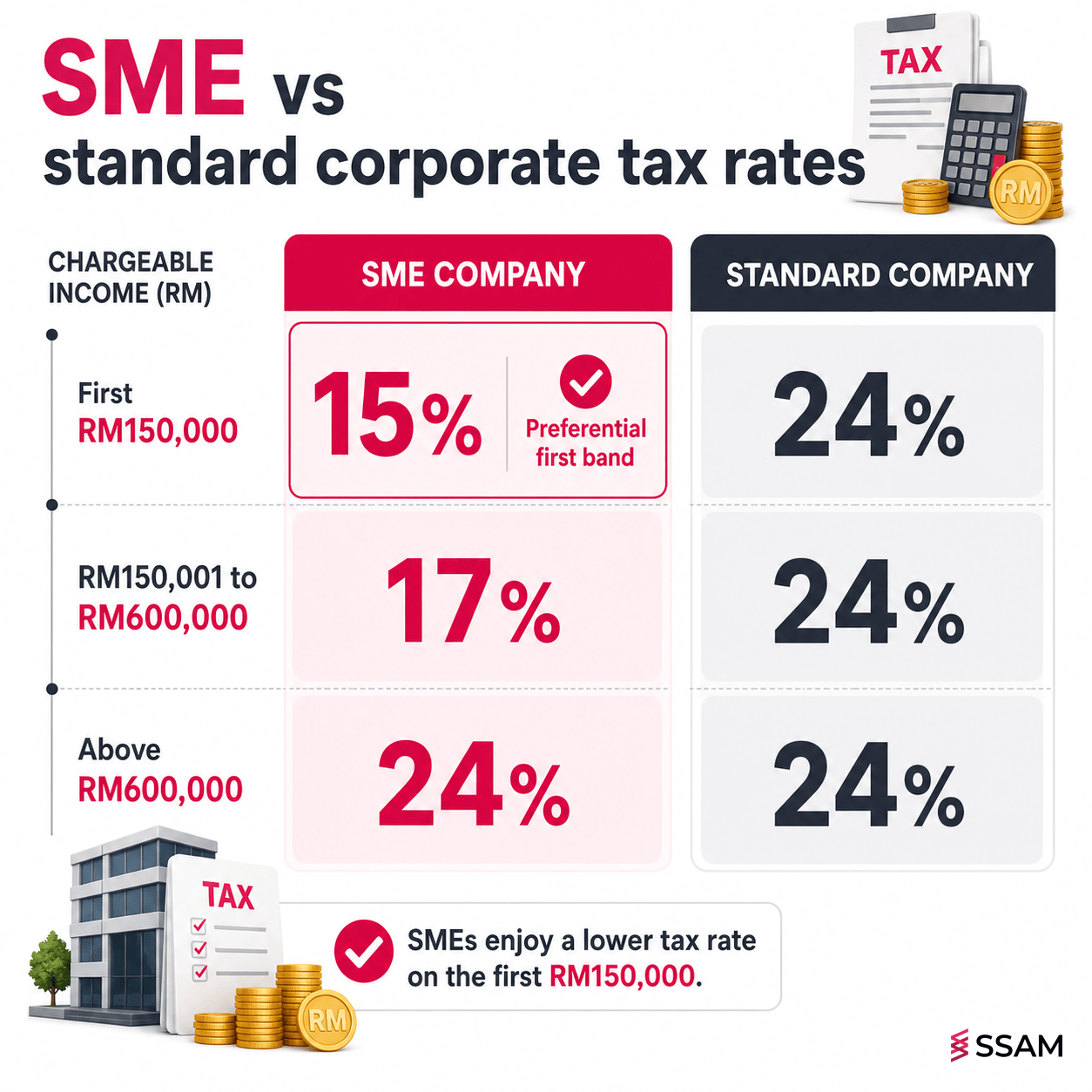
Malaysia gives qualifying small and medium companies a preferential rate on their lower income bands. A resident SME with paid-up capital of RM2.5 million or less and annual gross business income not exceeding RM50 million pays a reduced rate on its first slices of chargeable income, while larger companies pay the flat rate on everything.
| Chargeable income band | Qualifying SME rate | Non-SME rate |
|---|---|---|
| First RM150,000 | 15% | 24% |
| RM150,001 to RM600,000 | 17% | 24% |
| Above RM600,000 | 24% | 24% |
To qualify as an SME for these rates your company must not be more than 20 percent owned by foreign interests, and must not be part of a group where a related company exceeds the RM2.5 million paid-up capital threshold. If you are close to these limits, how you structure ownership and group relationships can decide whether you keep the lower rate. If you have not settled on a structure yet, our comparison of sole proprietorship versus Sdn Bhd tax is a useful starting point.
How Chargeable Income Is Calculated
Think of chargeable income as a funnel. Start with gross income, remove allowable business expenses, then deduct capital allowances on your assets, then apply any incentives or approved allowances. The narrower you make that funnel through legitimate claims, the lower your tax. Every section below is simply a different way to widen one of those deductions without breaking the rules.
Is It Legal to Reduce Corporate Tax in Malaysia?
Yes, reducing corporate tax in Malaysia is legal when you do it through tax planning. Tax planning and tax avoidance mean arranging your affairs to use the deductions, allowances and incentives the law allows. Tax evasion means hiding income, faking expenses or misreporting figures, which is a criminal offence. The difference is simple. Planning works within the rules, evasion breaks them.
LHDN actively encourages businesses to claim the reliefs they are entitled to. What it pursues is dishonesty, such as undeclared cash sales, personal costs dressed up as business expenses, or invoices for services that never happened. Stay on the planning side of that line and you have nothing to fear from a review.
Claim Every Allowable Business Expense
The simplest way to lower chargeable income is to make sure you claim every expense that was incurred wholly and exclusively in producing your income. Many SMEs lose money here by failing to keep receipts or by leaving legitimate costs off the books.
Common Deductible Expenses
Typical allowable expenses include staff salaries and EPF and SOCSO contributions, rental of business premises, utilities, marketing and advertising, professional fees, business insurance, repairs and maintenance, and the financing interest on loans used for the business. Keeping the hidden costs of compliance organised also matters, and our guide to Sdn Bhd running costs sets out what to budget for.
Expenses LHDN Commonly Disallows
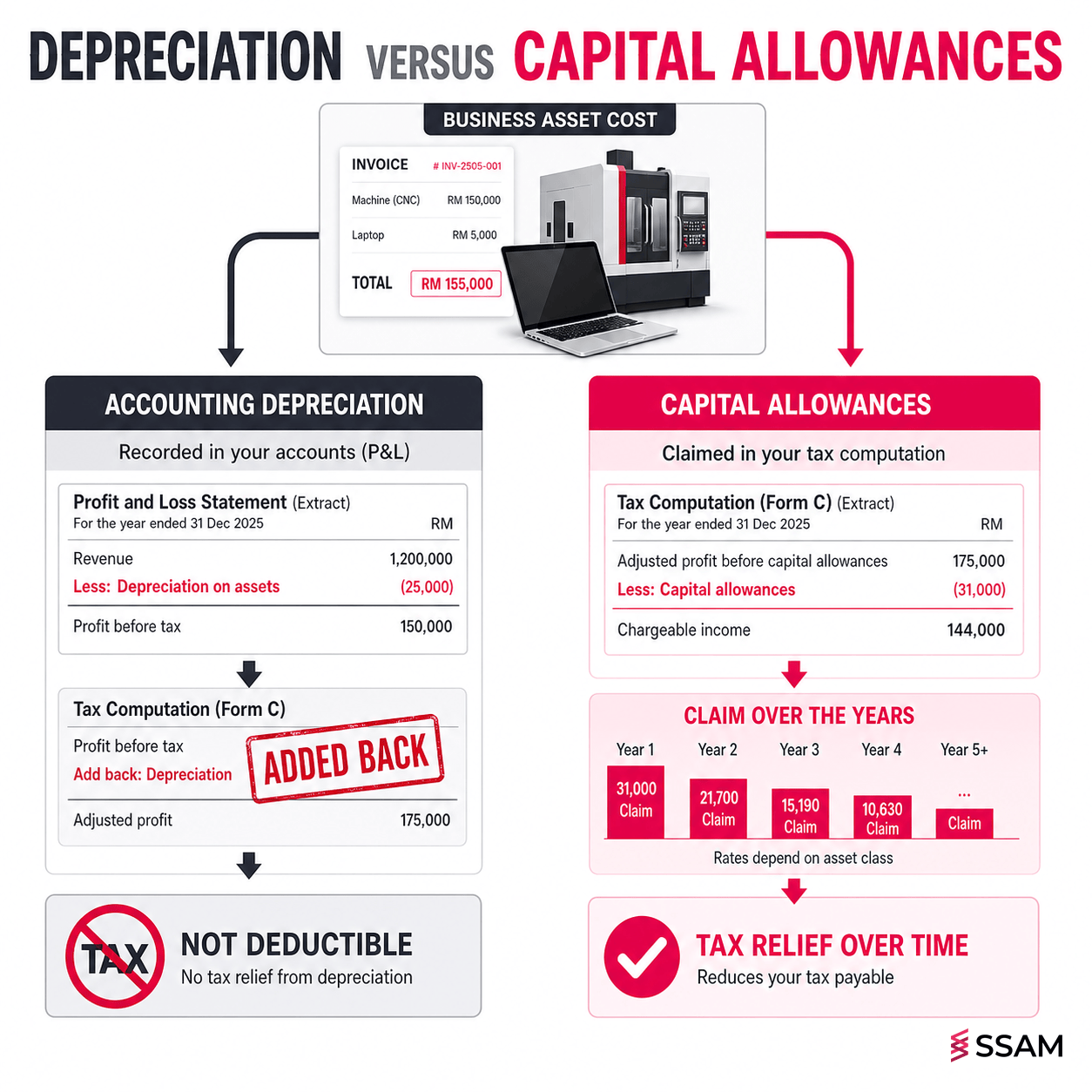
Not everything is deductible. Private and domestic expenses, your own drawings, general provisions, fines and penalties, and capital expenditure claimed as if it were a running cost are commonly disallowed. Entertainment is often restricted to half the amount unless it meets specific conditions. Depreciation in your accounts is never deductible, which is exactly why capital allowances exist.
Maximise Capital Allowances on Assets
When you buy assets such as machinery, computers, office equipment or commercial vehicles, you cannot deduct the cost as an ordinary expense and you cannot deduct accounting depreciation. Instead you claim capital allowances, which spread tax relief on the cost of the asset over time. For most businesses this is the single largest planning lever after everyday expenses.
Capital allowances usually combine an initial allowance in the year of purchase with an annual allowance for the following years, with the rates depending on the asset type. Used well, they can significantly reduce chargeable income in the years you invest in your business. Our dedicated guide to capital allowances breaks down the rates and worked examples in full.
Accelerated Capital Allowance for 2026
The 2026 Budget introduced an accelerated capital allowance for qualifying capital spending made between 11 October 2025 and 31 December 2026, covering categories such as heavy machinery, plant and machinery, and ICT equipment and software. An accelerated allowance lets you write off a larger portion of the cost sooner, which brings forward your tax relief. If you were already planning to invest, aligning the purchase with this window can improve your cash flow. Confirm the qualifying categories and rates before you rely on them.
Tax Incentives Every Business Should Check
Malaysia offers a wide range of incentives to encourage investment, exports, automation and activity in priority sectors. Many SMEs never check whether they qualify, and leave real savings on the table. Our guide to tax incentives for SMEs goes deeper, but the essentials are below. Match your activity to the incentive, then confirm eligibility with the relevant authority.
Pioneer Status and Investment Tax Allowance
Companies in promoted activities or products may apply for Pioneer Status, which exempts a portion of statutory income for a set period, or for the Investment Tax Allowance, which gives an allowance of 60 percent of qualifying capital expenditure to set against statutory income. These are usually alternatives rather than claimed together, so the right choice depends on whether your business is profit-rich or capital-intensive.
Reinvestment Allowance
Established manufacturing companies that reinvest in expansion, automation or modernisation may claim a reinvestment allowance on qualifying capital expenditure. This rewards businesses that put profits back into growing capacity rather than extracting them.
Start-Up SME Tax Rebate
Newly incorporated qualifying SMEs may be entitled to a tax rebate in their early years of assessment, intended to offset some of the cost of getting started. Eligibility conditions and time limits apply, so verify your company qualifies before counting on it.
Structure Director Pay for Tax Efficiency
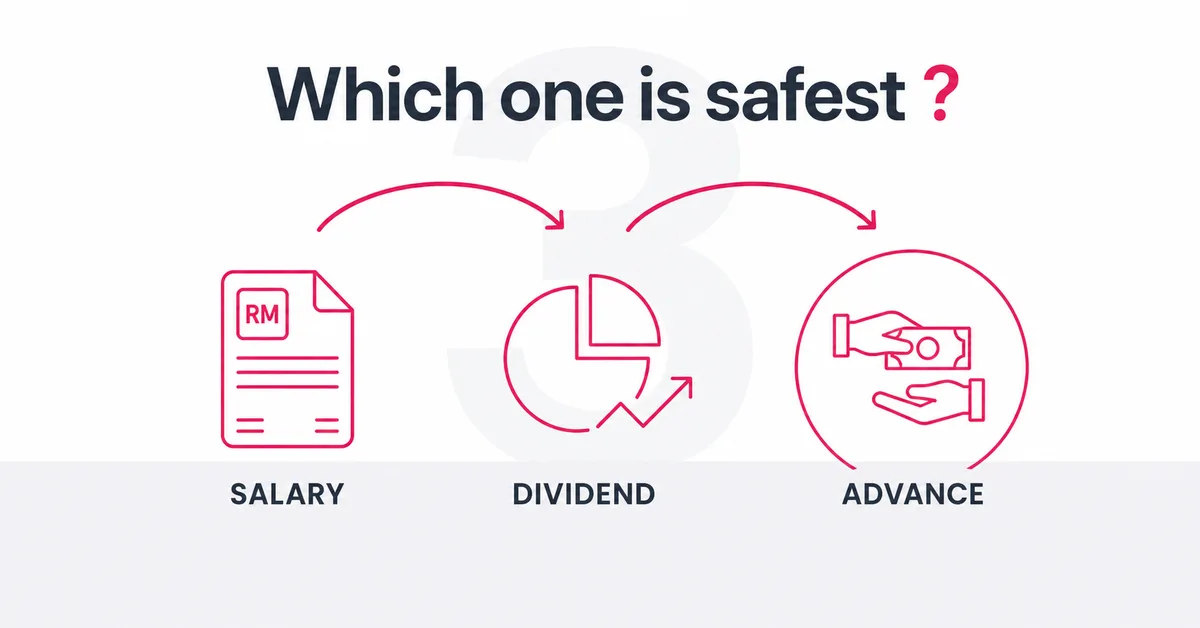
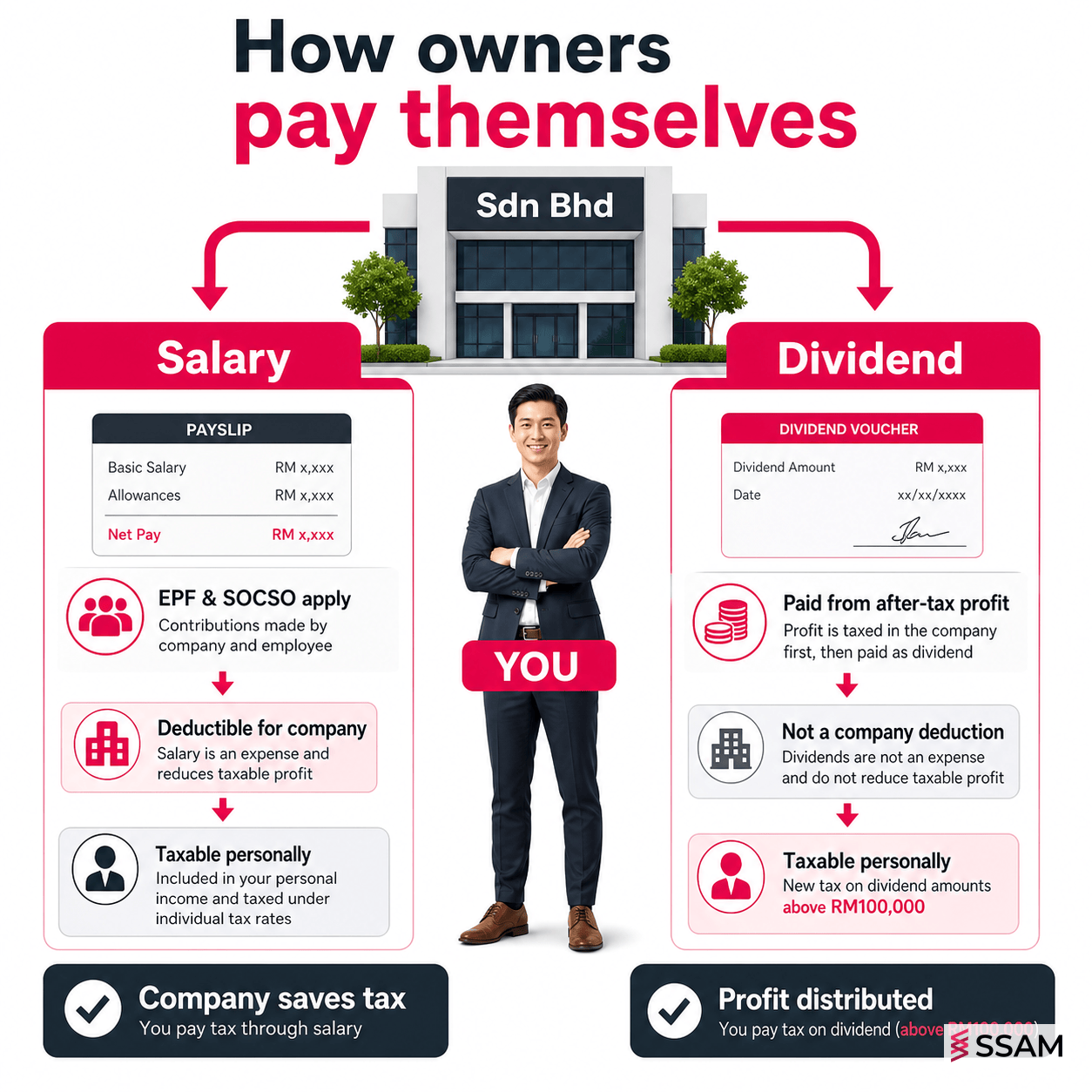
How owners pay themselves affects tax at both the company and the personal level. A director salary is a deductible expense for the company, which lowers its chargeable income, but it is taxable in the director's hands and carries EPF and statutory contributions. Dividends are paid from after-tax profit, so they do not reduce company tax, but they have traditionally been received without further personal tax.
The 2026 planning picture changed with the introduction of a tax on individual dividend income above RM100,000 a year. That shifts the balance for owners who take large dividends, and makes the salary, bonus and dividend mix worth modelling carefully. Our comparison of taking an advance to a director versus salary and dividend works through the trade-off in detail. In the meantime, the right blend depends on your profit level, personal tax bracket and cash needs.
Time Your Income and Purchases Wisely
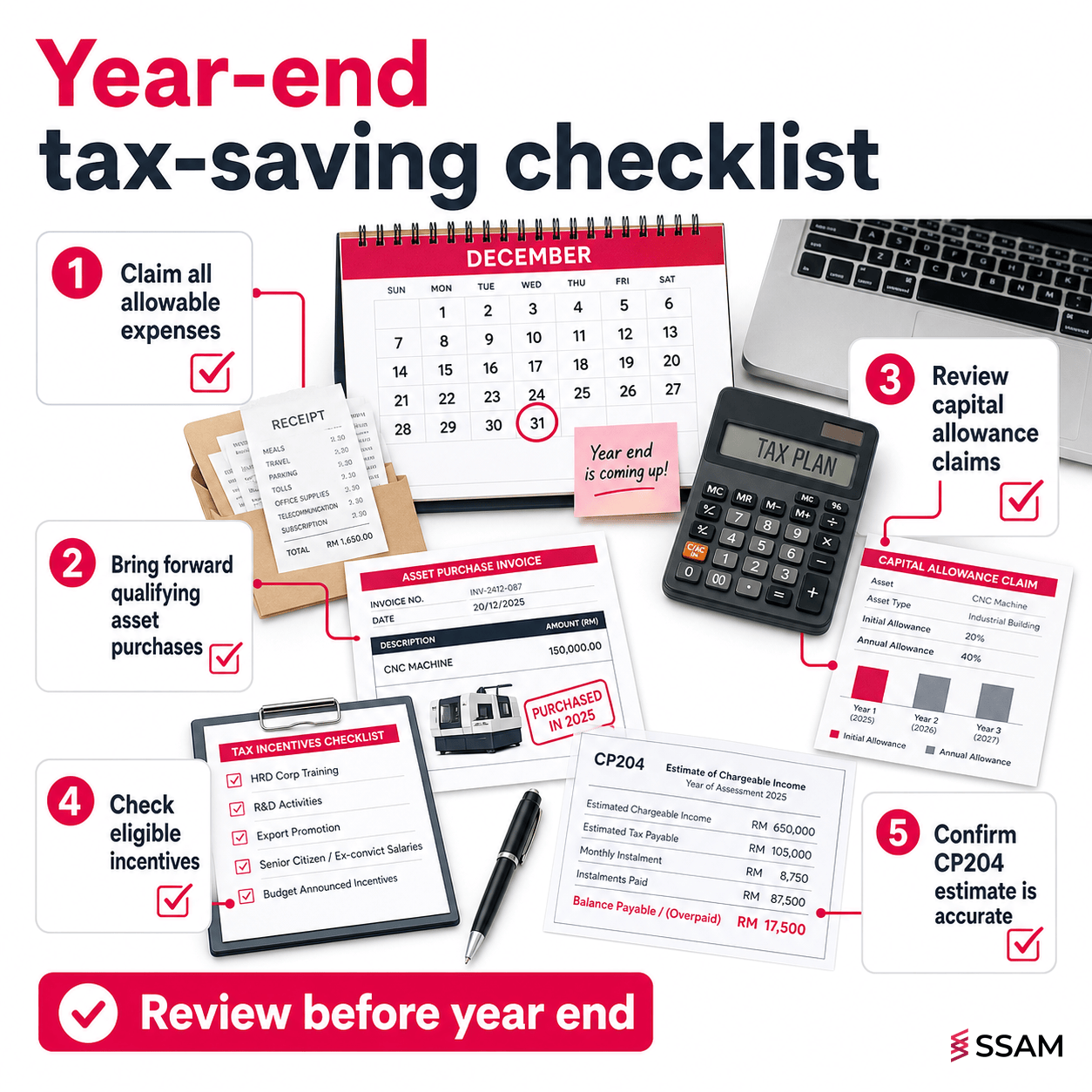
Timing is an underused lever. Because tax is assessed by year of assessment, when something happens can matter as much as whether it happens. If you plan to buy qualifying equipment, completing the purchase before your financial year end can bring the capital allowance into the current year rather than the next. Equally, recognising income and settling supplier costs around year end should be done on commercial terms and recorded honestly, never manipulated.
The other half of timing is your CP204 estimate. Companies must estimate their tax and pay monthly instalments, and a serious under-estimate can trigger a penalty on the shortfall. An accurate estimate avoids that penalty and helps you manage cash flow rather than facing a large balance at filing. Our guide to the CP204 tax estimate explains how to get the figure right and when you can revise it.
Here is a simple worked example. Imagine a qualifying SME with RM650,000 of profit before allowances. After claiming RM150,000 of capital allowances and RM20,000 of other deductible costs it had overlooked, chargeable income falls to RM480,000.
| Scenario | Chargeable income | Estimated tax |
|---|---|---|
| Before claiming allowances | RM650,000 | RM111,000 |
| After claiming allowances | RM480,000 | RM78,600 |
In this illustration the company keeps about RM32,400 simply by claiming what it was entitled to. The figures are for explanation only and depend on your actual accounts.
Mistakes That Turn Planning into Tax Evasion
This is the part most guides skip, and it is where SME owners get hurt. The strategies above are safe because they follow the rules. Problems begin when planning crosses into misreporting. Common red lines include claiming personal spending as business expenses, omitting cash sales, raising invoices for services that did not take place, and shifting profit to related parties without commercial substance.
Patterns that tend to draw LHDN attention include results that look out of step with your industry, repeated late or amended filings, large unexplained swings in margin, and expense claims that do not match the nature of the business. None of these are about paying less through legitimate means. They are about honesty of reporting. Keep clean records, retain supporting documents, and when something is genuinely uncertain, get advice rather than guess.
When to Get Professional Tax Help
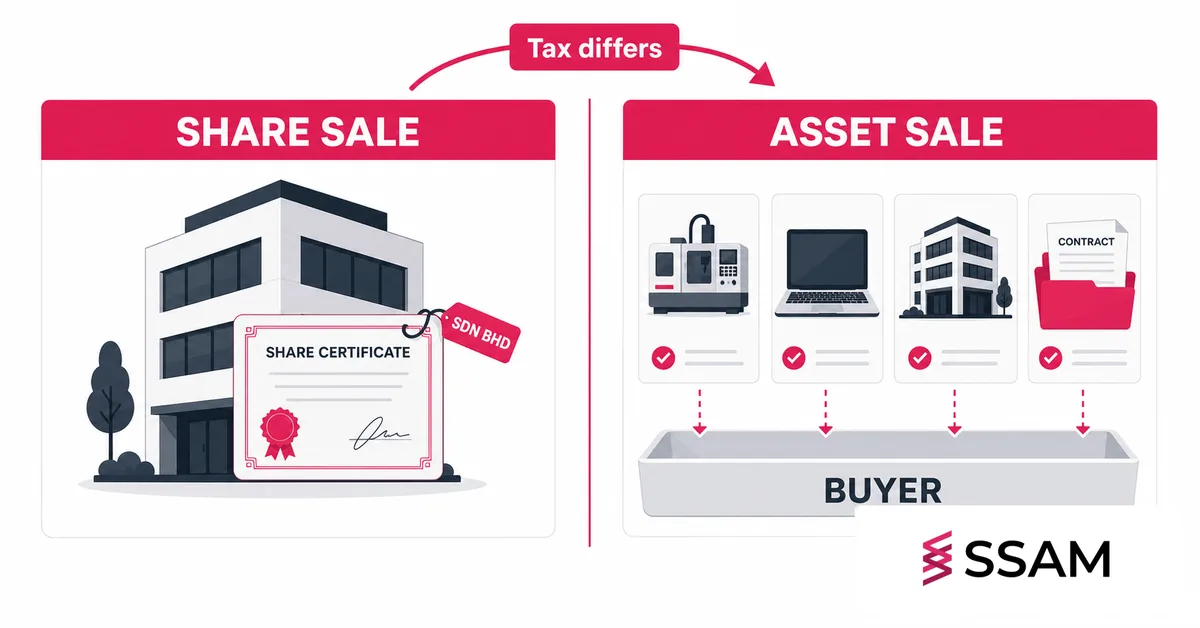
Much of this you can manage with disciplined bookkeeping. Professional help becomes worthwhile when the numbers get larger or the decisions get more complex, for example choosing between Pioneer Status and the Investment Tax Allowance, modelling the salary and dividend mix under the new dividend tax, planning ahead for the capital gains tax on a business sale, or preparing for an LHDN review. If you are unsure whether you have reached that point, the signs covered in our guide on when to hire a tax consultant are a useful gauge.
SSAM Group is a licensed tax agent whose tax planning in Kuala Lumpur supports Malaysian SMEs with planning, compliance and dealings with LHDN. If you would like a clear view of where your business is overpaying and which levers apply to you, speak to SSAM and the team can talk it through. The goal is simple. Pay what you owe, keep what you are entitled to keep, and sleep well knowing it is all above board.
Frequently Asked Questions
How can I reduce my company tax in Malaysia?
Lower your chargeable income through legitimate means. Claim every allowable expense, maximise capital allowances on assets, check whether you qualify for incentives such as the Investment Tax Allowance or a reinvestment allowance, and structure owner pay sensibly. Accurate records and correct classification do most of the work.
What is the SME corporate tax rate in Malaysia?
A qualifying resident SME pays a preferential rate on its lower income bands, currently 15 percent on the first RM150,000 and 17 percent on the next slice up to RM600,000, with income above that taxed at the standard 24 percent. Your company must meet the paid-up capital, income and ownership conditions to qualify.
Is tax avoidance legal in Malaysia?
Using the deductions, allowances and incentives the law provides is legal and is normally described as tax planning. Tax evasion, which means hiding income or falsifying records, is a criminal offence. The deciding factor is whether you are working within the rules or breaking them.
Can I claim a company car as a business expense?
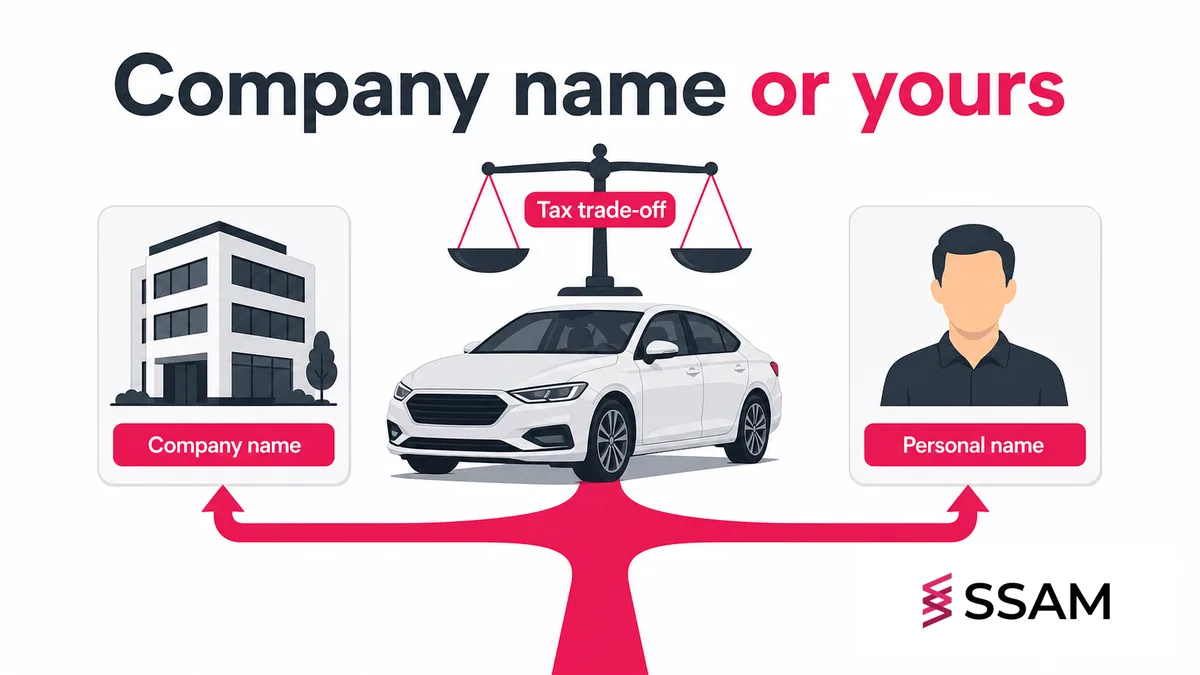
A vehicle used for business is claimed through capital allowances rather than as a one-off expense, and qualifying expenditure is subject to caps depending on the type and cost of the vehicle. Running costs that relate to business use may be deductible. Private use affects what can be claimed, so keep proper records. Our guide on company car tax for a Sdn Bhd walks through whether to buy under the company or in your own name.
What happens if LHDN audits my company?
LHDN will ask to see records supporting your returns, such as invoices, receipts, contracts and accounts. If your filings are honest and well documented, an audit is a process rather than a threat. Problems arise when income is understated or expenses cannot be supported, which can lead to additional tax and penalties.
Data Sources and References
- Lembaga Hasil Dalam Negeri (LHDN), Tax Rate of Company: https://www.hasil.gov.my
- PwC Worldwide Tax Summaries, Malaysia corporate taxes: https://taxsummaries.pwc.com/malaysia
- Malaysian Investment Development Authority (MIDA), incentives: https://www.mida.gov.my
The information in this article is provided for general informational purposes only and does not constitute tax, accounting, financial or legal advice. Tax laws change frequently and may not apply to your situation. Always consult a qualified professional before acting on any information here.