

Key Takeaways
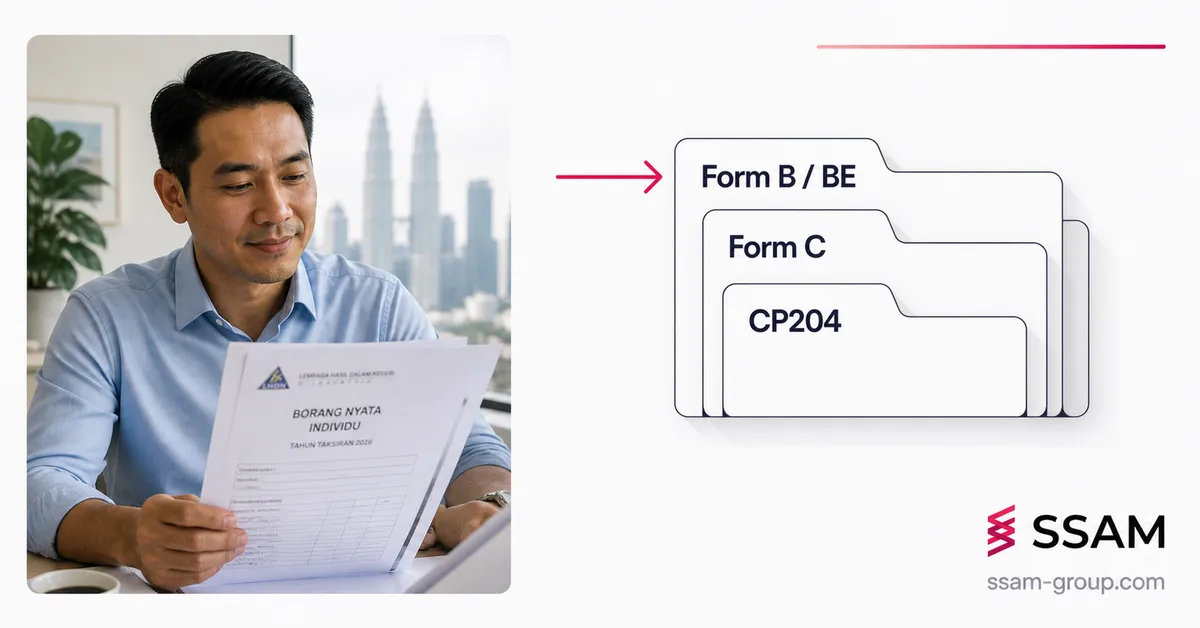
- A Sdn Bhd director in Malaysia wears two tax hats at the same time. Personally you file Form B or Form BE. As an officer of the company, you are accountable for Form C, CP204, Form E and related filings.
- Under Section 75A of the Income Tax Act 1967, directors can be held personally liable for the company's unpaid tax. Outsourcing the work does not outsource the responsibility.
- How you pay yourself matters. Director's fee, monthly salary with PCB, and dividend each have different tax and timing rules, including Section 29(4) on when director's fees are taxed.
- Advance to director is the classic first-year trap. Under Section 140B, LHDN can deem notional interest income for the company on director advances funded by company resources.
- The calendar drives everything. CP204 filed before the basis period, CP204A revisions in the 6th, 9th and 11th months, Form EA by end of February, Form E by 30 April, Form BE by 15 May, Form B by 15 July, Form C within 8 months of year-end.
Being appointed as a Sdn Bhd director in Malaysia brings a specific set of tax obligations that start the moment your name enters the SSM register, not the day the company earns its first ringgit. Most first-time directors only realise this in April the following year, when the deadlines stack up faster than the bookkeeping.
The reason it feels overwhelming is not that Malaysian tax is unusually hard. It is that becoming a director of a Sendirian Berhad (Sdn Bhd) means you now sit inside three taxpayer relationships at once, an individual, an officer of a company, and an employer. Each one has its own forms, rates and deadlines with LHDN (Lembaga Hasil Dalam Negeri, the Inland Revenue Board of Malaysia).
This pillar guide is your map. It covers every tax obligation a first-time director carries, separated cleanly into you as an individual and you as an officer of the company, with the director-specific traps that newer guides tend to miss.
What tax obligations does a Sdn Bhd director have in Malaysia?
A Sdn Bhd director in Malaysia carries two sets of tax obligations. Personally, you file Form B or Form BE based on your income type. As an officer of the company, you are accountable for the Sdn Bhd's Form C, CP204 instalments, Form E and related filings. Under Section 75A of the Income Tax Act 1967, directors can be held personally liable for unpaid company tax debts.
That single paragraph is the headline answer. The rest of this guide unpacks what that actually means in your first twelve months as a director.
Personal vs company tax: the director's two hats
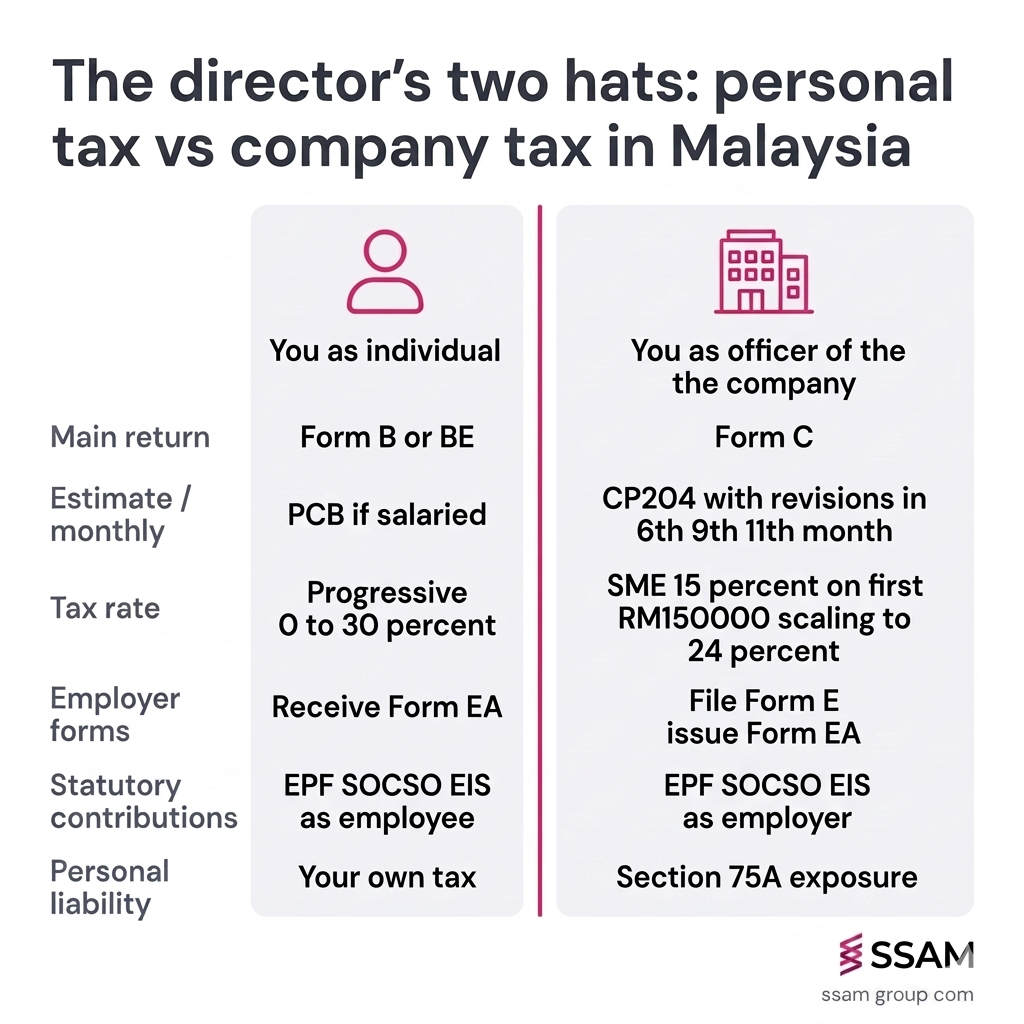
The cleanest mental model is to separate the director's two hats before you touch any form.
- Director as an individual. You report whatever you personally received (salary, director's fee, bonus, benefits-in-kind, dividend, other income) on your own return. You are taxed on your own chargeable income at progressive rates.
- Director as an officer of the company. The Sdn Bhd reports its own income, deducts allowable expenses (including what it paid you), and pays corporate income tax on its chargeable income. Many of those filings carry your signature as director, which is why Section 75A liability matters.
The table below is the responsibility matrix you should keep in front of you during your first year.
| Area | Director as individual | Director as officer of the company |
|---|---|---|
| Filer | You | The Sdn Bhd |
| Main return | Form B or Form BE | Form C (corporate income tax) |
| Tax estimate | None (PCB deducted monthly if salaried) | CP204 with CP204A revisions |
| Employer filings | Receive Form EA (CP8A) | File Form E and issue Form EA |
| Statutory contributions | EPF, SOCSO, EIS as employee | EPF, SOCSO, EIS as employer |
| Indirect tax | Not applicable | SST if registered, e-Invoicing where applicable |
| Withholding tax | Not applicable | Required on certain payments to non-residents |
| Personal liability | Your own tax only | Section 75A exposure for company tax debts |
Mixing up the two hats is the single most common reason first-time directors overpay, underpay, or receive a firm letter from LHDN in year two.
Director's personal tax obligations (Form B and Form BE)
Your personal filing depends on the type of income you received during the year of assessment. First-time directors often assume they still file Form BE because they used to. That is only true if your income structure has not actually changed.
Form BE for employment income only
Form BE applies if your only income during the year was employment income (for example, a monthly director's salary with PCB deducted, with no business income).
- Deadline: 30 April of the following year (15 May via e-Filing).
- Typical profile: executive director drawing only a monthly salary, no sole proprietorship on the side declared as a business source.
Form B for business or mixed income
Form B applies once you have any business or non-employment income, which most directors eventually do. Common triggers are director's fees declared as a employment income, sole proprietorship income on the side, rental income in your own name, or freelance consulting.
- Deadline: 30 June of the following year (15 July via e-Filing).
- Director's fees approved by resolution under the Companies Act 2016 are taxed in the year they are credited to you, not the year the work was done. This is covered by Section 29(4) of the Income Tax Act 1967 and regularly catches first-year directors off guard.
Form M for non-resident directors
Form M applies if you are a non-resident individual for Malaysian tax purposes during the year of assessment. Residency in Malaysia is determined by physical presence rules, not citizenship or passport.
- Deadline: same as Form BE for non-resident directors who do not carry on business (30 April, 15 May via e-Filing), same as Form B for non-resident directors who carry on business (30 June, 15 July via e-Filing)
- Non-residents are taxed at a flat rate (currently 30 percent) and have limited access to personal reliefs and rebates. If you or a co-director spend most of the year overseas, confirm residency with a licensed tax agent early.
Across all three forms, if you do not yet have a personal tax file number, activate via MyTax on the LHDN portal as soon as the company starts paying you. Without it, PCB and year-end filing both break down.
Company tax filings the director is accountable for
Even if your tax agent prepares every form, your signature as director is what makes the filing valid. That is the practical effect of Section 75A, Income Tax Act 1967: if the company fails to pay, LHDN can recover the debt personally from the directors of the company.
Form C: annual corporate tax return
Form C reports the Sdn Bhd's income, deductions and chargeable income for the year of assessment.
- Deadline: within 7 months after the end of the company's financial year, 8 months after the end of the company's financial year via e-Filing. If year-end is 31 December, Form C is due by 31 August of the following year.
- SME preferential rate: 15 percent on the first RM150,000 of chargeable income, scaling up to 24 percent, subject to qualifying conditions (mainly paid-up capital and gross business income thresholds).
- Non-SME or disqualified companies: flat 24 percent on chargeable income.
Even if the company made a loss, Form C still has to be filed. Unfiled returns trigger penalties regardless of loss position. Filed unabsorbed tax losses can carry forward and reduce future chargeable income, so filing protects future tax savings. More detail in the article on filing tax returns when your business makes a loss in Malaysia.
CP204: the tax estimate
CP204 is your company's estimate of tax payable for the year. It is filed separately from Form C and paid in monthly instalments through the year.
- Existing companies submit CP204 no later than 30 days before the start of the basis period.
- New companies with paid-up capital of RM2.5 million or less and gross business income not exceeding RM50 million are generally exempt from CP204 for the first two years of assessment, subject to the qualifying conditions. Your tax agent should confirm your exact start point based on your incorporation date and year-end.
- Instalments are paid by the 15th of each month.
- If actual tax payable exceeds the estimate by more than 30 percent, a 10 percent penalty applies to the shortfall.
The 10 percent penalty is why CP204 deserves real thought, not a round-number guess. Full breakdown in the guide on CP204 tax estimates in Malaysia.
CP204A: revisions in the 6th, 9th and 11th months
Business conditions change quickly in a new company. Revise the CP204 estimate in the 6th, 9th and 11th months of the basis period using Form CP204A. Skipping these revisions is one of the most common reasons first-year Sdn Bhds end up paying the underestimation penalty.
Form E and Form EA (CP8A)
Even a one-person Sdn Bhd is an employer under the Income Tax Act.
- Form E: employer's annual return. Due by 31 March (with e-Filing extension to 30 April).
- Form EA (CP8A): given to each employee, including you, by end of February of the following year. You use your own Form EA to prepare your personal Form B or BE.
- PCB (Potongan Cukai Berjadual): monthly tax deduction on salaried directors and staff, remitted to LHDN by the 15th of the following month.
Skipping Form E on the logic of "I am the only employee, why file" is one of the fastest routes to compound notices in year one. See the guide on Form B, Form C and Form E for a Sdn Bhd.
Director's fees, salary, dividends: how each is taxed
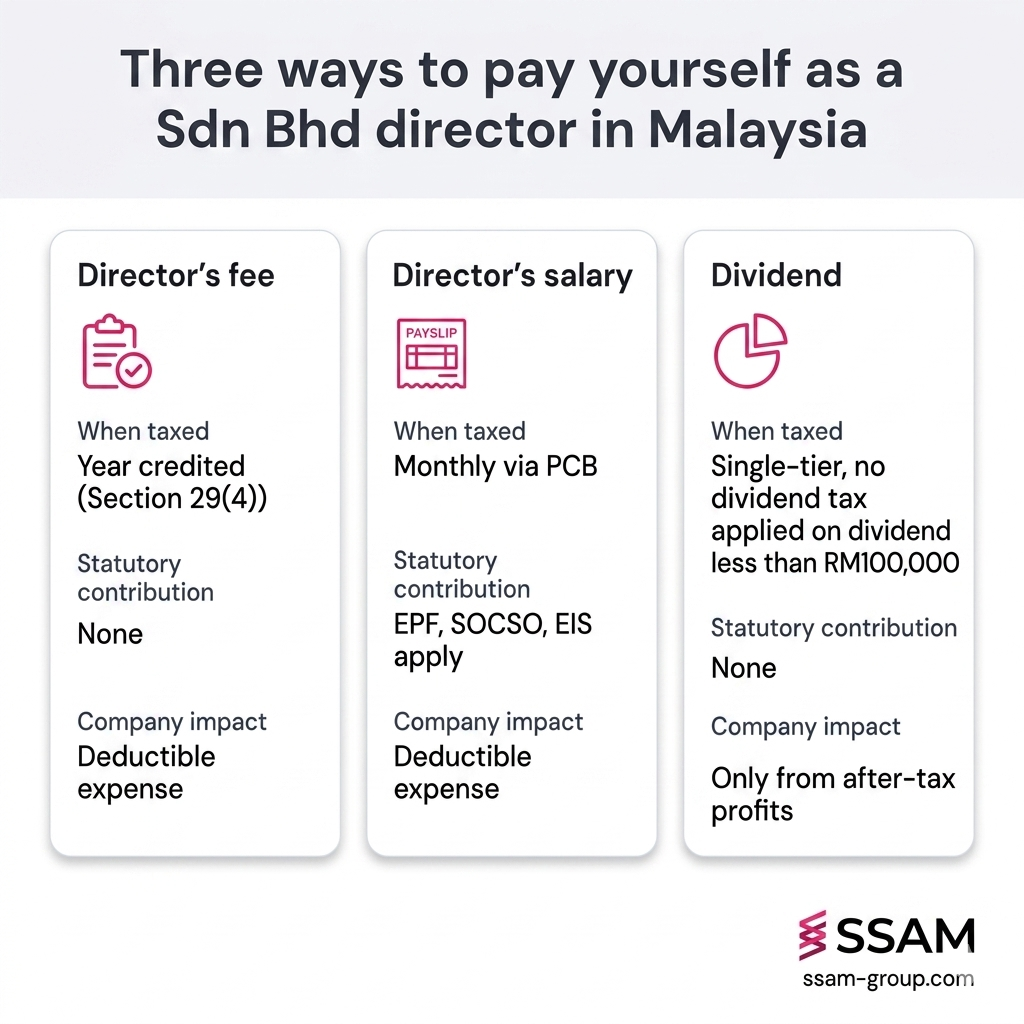
A first-year director usually has three main ways to take money out of the Sdn Bhd. Each has a different tax and timing profile.
- Director's fee. Approved at an AGM or by written resolution. Under Section 29(4) of the Income Tax Act 1967, director's fees are taxable on you in the year they are credited to you, even if they relate to services rendered in earlier years. The company can deduct them as an expense in its accounts.
- Director's salary. Treated like normal employment income. Subject to PCB, EPF, SOCSO and EIS. Reported on your Form EA. The company deducts it as an expense in the year incurred.
- Dividend. Declared out of after-tax profits of the Sdn Bhd. Malaysia uses a single-tier system, so dividends are generally not taxed again in your personal hands. You cannot declare a dividend if the company has no distributable profits.
- Benefits-in-kind (BIK). Things like a company car, accommodation or club membership provided to you as a director are taxable on you as BIK. Public Ruling No. 8/2020 is the main reference point LHDN uses when valuing BIK, and your tax agent can walk through the specifics if the company plans to provide any.
A mix of salary and dividend is common and legal. The right mix is not universal. It depends on your Sdn Bhd's profitability, your EPF goals, your personal cash flow, and whether the company qualifies for SME tax rates. A deeper comparison is in the article on advance to director vs salary vs dividend for your Sdn Bhd.
Director-specific tax traps that first-timers miss
These are the issues that rarely appear in generic guides but routinely surface in SSAM's client audits.
Advance to director and Section 140B imputed interest
You pay a personal expense with the company card, or take a lump sum out of the Sdn Bhd for a personal need. On the books this shows up as a loan from the company to you, commonly called an "advance to director".
Under Section 140B of the Income Tax Act 1967, where a Sdn Bhd makes an advance or loan to a director and the company had internal funds available, LHDN can deem the company to have earned notional interest on that advance. That imputed interest is then taxable on the company. Over a few years, an untracked director's current account can quietly create a corporate tax liability that surprises you at audit.
Cleaner options:
- Pay yourself through proper payroll and declared director's fee.
- Repay any advances promptly, ideally within the same basis period.
- If a genuine director loan is required, document it with a written agreement and a reasonable interest rate.
Full breakdown in the article on advance to director in Malaysia and its tax risks.
Section 75A director liability for company tax debts
If the Sdn Bhd fails to pay its tax, LHDN can recover the debt personally from any person who was a director during the relevant period, under Section 75A of the Income Tax Act 1967. This is why "we outsourced it" is not a defence. Directors are expected to make sure the company's tax filings and payments actually happen, even when the day-to-day work sits with a tax agent.
Treating Form E as optional
Form E is a filing by the employer, not by the employees. If your Sdn Bhd existed at any point during the year, it files Form E. This is separate from your own Form B or BE.
Missing benefits-in-kind
If the company provides you a car, accommodation, phone, fuel card or similar benefits, those have to be valued as benefits-in-kind and shown on your Form EA. Public Ruling No. 8/2020 gives the valuation method. Missing these leads to under-declared personal income.
Key deadlines and your year-one compliance calendar
If you only fix one thing in your first year, fix the calendar. Most penalties first-time directors face are timing failures, not technical mistakes. For the full-year view, see the overview of Malaysia tax filing deadlines for 2026 and the list of common tax filing mistakes Malaysian SMEs make.
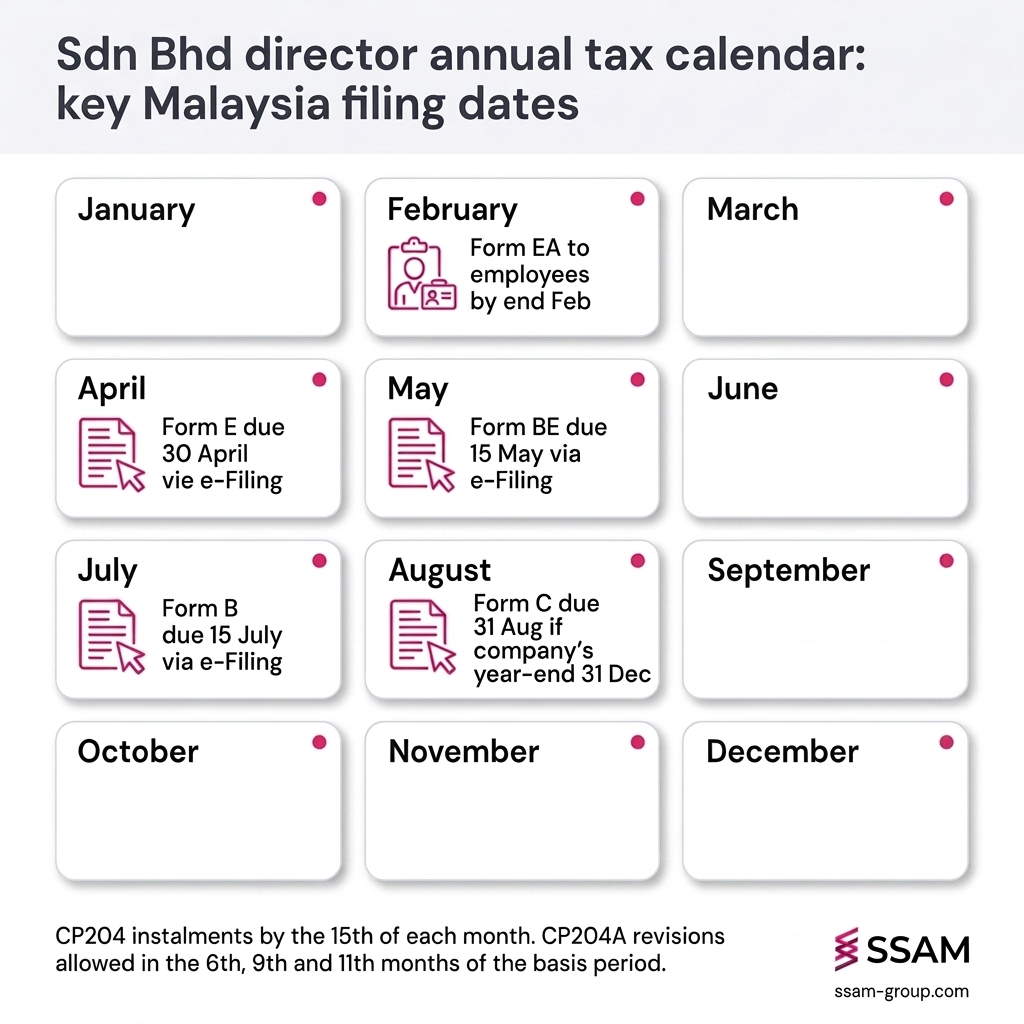
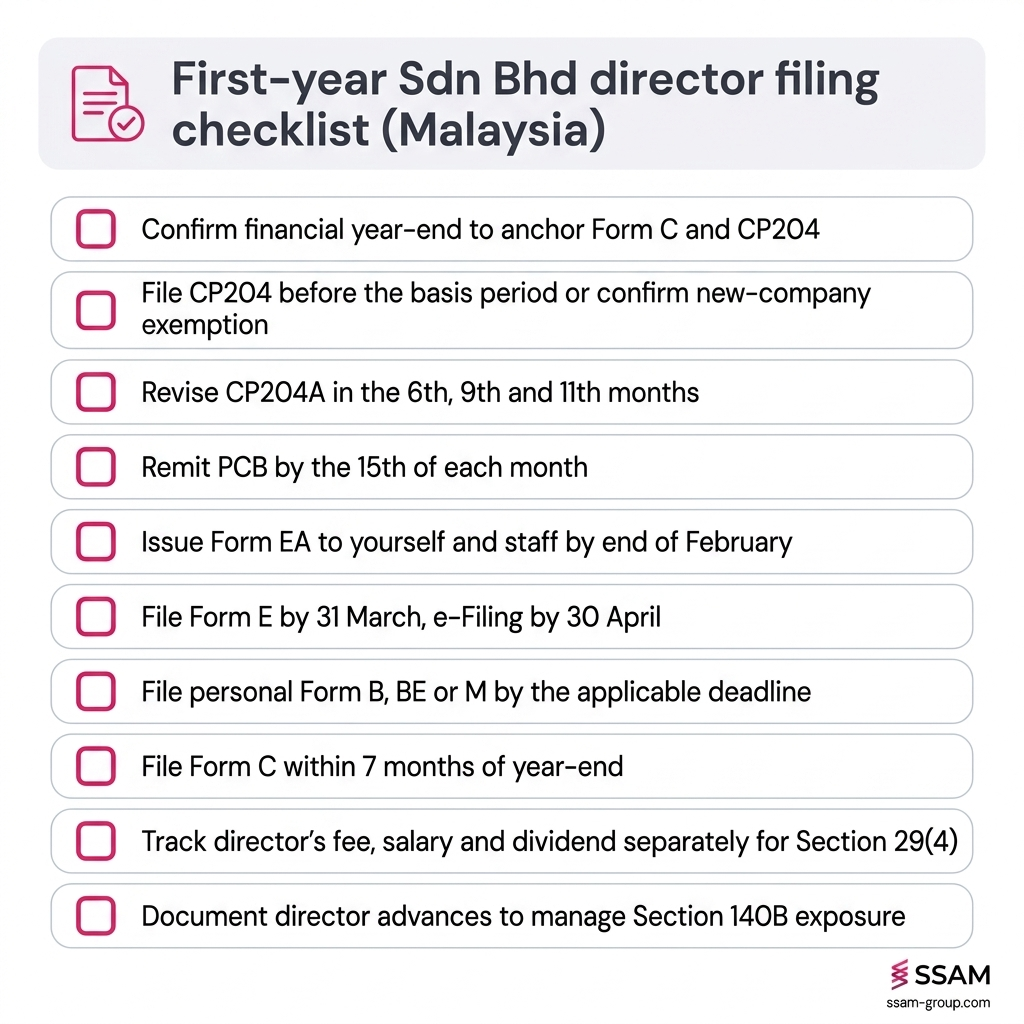
A simple year-one filing rhythm you can lock in today:
- Run payroll monthly so PCB is remitted by the 15th and Form EA data is ready by end of February.
- Lock in your financial year-end early and work backwards from Form C (due 8 months later via e-Filing) and CP204A revisions (6th, 9th and 11th months).
- Calendar your CP204 submission before the basis period starts, or confirm your new-company exemption window.
- File Form E by 30 April via e-Filing even if you are the only employee on the Sdn Bhd's books.
- Track director's fee, salary and dividend amounts separately so each flows into the correct filing under Section 29(4).
For a full year-one compliance checklist, see the tax compliance checklist for new Sdn Bhd companies in Malaysia and the overview of LHDN penalties for late tax filing.
When a licensed tax agent is worth engaging
Most first-time Sdn Bhd directors try to handle year one alone and regret it by April. A MOF-licensed tax agent is worth engaging early if any of these apply:
- You expect revenue above RM500,000 in year one.
- You have multiple directors, shareholders or related-party transactions.
- You draw income through a mix of fee, salary and dividend.
- You deal with foreign suppliers where withholding tax may apply.
- You plan to take a loan, raise equity, or sell in the next 24 months, where your tax position will be reviewed by a third party.
SSAM Group is a MOF-licensed tax agent and operates as a 1-stop centre for Malaysian SMEs, covering company secretarial, accounting, tax and HR & payroll. With 40 years of experience and over 1,000 clients, the team has seen almost every first-year director scenario. If you are unsure about your mix of salary, fee and dividend, your first CP204 position, or your Section 75A exposure, speak to SSAM or WhatsApp the team on +6011-6529 9879.
Frequently asked questions
Do I still need to file personal tax if my Sdn Bhd made no profit?
Yes. Your personal return is based on what you personally received, not what the company made. If you drew a salary, director's fee or any other income, you file Form B or Form BE. The company's loss is reported separately on Form C, which still has to be filed.
Am I personally liable if the Sdn Bhd cannot pay its taxes?
Potentially, yes. Under Section 75A of the Income Tax Act 1967, directors can be held jointly and severally liable for the company's unpaid tax. That is why you should never treat tax filings as purely back-office tasks, even when an agent prepares them.
What is the penalty for late CP204 or filing Form C or Form E late?
Late or under-estimated CP204 can attract a 10 percent penalty on the shortfall where actual tax exceeds the estimate by more than 30 percent. Late Form C and Form E can trigger compound fines and, in serious cases, prosecution under the Income Tax Act 1967. Actual amounts are set by LHDN at the time of assessment, so file on time rather than rely on last year's numbers.
Do I need Form E if I am the only "employee" of my Sdn Bhd?
Yes. The Sdn Bhd is a separate legal entity, and as long as it pays wages to anyone including you, it is an employer under the Income Tax Act. Form E is due by 31 March, with an e-Filing extension to 30 April.
When should a new Sdn Bhd director first speak to a tax agent?
Ideally before incorporation, or within the first two months after. The earliest decisions (financial year-end, paid-up capital, director compensation mix, employer registrations) shape your tax position for years and are far easier to set correctly than to correct later.
Data sources and references
- Income Tax Act 1967, including Section 29(4), Section 75A and Section 140B
- Companies Act 2016
- Public Ruling No. 8/2020: Benefits-in-Kind, LHDN
- LHDN (Inland Revenue Board of Malaysia): https://www.hasil.gov.my/
- SSM (Companies Commission of Malaysia): https://www.ssm.com.my/
The information in this article is provided for general informational purposes only and does not constitute tax, accounting, financial or legal advice. Tax laws change frequently and may not apply to your situation. Always consult a qualified professional before acting on any information here.