

Key Takeaways
- Most tax filing mistakes among Malaysian SMEs come from using the wrong form, mixing personal and business expenses, and missing deadlines, not from fraud.
- Under-declaring director fees or cash sales is a major LHDN audit trigger, with penalties of 200 percent of the tax undercharged under Section 113(1) of the Income Tax Act 1967.
- CP204 and CP204A mistakes can cost you a 10 percent surcharge if actual tax exceeds your estimate by more than 30 percent.
- Many SMEs overpay tax by missing the tiered SME rate (15 percent, 17 percent, 24 percent) and capital allowances on equipment, vehicles and software.
- From 2026, mismatches between MyInvois data, your audited accounts and Form C are a live LHDN audit trigger, so monthly reconciliation is no longer optional.
Why tax filing mistakes hurt Malaysian SMEs
Tax filing mistakes quietly cost Malaysian SMEs more money than most owners realise. They damage cash flow, invite LHDN audits, and lock your business into problems that can take years to clean up. A single wrong entry on Form C can lead to disallowed deductions, back taxes, and LHDN penalties for late tax filing that compound each month the issue is left unresolved.
The risk is higher than owners assume. LHDN audit findings on SMEs routinely surface under-reported income, disallowed deductions, and misclassified expenses, and the agency has made it clear that SMEs remain a priority enforcement group. Beyond penalties, filing errors also affect your ability to secure financing. Banks, grant agencies, and investors all review your tax filings as proof of financial discipline.
The good news is that most mistakes are preventable. They come from process gaps, not dishonesty. The sections below walk through the seven most common errors we see at SSAM, and what your business can do before the next filing window closes.
What is the most common tax filing mistake Malaysian SMEs make?
The most common tax filing mistake Malaysian SMEs make is mixing personal and business expenses, which leads to incorrect Form C entries, rejected deductions, and LHDN penalties. Other frequent errors include using the wrong tax form, under-declaring director income, missing the seven-month Form C deadline, and overlooking legitimate deductions that would reduce tax payable.
Using the wrong tax form for your business structure
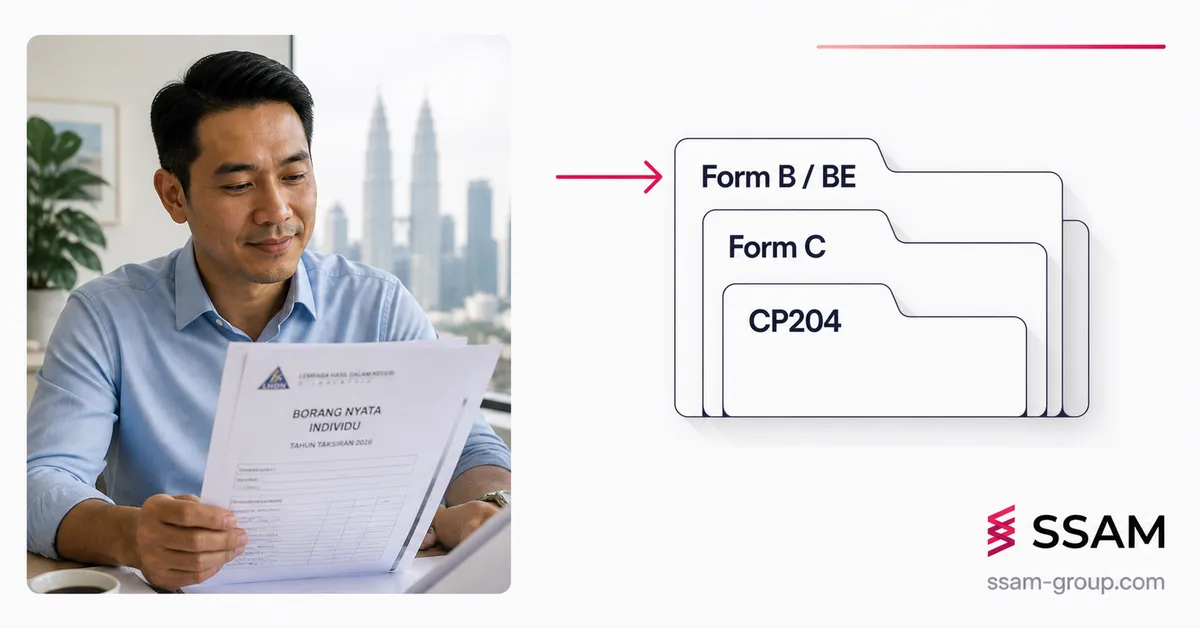
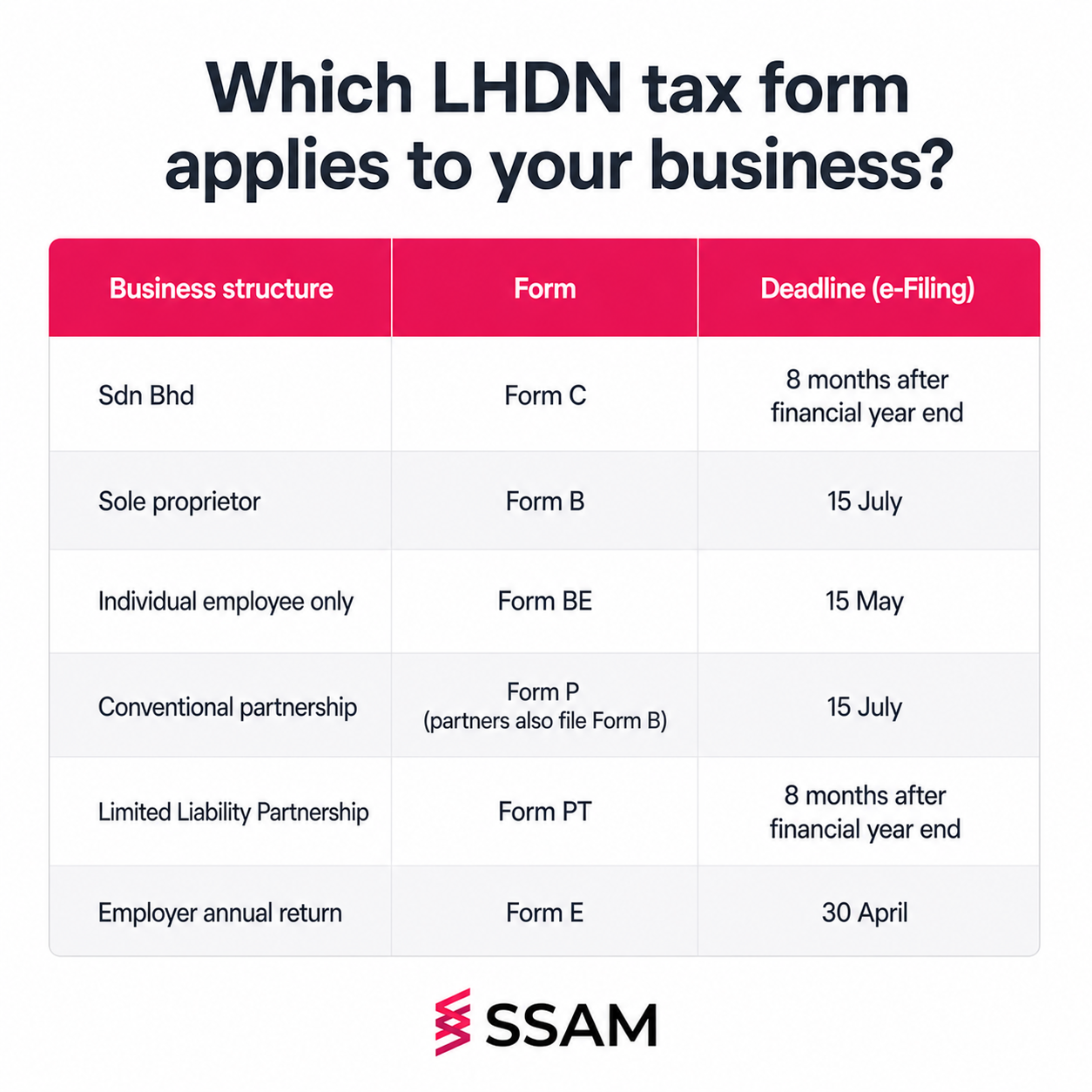
Many first-time filers submit the wrong form entirely, and it is often a director issue rather than an accounting issue. Your business structure decides which LHDN form you file, and the deadlines are not interchangeable. For a full breakdown, see our guide on which tax forms your Sdn Bhd needs.
Sdn Bhd directors filing Form B by mistake
A Sdn Bhd files Form C for company income, while the director files Form B or Form BE for personal income. New directors sometimes report company profits on Form B, or ignore Form C entirely because the company has not made much. Both are wrong. Every registered Sdn Bhd must file Form C annually, even if the company is dormant or loss-making.
Sole proprietors filing BE instead of B
Sole proprietors carry business income, so the correct form is Form B, not Form BE. Form BE is for individuals whose income is purely from employment. Getting this wrong often means losing deductions you are entitled to claim as a business owner.
When partnerships need Form P and Form PT
Conventional partnerships file Form P, and each partner also files Form B for their share of profit. Limited Liability Partnerships (LLPs) file Form PT. Forms P and PT do not assess tax at the entity level in the same way as Form C, but late submission still carries penalties.
Form C is due eight months after financial year end for e-Filing. Form B is due 15 July, and Form E is due 30 April.
Under-declaring income, director fees and cash sales
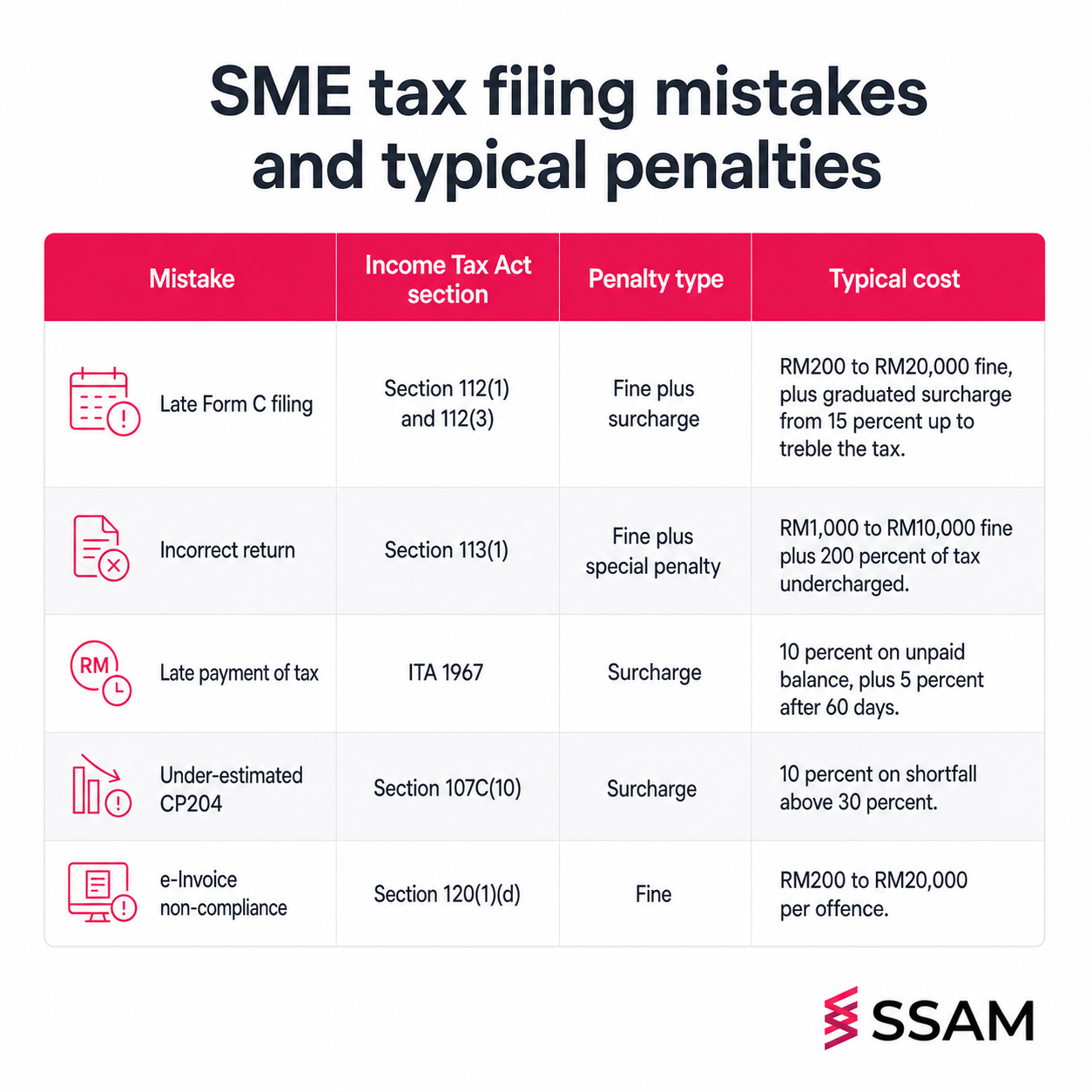
This is one of the biggest audit triggers in LHDN's playbook. Under Section 113(1) of the Income Tax Act 1967, an incorrect return can attract a fine of RM1,000 to RM10,000 together with a special penalty of 200 percent of the tax undercharged. If LHDN can prove wilful intent to evade, Section 114 raises the stakes to a fine of RM1,000 to RM20,000 and a penalty of up to 300 percent of the tax undercharged, plus possible imprisonment.
Underreporting profit when sales grow
It is common for younger SMEs to under-report profit because they file based on bank deposits alone, or because their accounting is done once a year in a rush. LHDN flags "lifestyle does not match declared income" as a classic audit signal. If your revenue grows sharply but your declared profit does not, expect scrutiny.
Director fees paid but not declared
Directors who draw fees or salaries from their own Sdn Bhd must declare them on two sides. The company records the director remuneration in its accounts and Form E, and the director declares it on their personal Form BE. Paying fees without declaring on either side is a double error that LHDN can reconstruct from bank trails. For a full list of obligations, see our guide on Sdn Bhd director tax obligations.
Cash sales never banked or recorded
For retail, F&B, and service businesses, cash sales that never reach the bank are a recurring issue. If sales receipts do not reconcile to deposits, your declared revenue is already wrong before anyone looks at the tax form. Build a weekly reconciliation habit and keep a simple daily takings log.
Mixing personal and business expenses in your accounts
This is the universal SME accounting hygiene issue, and it is the reason many Form C deductions are disallowed. When personal groceries, family meals, or household bills sit inside the company account, LHDN rejects the lot, not just the personal portions.
Three fixes solve most of it:
- Open a dedicated business bank account in the company name.
- Use cloud accounting so transactions are categorised in real time, not at year end.
- Reconcile bank and accounting records once a month, even if the bookkeeper is part-time.
At SSAM, outsourced accounting starts from RM2,400 per year, which includes the software, a qualified accountant, and monthly reconciliation. For most SMEs, that is less than the cost of one fresh-grad hire plus EPF, and avoids the disallowed expense problem entirely.
Missing Form C, CP204 and CP204A deadlines
Tax deadlines in Malaysia are strict, and the surcharges add up quickly. A full calendar is in our guide on Malaysia tax filing deadlines for 2026.
Form C seven-month filing deadline
Form C is due seven months after financial year end (eight months via e-Filing). Section 112(1) of the Income Tax Act 1967 allows a fine of RM200 to RM20,000, imprisonment of up to six months, or both, for failing to file on time. Section 112(3) additionally permits a penalty of up to three times (treble) the tax payable, though in practice LHDN applies the graduated rates in Operational Guidelines GPHDN 3/2020, starting at 15 percent of the tax payable for a first year of delay and rising with repeat offences. Once the tax is assessed, a separate 10 percent late payment surcharge applies to any unpaid balance, with a further 5 percent if the balance is still unpaid after 60 days.
CP204 tax estimate errors
CP204 is your company's tax estimate for the year, submitted before the start of the basis period. Section 107C(10) adds a 10 percent surcharge when the actual tax payable exceeds the estimate by more than 30 percent. Many SMEs submit a conservative low estimate to protect cash, then get hit with the surcharge at year end. For a detailed walk-through, see our article on the CP204 tax estimate in Malaysia.
When to file CP204A to revise
CP204A lets you revise your estimate in the 6th, 9th and 11th months of the basis period. Most SMEs forget this window exists. If business is trending ahead of your original estimate, a CP204A revision before the 11th month protects you from the 30 percent surcharge.
Also easy to miss: the MITRS upload window. Your tax computation must be uploaded to MITRS within 30 days of Form C filing.
Overlooking deductions, reliefs and tiered SME tax rates
Most SMEs worry about under-declaring. Fewer notice that they are also over-paying. Missed deductions and misused rates quietly raise your tax bill year after year.
Tiered SME rate of 15, 17 and 24 percent
Qualifying SMEs pay 15 percent on the first RM150,000 of chargeable income, 17 percent on the next RM450,000, and 24 percent above that. To qualify under LHDN Public Ruling 8/2025, the company's paid-up capital must not exceed RM2.5 million, gross income must not exceed RM50 million, and the company must not have a 20 percent or more corporate shareholder that is non-resident. Some SMEs forget to check these conditions and end up taxed at the flat 24 percent when they could have benefited from the tiered rate.
Capital allowances on machinery and software
Capital allowances cover equipment, vehicles, computers, and qualifying software. There is also a special allowance for small-value assets not exceeding RM2,000 each, which allows SMEs to claim 100% capital allowance in a single year by deducting the entire cost of the asset.
Training, marketing and research deductions commonly missed
Section 44(6) covers donations to approved institutions. Staff training, certain marketing costs, and qualifying research and development are also deductible under specific conditions. Keep receipts, approval letters, and training attendance records. If you cannot evidence the expense, LHDN will disallow it.
Ignoring e-Invoice reconciliation with Form C
This is the new mistake that very few articles cover properly. Malaysia's e-Invoice rollout means LHDN now receives your transaction data in close to real time through MyInvois. From the 2026 filing cycle, mismatches between MyInvois revenue, your audited accounts, and Form C revenue are a live audit trigger.
Phase 4 of the rollout covers SMEs with annual revenue between RM1 million and RM5 million, with implementation running from 1 January 2026. LHDN has extended the relaxation (grace) period during which no penalties apply, so SMEs should confirm the current mandatory enforcement date with their tax agent before relying on it. Once the grace period ends, Section 120(1)(d) of the Income Tax Act 1967 provides for fines of RM200 to RM20,000 per offence for non-compliance.
The fix is a monthly reconciliation routine that compares three data sets: MyInvois output, your accounting system, and the tax computation used for CP204 and Form C. If your bookkeeper is not already doing this, add it to the month-end checklist now, not after the next deadline.
What to do before the next filing window closes
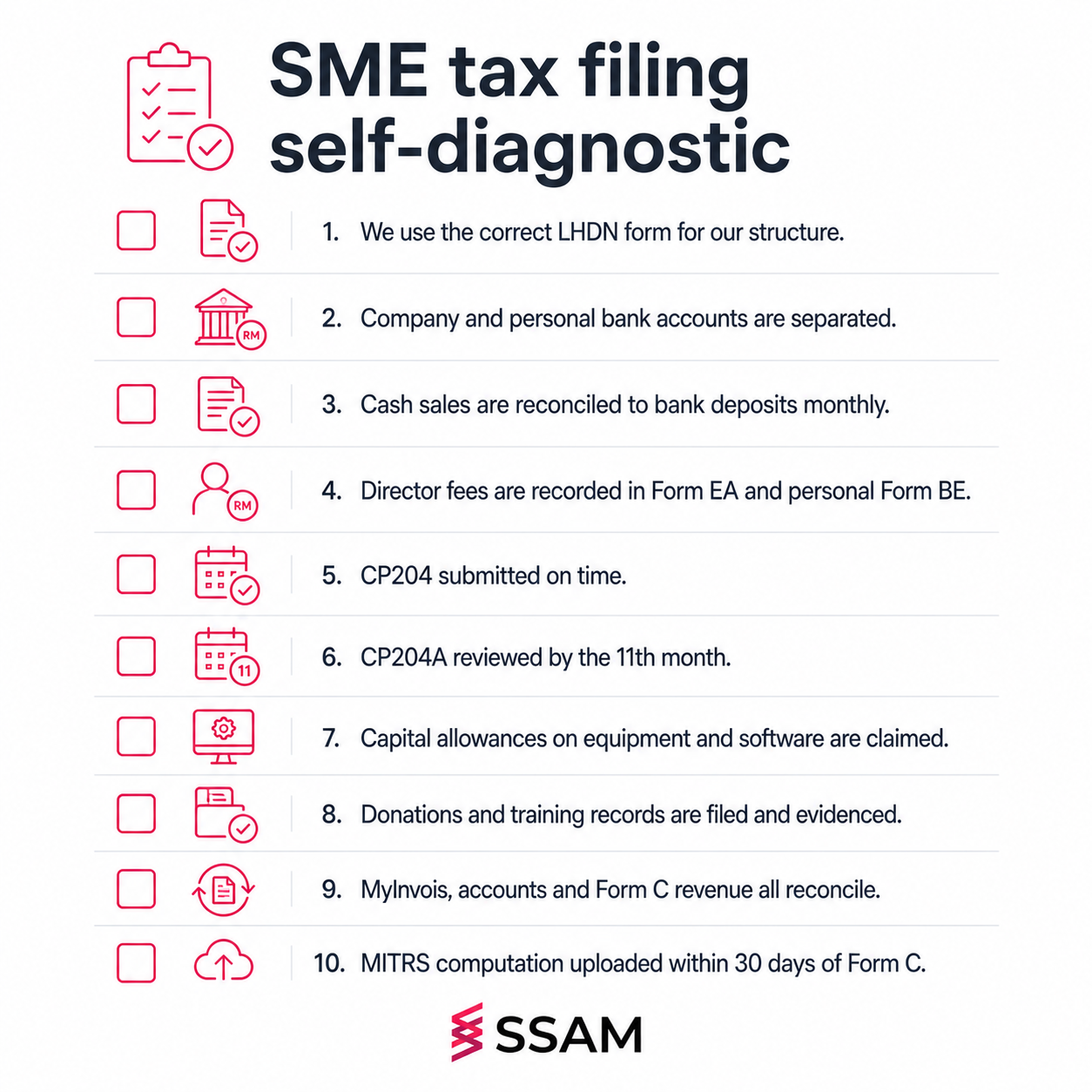
If any of these mistakes sound familiar, you do not need to panic. You need a clean pre-filing review. Start with the ten-question checklist above. Pull your income statement, your MyInvois export, and your last CP204 submission side by side. Flag any discrepancy that would cost you more than a day to explain to LHDN. That becomes your priority list.
For most SMEs, the most reliable fix is monthly bookkeeping plus a MOF-licensed tax agent signing off the annual tax return. SSAM Group has been doing this for Malaysian SMEs for 40 years, with 99 percent client satisfaction across more than 1,000 businesses. Our tax arm, TSE Taxation Services Sdn Bhd (198401012049), is a MOF-licensed tax agent and handles Form C, CP204, and CP204A filings as part of the same engagement.
To get a specific view of your risk exposure before the next deadline, WhatsApp the team on +6011-6529 9879, call +6011-6529 9879, or email tax@ssam-group.com.
Frequently asked questions about SME tax filing mistakes
What is the penalty for late tax filing in Malaysia?
Under Section 112(1) of the Income Tax Act 1967, late filing of a tax return can attract a fine of RM200 to RM20,000, imprisonment of up to six months, or both. Section 112(3) additionally allows LHDN to impose a penalty of up to three times (treble) the tax payable, although in practice the Operational Guidelines GPHDN 3/2020 apply graduated rates that start at 15 percent of the tax payable for a first year of delay. For incorrect returns, Section 113(1) imposes a fine of RM1,000 to RM10,000 together with a special penalty of 200 percent of the tax undercharged.
How do I amend a tax return after submission to LHDN?
You can submit a self-amendment via the Amended Return Form within the statutory window, or write in to the LHDN branch that holds your file to explain the correction. Section 91 of the Income Tax Act 1967 also gives LHDN up to five years to raise additional assessments if an error is found. Do not wait for an audit before correcting a known mistake.
Can I claim my home office and car as business expenses?
Only to the extent that the expense is wholly and exclusively incurred in producing business income. A home office portion must be reasonable and supported by utility bills and floor area calculations. Passenger vehicles have a capital allowance cap, and private use needs to be excluded. Keep clean records from day one so the claim holds up under review.
What happens if LHDN audits my SME?
An audit typically starts with a field audit letter or a desk audit request for documents. LHDN will review your accounts, Form C, CP204, and supporting documents such as invoices, bank statements, and payroll records. If discrepancies are found, LHDN can raise an additional assessment, impose Section 113 penalties, and extend the review period under Section 91. Engaging a MOF-licensed tax agent early tends to shorten the process.
Do I need a tax agent to file Form C for my Sdn Bhd?
It is not a legal requirement, but it is strongly recommended. A MOF-licensed tax agent can sign off the return on your behalf, defend the computation if questioned, and make sure you are applying the correct SME tiered rate, capital allowances, and reliefs. For most owner-led SMEs, the time saved and the penalties avoided more than cover the fee.
Data sources and references
- LHDN Public Ruling 8/2025: Tax Treatment for Micro, Small and Medium Companies. https://www.hasil.gov.my/media/fo1ptejq/pr-8-2025-tax-treatment-for-micro-small-and-medium-companies.pdf
- LHDN SME information page. https://www.hasil.gov.my/en/company/sme/
- LHDN Offences, Fines and Penalties. https://www.hasil.gov.my/en/legislation/offences-fines-and-penalties/
- LHDN guidance on amending the Income Tax Return Form. https://www.hasil.gov.my/en/company/amending-the-income-tax-return-form/
- LHDN Tax Estimation (CP204 / CP204A). https://www.hasil.gov.my/en/company/tax-estimation/
- LHDN e-Invoice implementation timeline. https://www.hasil.gov.my/en/e-invoice/implementation-of-e-invoicing-in-malaysia/e-invoice-implementation-timeline/
- PwC Malaysia Tax Summaries: Tax administration. https://taxsummaries.pwc.com/malaysia/corporate/tax-administration
- Income Tax Act 1967, Sections 44(6), 91, 107C, 112, 113, 114 and 120.
- Companies Act 2016.
The information in this article is provided for general informational purposes only and does not constitute tax, accounting, financial or legal advice. Tax laws change frequently and may not apply to your situation. Always consult a qualified professional before acting on any information here.