

Key Takeaways
- CP204 is your company's advance estimate of tax payable for the year, filed with LHDN under Section 107C of the Income Tax Act 1967.
- Existing companies must file e-CP204 at least 30 days before the start of the basis period. Newly incorporated companies with a first basis period of 6 months or more have 3 months from commencement of operations.
- Monthly instalments are due on the 15th of each month. New companies start paying instalments from the 6th month of their basis period.
- Your estimate must be at least 85% of the previous year's CP204 or CP204A, or LHDN may treat the filing as invalid.
- You can revise the estimate using Form CP204A in the 6th, 9th, and, from YA 2024 onwards, 11th month of the basis period.
- If actual tax payable exceeds the estimate by more than 30% of actual tax, a 10% penalty applies on the portion beyond the 30% buffer.
Your CP204 tax estimate in Malaysia sits at the intersection of two painful risks. File too high and your cash sits with LHDN for months before you see a refund. File too low and you could trigger the 30% under-estimation penalty. For most Sdn Bhd owners, getting this number wrong is a working-capital problem dressed up as a compliance problem.
This guide walks you through how Form CP204 works, who must file it, how to build a defensible estimate, when you can revise it using Form CP204A, and what the penalties actually cost. By the end, you will know what number to put down and when to adjust it without leaving money on the table.
What is CP204 tax estimate in Malaysia?
Form CP204 is the estimated tax payable form that every company, limited liability partnership (LLP), trust body, and co-operative society in Malaysia must submit to LHDN before each year of assessment (YA) begins. It tells LHDN how much tax your business expects to pay for the coming financial year, and that figure drives your monthly instalments.
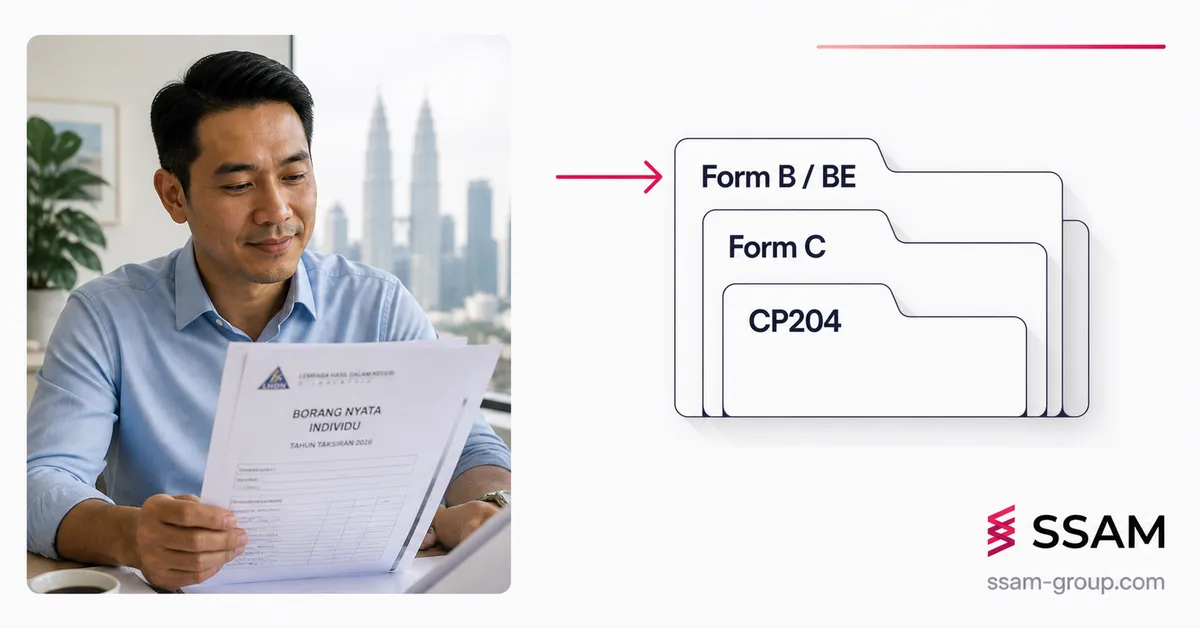
The legal anchor is Section 107C of the Income Tax Act 1967. CP204 is not your final tax return. That is Form C, filed after the year closes and reconciled against the instalments you have already paid. Think of CP204 as a pay-as-you-go schedule, and Form C as the year-end settlement.
Who must submit Form CP204 and when
CP204 applies to:
- Companies (Sdn Bhd, Bhd)
- Limited liability partnerships (LLPs)
- Trust bodies
- Co-operative societies
Sole proprietors and ordinary partnerships do not file CP204. They report through personal income tax forms instead.
Existing companies. Submit e-CP204 at least 30 days before the start of your basis period. If your financial year follows the calendar year, that means filing by 1 December of the previous year for a basis period beginning 1 January.
Newly incorporated companies. If your first basis period is six months or longer, you must submit e-CP204 within three months of commencing operations. Your first monthly instalment begins from the 6th month of that basis period, which gives your cash flow a short grace period.
SME exemption. Small and medium-sized companies that meet LHDN's SME criteria (generally paid-up capital of RM2.5 million or less and gross business income not exceeding RM50 million, subject to the related-company rules) are exempt from submitting CP204 and paying instalments for the first two years of assessment. Check your eligibility carefully before skipping submission, as the exemption is condition-based and can be lost if a related company fails the paid-up capital test.
Instalments fall due on the 15th of each month. Missing a deadline triggers a 10% late-payment penalty on the unpaid instalment.
How to calculate your CP204 tax estimate
Your CP204 estimate is not a guess. It is a forward-looking calculation built from your expected chargeable income for the year, multiplied by the tax rate that applies to your company.
Step 1. Forecast your chargeable income. Project revenue for the coming year, deduct expected operating costs, and adjust for non-deductible expenses, capital allowances, and any claimed reliefs. If you closed last year at RM500,000 chargeable income and expect flat performance, that is your starting point.
Step 2. Apply the right tax rate. For YA 2023 and onwards, the SME tiered rates are:
- 15% on the first RM150,000 of chargeable income
- 17% on the next RM450,000 (from RM150,001 to RM600,000)
- 24% on chargeable income above RM600,000
Non-SME companies pay a flat 24% across the board.
Step 3. Sense-check against last year. Your estimate must be at least 85% of last year's final CP204 or CP204A (whichever is higher). If it falls below that floor, LHDN may reject the filing or treat it as invalid. More on this in the next section.
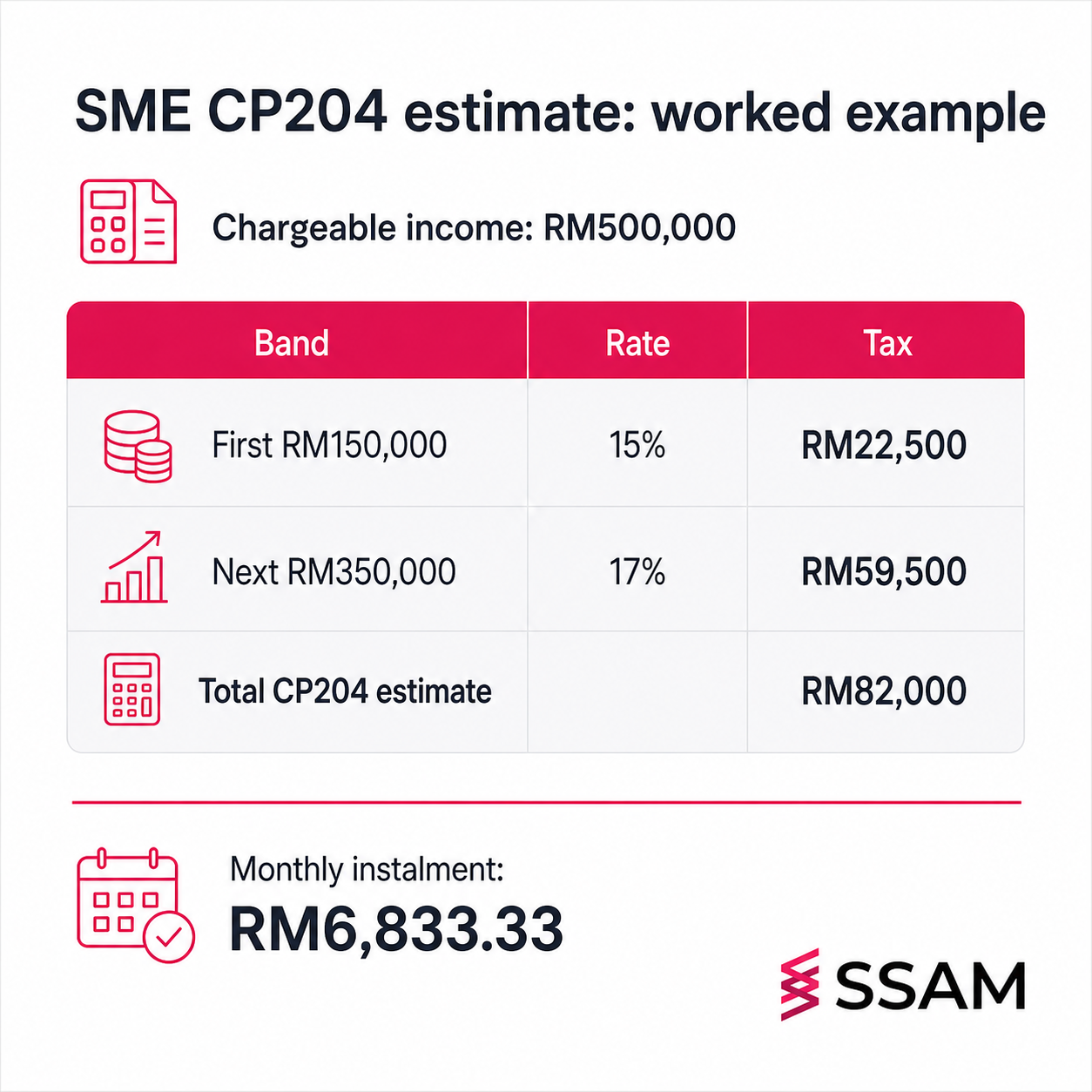
Worked SME example. A trading Sdn Bhd projects chargeable income of RM500,000.
- First RM150,000 × 15% = RM22,500
- Next RM350,000 × 17% = RM59,500
- Total CP204 estimate = RM82,000
- Monthly instalment = RM82,000 ÷ 12 = RM6,833.33
Worked non-SME example. A company with RM500,000 chargeable income and paid-up capital above RM2.5 million:
- RM500,000 × 24% = RM120,000
- Monthly instalment = RM120,000 ÷ 12 = RM10,000
Building the number is the easy part. Defending it through the year is where most businesses trip. Cross-check your assumptions against our round-up of common tax filing mistakes Malaysian SMEs make before you submit.
The 85% rule every Sdn Bhd must respect
Section 107C(3) sets a floor under your CP204: the current year's estimate must be at least 85% of the immediately preceding year's CP204 or CP204A, whichever was higher.
Why it matters: if your estimate falls below that 85% floor, LHDN can treat the submission as invalid, raise additional assessments, or, in edge cases, issue a CP205 notice that sets the tax estimate for you.
This rule puts pressure on businesses that have genuinely contracted. You cannot drop your estimate to RM1 just to protect cash. You must file at or above the 85% floor, then use Form CP204A to revise downwards once reality is clearer and you are within a permitted revision window.
Revising your estimate with Form CP204A
Real business performance rarely tracks your January forecast exactly. Form CP204A lets you revise your CP204 estimate in pre-set windows during the basis period:
- 6th month of the basis period
- 9th month of the basis period
- 11th month of the basis period (applicable from YA 2024 onwards, introduced under Budget 2024)
The 11th month window is the newest addition and gives you a final chance to correct the estimate before the year closes. Once the basis period ends, you cannot revise CP204. Any shortfall or overpayment reconciles through Form C.
When to revise upwards. If mid-year results show chargeable income will exceed your original estimate by more than 30%, revise up before year-end. This is the single cleanest way to avoid the under-estimation penalty.
When to revise downwards. If a large contract falls through, a major client exits, or input costs spike, revise down so you are not overpaying month after month. Cash parked in instalments is cash you cannot deploy into inventory, payroll, or growth.

Revisions are submitted through e-CP204A on the MyTax portal. The revised instalment schedule kicks in the month after submission.
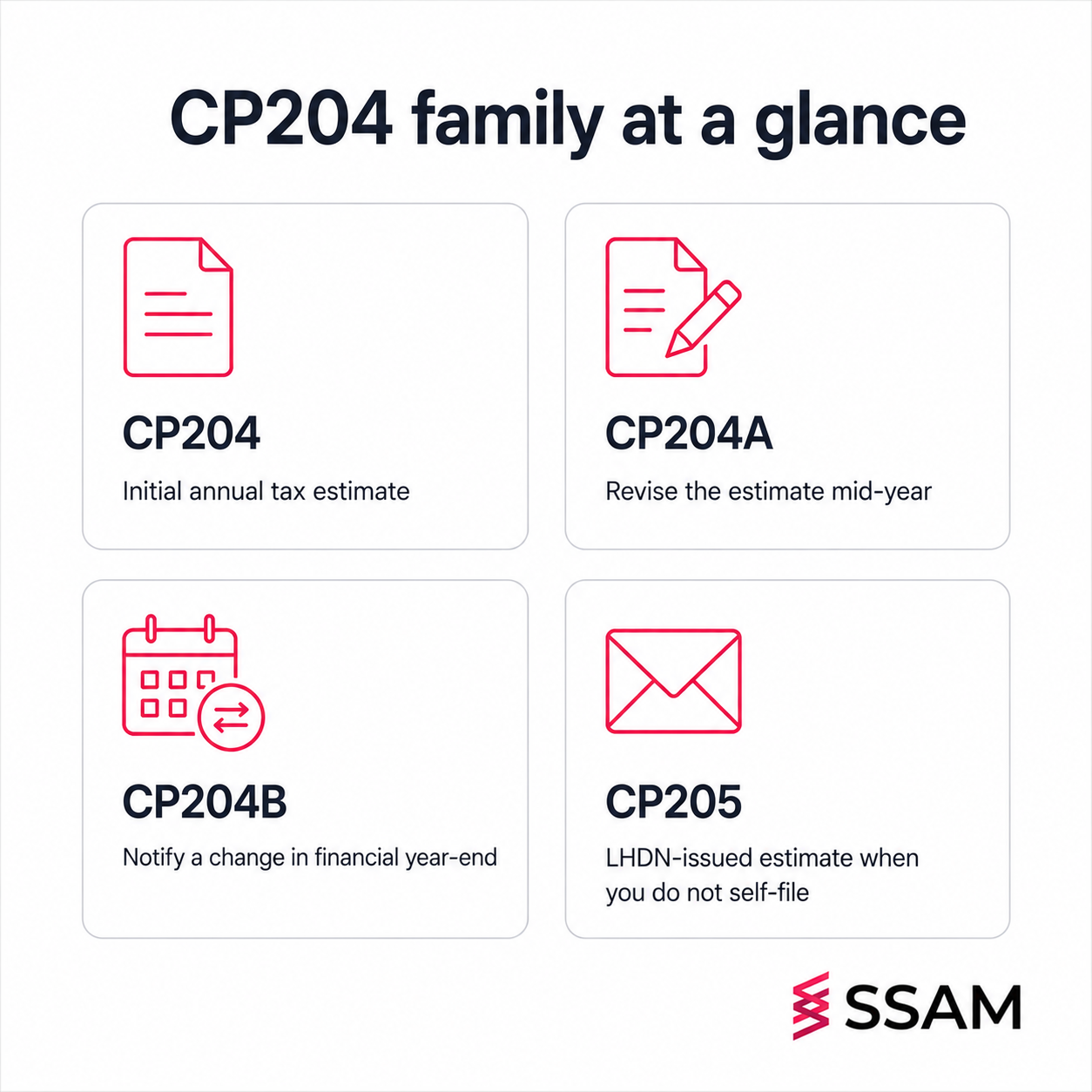
CP204 vs CP204A vs CP204B vs CP205: what is the difference?
Four forms sit inside the CP204 family, and knowing which one applies saves hours of guessing and one or two avoidable penalties.
| Form | Purpose | Who files it | When |
|---|---|---|---|
| CP204 | Initial estimate of tax payable for the year of assessment | Companies, LLPs, trust bodies, co-operatives | At least 30 days before the basis period (existing), or 3 months from commencement (new with basis period of 6 months or more) |
| CP204A | Revision of the CP204 estimate during the year | Same taxpayers as CP204 | 6th, 9th, and 11th month of the basis period (11th month from YA 2024) |
| CP204B | Notice to LHDN of a change in the company's financial year-end | Any taxpayer changing financial year-end | At least 30 days before the new basis period starts or ends, whichever is earlier |
| CP205 | Notice issued by LHDN setting the tax estimate when the taxpayer has not self-filed | Issued by LHDN to the taxpayer | When CP204 is missing, invalid, or rejected |
Many SMEs confuse CP204B with CP204A. CP204A changes the tax number. CP204B changes the financial year-end itself. They are not substitutes. If you are planning a change of year-end alongside a chargeable income revision, you may need both.
Penalties for under-estimation and late payment
Two distinct penalties sit in Section 107C, and both can hit the same company in the same year.
10% late-payment penalty (Section 107C(9)). Any monthly instalment not paid by the 15th of the month attracts an automatic 10% penalty on the unpaid amount. This applies per instalment, not per year. Missing multiple months compounds the damage quickly.
30% under-estimation penalty (Section 107C(10)). If your actual tax payable exceeds your CP204 or CP204A estimate by more than 30% of actual tax, LHDN imposes a 10% penalty on the shortfall that falls beyond the 30% buffer.
LHDN's formula:
Penalty = (Actual tax payable − CP204/CP204A estimate − (30% × Actual tax payable)) × 10%
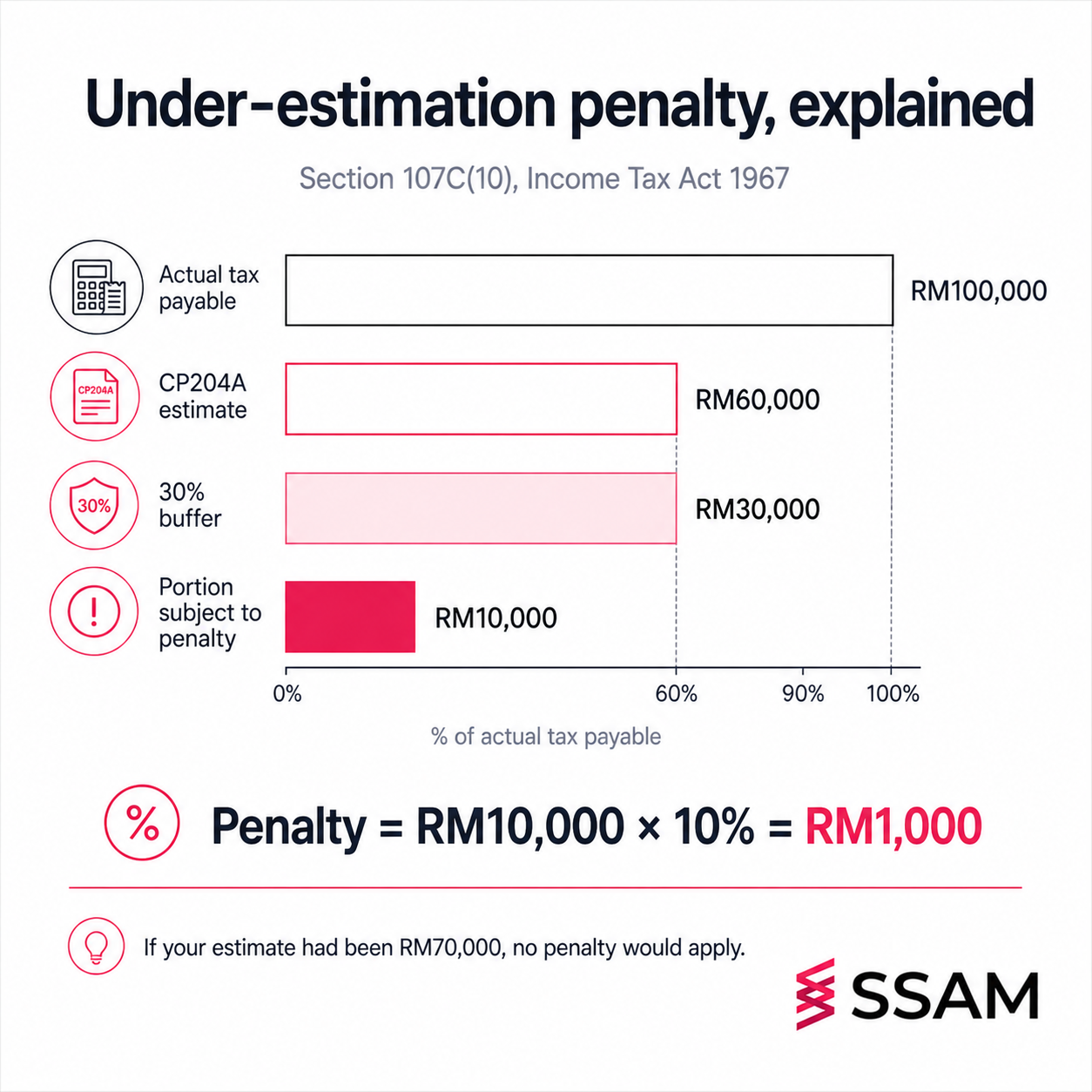
Worked penalty example. Your final Form C actual tax is RM100,000. Your last CP204A estimate was RM60,000.
- 30% buffer on actual tax = RM30,000
- Shortfall between actual and estimate = RM100,000 − RM60,000 = RM40,000
- Portion subject to penalty = RM40,000 − RM30,000 = RM10,000
- Penalty = RM10,000 × 10% = RM1,000
If your estimate had been RM70,000 instead, the shortfall would be RM30,000, which sits entirely within the 30% buffer, and no penalty would apply.
For the wider picture on penalties across Form C, Form E, and other filings, see our guide on LHDN penalties for late tax filing.
How to submit CP204 via MyTax (e-CP204)
All CP204 submissions are done online through the MyTax portal. Paper forms are no longer accepted for most taxpayers.
- Log in at
mytax.hasil.gov.myusing your director's digital certificate or your authorised company PIC access. - Under the Services menu, select e-Filing, and then choose e-Company's Tax Estimation.
- Choose your company basis period.
- Key in the estimated tax payable for the year.
- Review the system-calculated monthly instalment and the first payment due date.
- Submit and save the acknowledgement PDF. This is your filing proof.
Payment is made separately through MyTax or via bank giro using LHDN's virtual account. Make sure your finance team or payroll processor knows the monthly instalment amount so cash is ready before the 15th of each month.
For a full map of your company's filing dates alongside CP204, see our breakdown of Malaysia tax filing deadlines 2026.
Closing thoughts: get the estimate right, then adjust
A well-chosen CP204 estimate protects two things at once: your cash flow and your compliance record. The defensible middle ground is not the lowest legal number or the safest high one. It is the number your forecast genuinely supports, reviewed at the 6th, 9th, and 11th month so you adjust as reality unfolds.
If your year-to-date performance is drifting too far from your estimate, act at the next CP204A window rather than waiting for Form C. If you are a first-time Sdn Bhd director and want a full picture of what else sits on your plate, read our companion guide on first-time Sdn Bhd director tax obligations alongside this article, or speak to SSAM for a calm, second-opinion review of your tax estimate before you file.
Frequently asked questions about CP204
What is CP204 in simple terms?
CP204 is the form a Malaysian company, LLP, trust body, or co-operative submits to LHDN to declare its estimated tax payable for the coming year. The figure on CP204 is then paid to LHDN in 12 equal monthly instalments, due on the 15th of each month.
When is the first CP204 instalment due for a newly incorporated company?
A newly incorporated company with a first basis period of six months or longer has three months from the date of commencement of operations to submit e-CP204. The first monthly instalment begins from the 6th month of that first basis period, giving the business a short runway before cash outflows start.
Can I revise my CP204 estimate more than once?
You can revise CP204 up to three times in the basis period using Form CP204A, in the 6th, 9th, and 11th months. The 11th month window applies from YA 2024 onwards. Once the basis period closes, the final reconciliation happens through Form C.
What happens if my CP204 under-estimates actual tax by more than 30%?
Under Section 107C(10), if your actual tax payable exceeds the CP204 or CP204A estimate by more than 30% of actual tax, a 10% penalty applies on the portion of the shortfall that falls beyond the 30% buffer. The penalty is calculated and issued after you file Form C and the final tax is known.
Is my SME exempt from CP204 in its first two years of assessment?
Qualifying SMEs (generally paid-up capital of RM2.5 million or less and gross business income not exceeding RM50 million, subject to related-company tests) are exempt from submitting CP204 and paying instalments for the first two years of assessment. Eligibility is condition-based, so confirm your status before skipping the filing.
Do I still need to file Form C after paying CP204 instalments?
Yes. CP204 instalments are advance payments only. You must still file Form C, Form B, or Form E depending on your entity type, reconcile the actual tax payable, and settle any balance of tax within seven months from the close of the accounting period.
Data sources and references
- Section 107C, Income Tax Act 1967.
- LHDN (Inland Revenue Board of Malaysia), Forms and CP204 guidance:
https://www.hasil.gov.my/en/ - LHDN MyTax portal:
https://mytax.hasil.gov.my/ - Budget 2024 announcement introducing the 11th month CP204A revision window.
The information in this article is provided for general informational purposes only and does not constitute tax, accounting, financial or legal advice. Tax laws change frequently and may not apply to your situation. Always consult a qualified professional before acting on any information here.