

Key Takeaways
- Capital gains tax (CGT) and real property gains tax (RPGT) are two separate Malaysian taxes, and a single disposal is never taxed under both.
- RPGT still covers every direct disposal of land, buildings, or interests in land in Malaysia for every type of disposer.
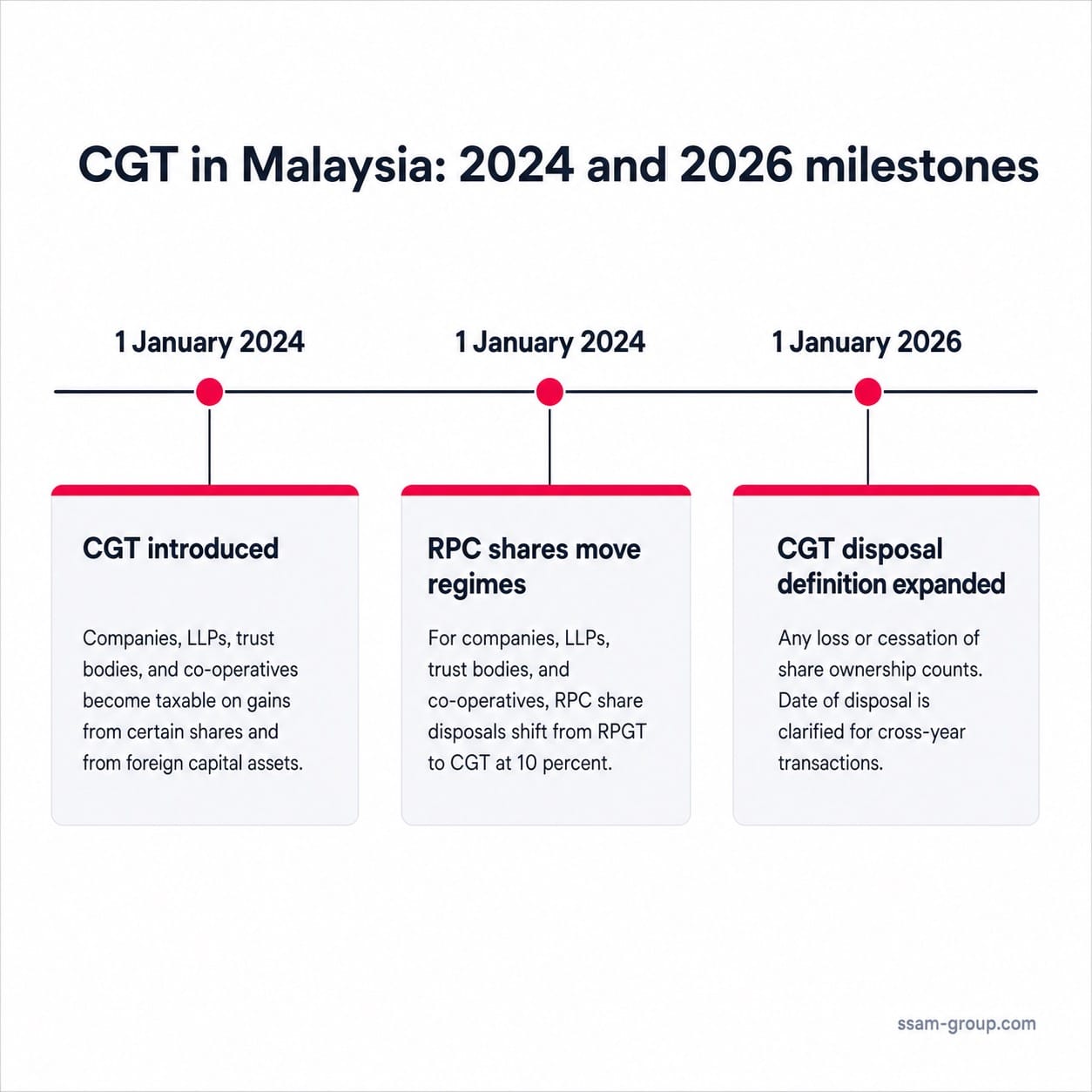
- From 1 January 2024, RPC share disposals by companies, LLPs, trust bodies, and co-operatives moved out of RPGT and into CGT at 10 percent.
- Individuals are generally outside CGT, so personal share sales stay in RPGT only when the shares are RPC shares.
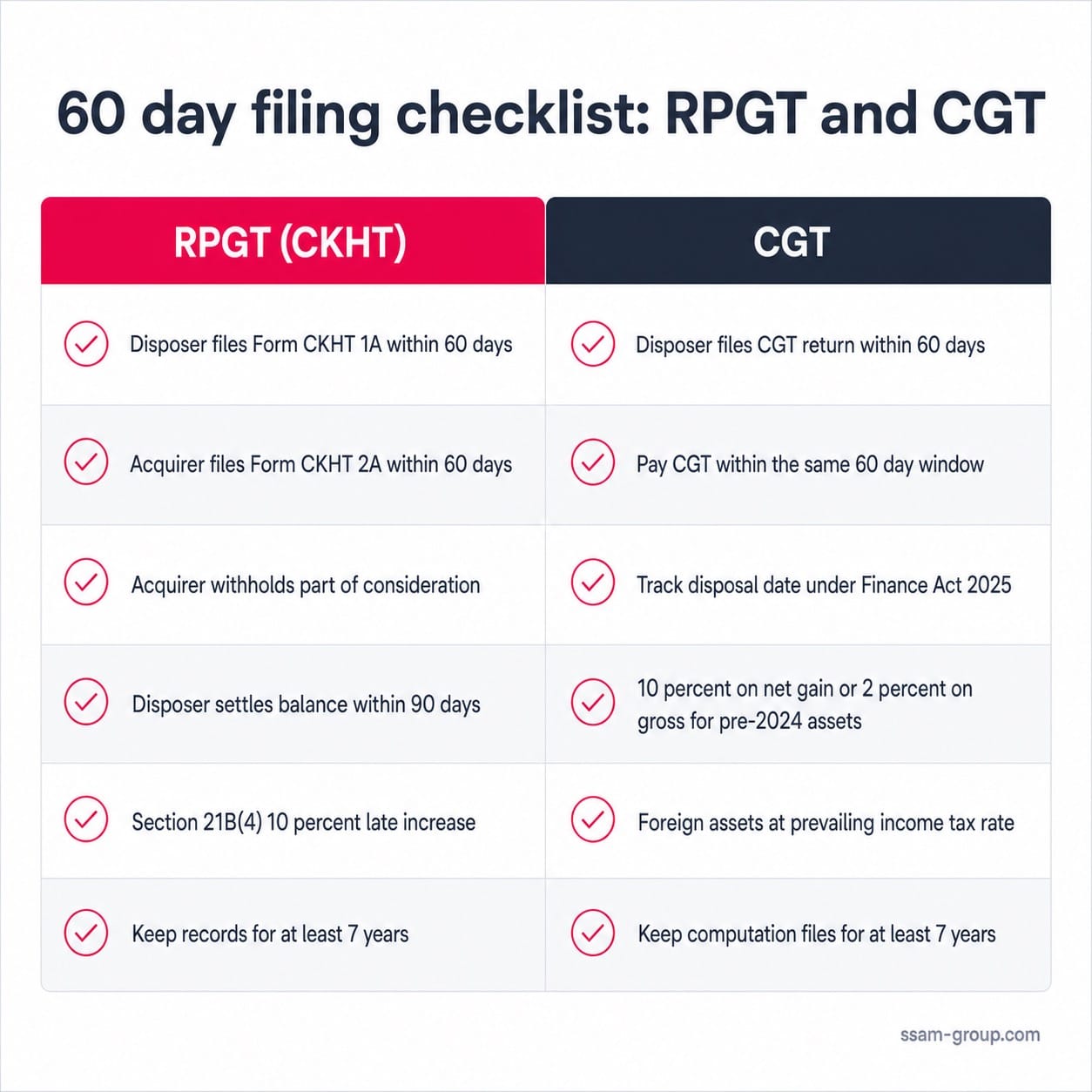
- Both regimes have a 60 day filing window from the disposal date, so the form is different but the deadline is not.
Capital gains tax vs RPGT Malaysia is one of the most confusing tax questions for Sdn Bhd owners and SME finance teams since CGT was introduced on 1 January 2024. Both taxes look like they apply to the same kind of transaction, but they sit in two different Acts, with two different scopes and two different chargeable persons. This guide walks through the difference, shows you which regime applies to which disposal, and flags the five mistakes that come up most often during LHDN reviews.
What is the difference between CGT and RPGT?
CGT and RPGT are two separate Malaysian taxes. RPGT, under the Real Property Gains Tax Act 1976, taxes disposals of real property and RPC shares in Malaysia. CGT, effective 1 January 2024, taxes companies, LLPs, trust bodies, and co-operatives on certain unlisted shares and on foreign capital assets received in Malaysia. A single disposal is never taxed under both.
Quick comparison: CGT vs RPGT at a glance
| Factor | RPGT | CGT |
|---|---|---|
| Governing law | Real Property Gains Tax Act 1976 | Income Tax Act 1967 (as amended by Finance (No.2) Act 2023) |
| Effective date | 1976 | 1 January 2024 |
| Who is taxed | Every disposer, including individuals, companies, LLPs, partnerships, trustees, societies | Companies, LLPs, trust bodies, co-operatives |
| What is taxed | Real property in Malaysia and RPC shares (RPC shares only for individuals from 1 Jan 2024 onwards) | Unlisted shares of Malaysian companies, Section 15C shares, foreign capital assets received in Malaysia |
| Rate | 0 percent to 30 percent depending on holding period and disposer | 10 percent on net gain, or 2 percent on gross for pre-2024 assets, or prevailing income tax rate for foreign assets |
| Holding period sensitive | Yes | No |
| Filing form | CKHT 1A (disposer), CKHT 2A (acquirer) | CGT return |
| Deadline | Within 60 days of disposal | Within 60 days of disposal |
What does RPGT cover and how is it taxed?
RPGT applies to gains from disposing real property in Malaysia, plus shares in a Real Property Company. It is the older and more familiar of the two regimes, and it still does most of the heavy lifting for property transactions. The big shift since 1 January 2024 is that RPC share disposals by certain disposers have moved out of RPGT and into CGT.
RPGT disposers and categories
RPGT applies to every kind of disposer. That includes individuals (citizens, permanent residents, non-citizens, non-PRs), Sdn Bhd companies, LLPs, partnerships, trustees, and societies. Your RPGT rate depends on which category you fall into and how long you held the asset.
RPGT rates by holding period (2025)
| Holding period | Citizens and PRs | Companies | Foreigners and non-PRs |
|---|---|---|---|
| Up to 3 years | 30 percent | 30 percent | 30 percent |
| 4th year | 20 percent | 20 percent | 30 percent |
| 5th year | 15 percent | 15 percent | 30 percent |
| 6th year onwards | 0 percent | 10 percent | 10 percent |
Common RPGT exemptions to know
Three exemptions help most individuals reduce or remove the RPGT bill:
- A flat exemption of RM10,000 or 10 percent of the chargeable gain, whichever is higher, per disposal for individuals.
- The once-in-a-lifetime private residence exemption for citizens and permanent residents under Section 8 of the RPGT Act.
- Disposal of low or medium-cost residential homes valued at RM200,000 or below for citizens.
Family transfers between spouse, parent, or child are deemed no gain no loss. Transfers into REITs and Property Trust Funds also have specific reliefs.
What does CGT cover and how is it taxed?
CGT is the newer regime. Before 1 January 2024, gains on most non-property capital assets were not taxed in Malaysia at all. Finance (No.2) Act 2023 changed that for a specific group of disposers and a specific group of assets.
Chargeable persons under CGT
Only four types of disposer sit inside the CGT net:
- Companies (including Sdn Bhd)
- Limited Liability Partnerships (LLPs)
- Trust bodies
- Co-operatives
Individuals are generally outside CGT. So if you sell unlisted shares in your personal name, the disposal is usually not subject to CGT. RPGT may still apply if those shares happen to be RPC shares.
Current CGT rate scenarios
| Asset | Rate |
|---|---|
| Capital assets acquired on or after 1 January 2024 | 10 percent on net gain |
| Capital assets acquired before 1 January 2024 | 10 percent on net gain or 2 percent on gross disposal price (disposer's option) |
| Foreign capital assets received in Malaysia | Disposer's prevailing income tax rate (24 percent headline for companies) |
Section 15C shares and the foreign-company test
CGT also reaches Section 15C shares. Those are shares in a foreign company that, directly or indirectly, owns Malaysian real property or RPC shares meeting the 75 percent test. If a CGT-in-scope disposer sells those shares, the gain is brought into Malaysia under CGT even though the share itself is foreign-issued.
CGT or RPGT: which one applies to your disposal?
Most SME owners get the two regimes mixed up because the disposal looks similar on paper. The cleanest way to decide is to ask three questions in order: what are you disposing of, who is the disposer, and when was the asset acquired.
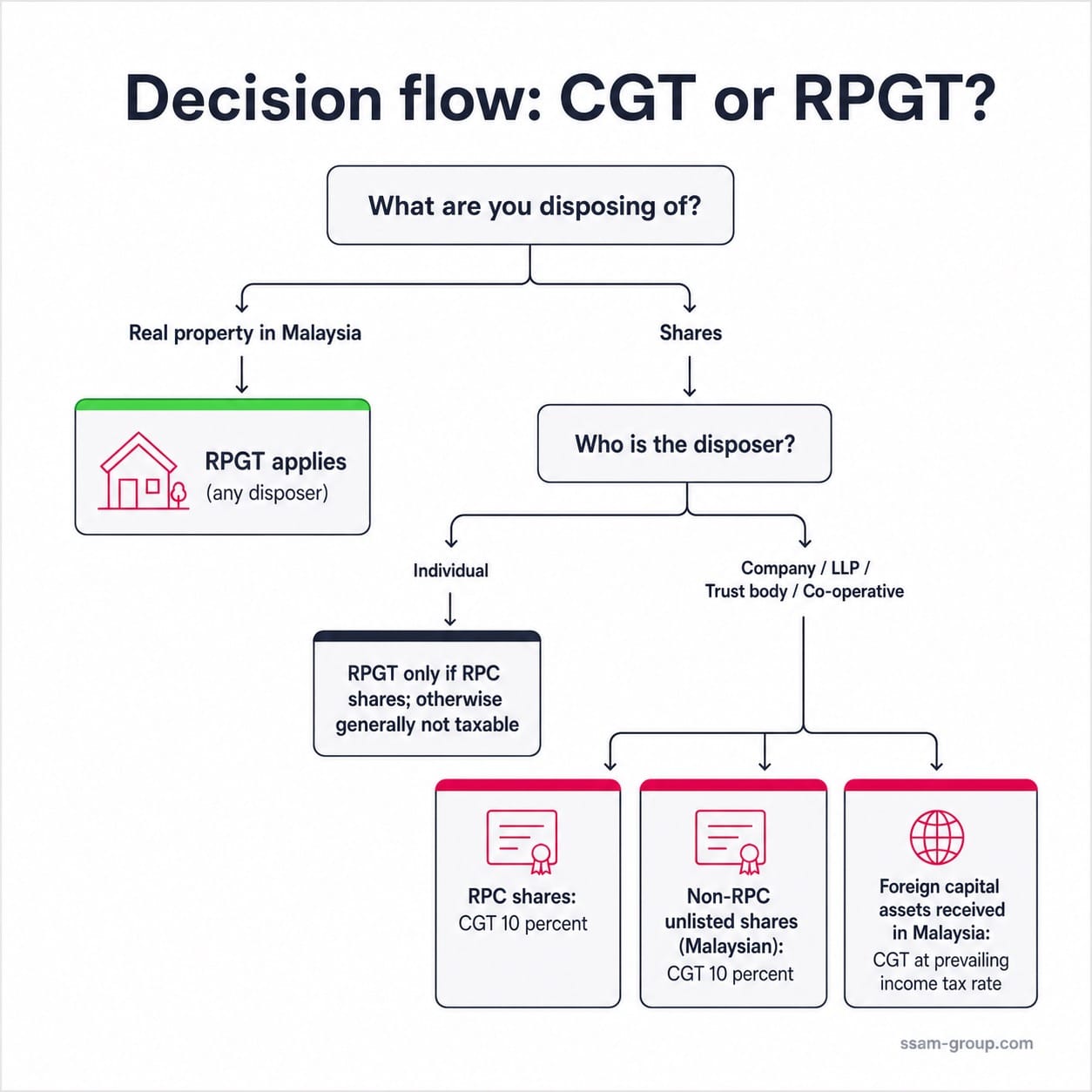
Direct real property in Malaysia
This stays under RPGT, no change. If your Sdn Bhd sells an office unit, a shophouse, a piece of land, or any interest in Malaysian land, the gain is RPGT, not CGT. The same applies if an individual sells a private residence or an investment property.
Worked example: A Sdn Bhd disposes of an office unit in Year 4 with a chargeable gain of RM200,000. RPGT at 20 percent is RM40,000.
RPC shares disposed by a company
This is the big switch. Before 1 January 2024, an RPC share disposal by any disposer was RPGT. From 1 January 2024 onwards, when a CGT-in-scope disposer (a company, LLP, trust body, or co-operative) sells RPC shares, the gain moves to CGT.
Worked example: A Sdn Bhd disposes of RPC shares acquired in 2025 with a chargeable gain of RM150,000. CGT at 10 percent is RM15,000.
RPC shares disposed by an individual
An individual selling RPC shares stays under RPGT, exactly as before. Individuals are not CGT chargeable persons, so the regime does not apply to them for this disposal type.
Non-RPC unlisted shares: company disposers
If a Sdn Bhd, LLP, trust body, or co-operative sells unlisted shares of a Malaysian company that is not an RPC, the gain falls under CGT. Before 1 January 2024 there was no Malaysian capital gains tax on this kind of share at all.
Foreign capital assets received in Malaysia
A CGT-in-scope disposer that brings foreign capital gains back into Malaysia is taxed at the prevailing income tax rate, currently 24 percent for companies. This is the most overlooked CGT scenario for groups with overseas holdings. New Sdn Bhd entities mapping out their first-year obligations should run through the tax compliance checklist Sdn Bhd Malaysia before they sign any disposal paperwork.
5 common SME mistakes when picking CGT vs RPGT
These are the patterns that surface during LHDN reviews and tax agent file checks. Each one is fixable with a quick decision-flow check before you submit any disposal paperwork.
1. Treating individual share sales as CGT
Individuals are not in the CGT net. If you sell shares in your personal name, do not lodge a CGT return for that disposal. RPGT may still apply if the shares are RPC shares. Otherwise, the disposal is typically not taxable unless you are trading shares as a business.
2. RPC shares moved to CGT for companies
Many SME owners still file CKHT 1A on RPC share disposals by their Sdn Bhd. Since 1 January 2024, those gains belong in a CGT return, not a CKHT form. Filing on the wrong form means filing the wrong tax even if you remit the right amount of cash. Keep your supporting computation and contracts in good order so the file holds up under the LHDN 7 year audit Malaysia record retention rules.
3. Missing the 60 day filing window
Both CGT and RPGT have a 60 day filing window from the disposal date. RPGT also requires the disposer to settle the balance of tax within 90 days of disposal, and late RPGT payment attracts a 10 percent increase under Section 21B(4) of the RPGT Act. CGT carries general LHDN late payment exposure on top of its 60 day deadline. The fastest way to lose money on a clean transaction is to miss the form date. Our LHDN tax audit Malaysia preparation guide is a useful checklist if you want to tighten the process before any disposal cycle.
4. Mis-classifying a company as an RPC
A controlled company is an RPC if 75 percent or more of its total tangible assets are real property and shares in another RPC. Many SMEs assume any property-owning company is an RPC. If the property holding falls below the 75 percent threshold, the share disposal sits outside the RPC rules and the tax answer changes. Get the asset test reviewed before you sign the share sale and purchase agreement.
5. Overlooking the 2026 CGT expansion
The 2026 expansion of the CGT disposal definition will catch more share movements than a straight sale. Mergers, share buybacks, capital reductions, and any cessation of share ownership through another mechanism are now in scope. If you are mid-way through a corporate exercise that closes after 1 January 2026, plan the timing on the new rules. While you are at it, review related Sdn Bhd traps such as the advance to director Malaysia tax treatment, which often surfaces during the same review cycle.

SSAM operates as a MOF-licensed tax agent through TSE Taxation Services Sdn Bhd (Reg No. 198401012049 / 124590-A). With 40 years of experience, 1,000+ clients, and 99 percent client satisfaction, the SSAM team handles RPGT and CGT computations, CKHT and CGT return filing, and disposal planning under one roof.
What is changing in 2026 under Finance Act 2025?
Finance Act 2025 was gazetted on 31 December 2025 and takes effect from 1 January 2026. Two changes matter for capital gains tax planning.
First, the disposal definition is expanded. CGT now covers any loss or cessation of share ownership through any mechanism, not only an outright sale. That captures share buybacks, share-for-share exchanges, capital reductions involving share cancellations, and corporate restructurings that move shares between group entities.
Second, the date of disposal is clarified. The clarification reduces ambiguity for transactions where signing and completion fall in different tax years, which directly affects the 60 day filing clock.
For groups doing a 2026 restructure, two practical effects matter:
- A share movement that previously would not have triggered CGT might now trigger it.
- The timing trigger needs to be tracked from the new date-of-disposal rule, not from the cash settlement date.
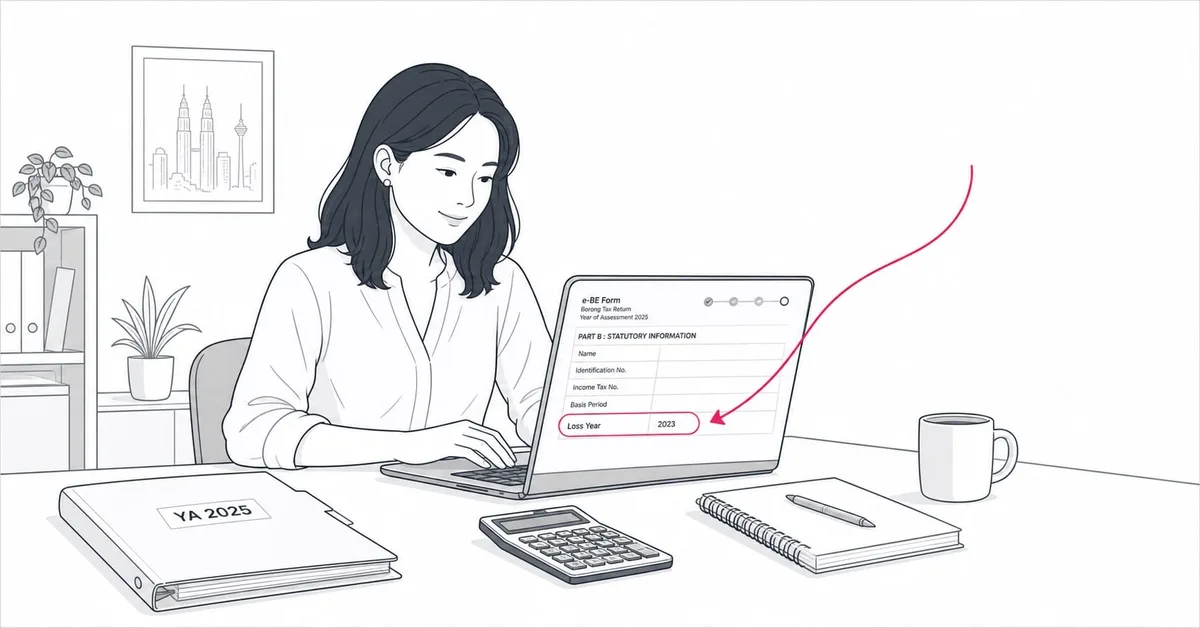
When a disposal year overlaps with a loss year, the loss-relief mechanics still need to be filed correctly under income tax rules. Our guide on how to file tax return loss Malaysia walks through that. For SMEs juggling these compliance items alongside their day-to-day reporting, what is e-invoicing Malaysia covers the rollout that will run alongside CGT compliance over the next two years.
If your CGT trigger is a business sale or succession event, the strategy side is covered separately in our guide on what CGT means when selling your business in Malaysia. This article stays focused on the compliance side: which regime applies, the rate, and the 60 day filing window.
The decision logic is short. Identify the asset, identify the disposer, then identify the regime. From there, the form and the rate follow naturally. If you are unsure where a disposal lands, SSAM's tax filing and compliance services in Kuala Lumpur can classify the disposal before you sign the share sale and purchase agreement, not after.
WhatsApp the SSAM team on +6011-6529 9879 or email tax@ssam-group.com for a CGT or RPGT review. The team will classify the asset, run the disposer test, and walk you through the 60 day filing window step by step.
Frequently asked questions about CGT vs RPGT in Malaysia
Are CGT and RPGT the same tax in Malaysia?
No. They are two separate taxes governed by two different Acts. RPGT is governed by the Real Property Gains Tax Act 1976 and applies to real property and RPC share disposals. CGT was introduced on 1 January 2024 under Finance (No.2) Act 2023 and applies to companies, LLPs, trust bodies, and co-operatives on certain unlisted shares and foreign capital assets.
Do individuals pay capital gains tax in Malaysia?
Individuals are generally outside the CGT net. If you sell shares or other capital assets in your personal name, the gain is usually not subject to CGT. RPGT can still apply when an individual sells real property in Malaysia or shares in an RPC.
Is the sale of a house in Malaysia subject to CGT or RPGT?
A direct sale of a Malaysian house, land, or building is RPGT, never CGT. The rate depends on the holding period and the disposer category, ranging from 30 percent in the first three years down to 0 percent from the sixth year onwards for citizens and permanent residents.
What is the capital gains tax rate in Malaysia?
For domestic capital assets acquired on or after 1 January 2024, CGT is 10 percent on the net gain. For assets acquired before 1 January 2024, the disposer can choose 10 percent on net gain or 2 percent on the gross disposal price. For foreign capital assets received in Malaysia, the rate is the disposer's prevailing income tax rate, which is 24 percent for most companies.
How are RPC share disposals taxed after 1 January 2024?
For a company, LLP, trust body, or co-operative, an RPC share disposal is now CGT, not RPGT. For an individual, an RPC share disposal stays under RPGT. The 60 day filing window applies to both regimes, so the deadline does not change even if the form does.
Data sources and References
- LHDN, Real Property Gains Tax Rates: https://www.hasil.gov.my/en/rpgt/real-property-gains-tax-rpgt-rates/
- PwC Malaysia, Taxes on capital gains (RPGT): https://www.pwc.com/my/en/publications/mtb/real-property-gains-tax.html
- PwC Malaysia, Capital Gains Tax (CGT): https://www.pwc.com/my/en/issues/capital-gains-tax.html
- EY Malaysia, Malaysia's new capital gains tax regime: https://www.ey.com/en_my/technical/tax-alerts/malaysias-new-capital-gains-tax-regime-your-questions-answered
- KPMG Malaysia, Capital Gains Tax: What do you need to consider? (April 2024): https://assets.kpmg.com/content/dam/kpmg/my/pdf/capital-gains-tax-what-do-you-need-to-consider-updated-in-april-2024.pdf
- KPMG TaxNewsFlash, Malaysia Direct and Indirect Tax Measures in Finance Act 2025: https://kpmg.com/us/en/taxnewsflash/news/2026/01/malaysia-tax-measures-finance-act-2025.html
- Real Property Gains Tax Act 1976
- Finance (No.2) Act 2023
- Income Tax Act 1967
The information in this article is provided for general informational purposes only and does not constitute tax, accounting, financial or legal advice. Tax laws change frequently and may not apply to your situation. Always consult a qualified professional before acting on any information here.