

Key Takeaways
- Every Malaysian business must file a tax return each Year of Assessment, including those that made a loss or had no income.
- Filing in a loss year is what unlocks the 10-year unabsorbed business loss carry-forward under Public Ruling 1/2022.
- Skipping a return exposes you to Section 112 fines from RM200 to RM20,000 even when no tax is owed.
- Dormant Sdn Bhds still need to submit Form C and Form E, with NIL declarations where applicable.
- Missing two or more Years of Assessment moves you into Section 112(1A), where LHDN can issue a best-judgement assessment.
You still need to file a tax return when your business makes a loss in Malaysia, and the cost of skipping it is far higher than most owners realise. LHDN treats a loss year the same way it treats a profit year for filing purposes, and the income tax law does not contain a "no profit, no filing" exception. This guide walks through who has to file, what penalties apply if you do not, and how filing actually protects your future tax bill through the unabsorbed loss carry-forward.
Filing tax returns when your business makes a loss
Every Malaysian business is required to submit an annual income tax return, regardless of whether the year ended in profit, breakeven, or loss. That includes sole proprietors, partnerships, limited liability partnerships, Sdn Bhd companies, and dormant companies that did nothing during the year. The Inland Revenue Board reminded owners of this in a Bernama statement in April 2025, confirming that anyone earning business income, including content creators, YouTubers, influencers, and freelancers paid through brand collaborations, must report their income even if the year ended in a loss.
The reason is simple. Your income tax return is how LHDN sees that you exist as a business and what your tax position looks like. A loss is a tax position. Zero income is a tax position. Both must be filed before the deadline, on the correct form, through MyTax e-Filing.
If you have just registered your Sdn Bhd, work through the tax compliance checklist Sdn Bhd Malaysia before your first deadline so you do not miss a filing in your loss-making first year.
Must loss-making businesses still file tax in Malaysia?
Yes. Every Malaysian business must submit its income tax return by the relevant Form deadline, whether it made a profit, broke even, or recorded a loss. Filing is how the loss becomes a claimable carry-forward. Skipping the return triggers penalties under Section 112 of the Income Tax Act 1967, even when no tax is owed.
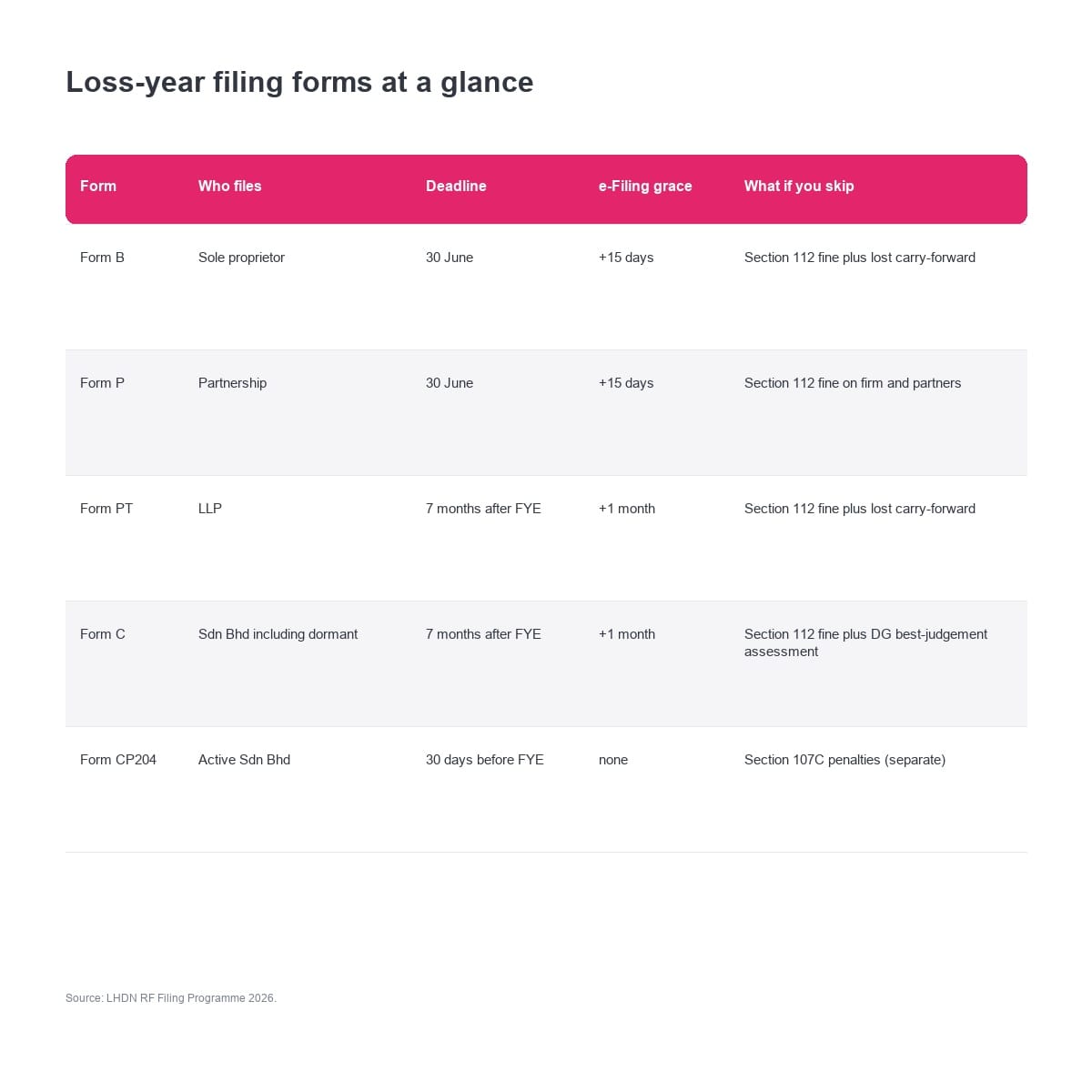
The rule applies across business structures. A sole proprietor uses Form B. A partnership files Form P, with each partner filing a personal Form B. An LLP files Form PT. A Sdn Bhd files Form C. Dormant companies still file Form C and, where applicable, Form E.
Penalties for skipping a loss-year tax filing
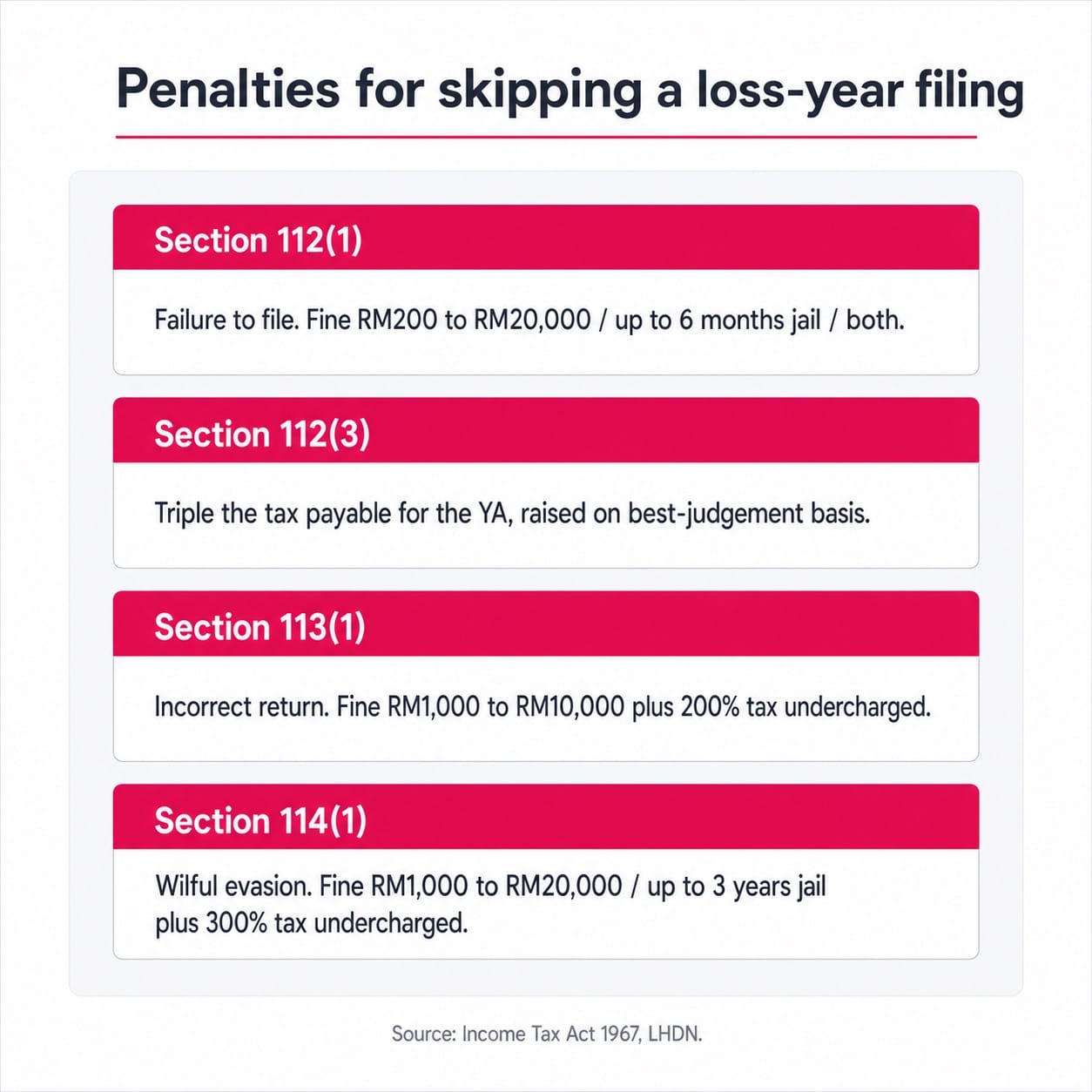
People often assume that no profit means no penalty. That is not how the Income Tax Act 1967 reads. The penalties below apply to the act of failing to file, not to the size of the tax bill.
- Section 112(1). Failure to furnish an Income Tax Return Form without reasonable excuse. Fine of RM200 to RM20,000, imprisonment of up to 6 months, or both.
- Section 112(3). Penalty equal to triple the tax payable for the Year of Assessment, raised on a best-judgement basis by the Director General.
- Section 113(1). Filing an incorrect return. Fine of RM1,000 to RM10,000, plus 200% of the tax undercharged.
- Section 114(1). Wilful evasion. Fine of RM1,000 to RM20,000, imprisonment of up to 3 years, or both, plus 300% of the tax undercharged.
- Late payment. A 10% surcharge on any unpaid tax, with a further 5% added if the balance remains unpaid after 60 days.
There is also a softer cost that owners forget about. A pattern of missed filings raises your audit profile, which means more scrutiny on later returns and slower processing for tax clearance letters when you need them. If a notice does arrive, the LHDN tax audit Malaysia process gives you specific rights and timelines to follow, but the easier path is to avoid the trigger in the first place.
How filing a loss return protects your future tax bill
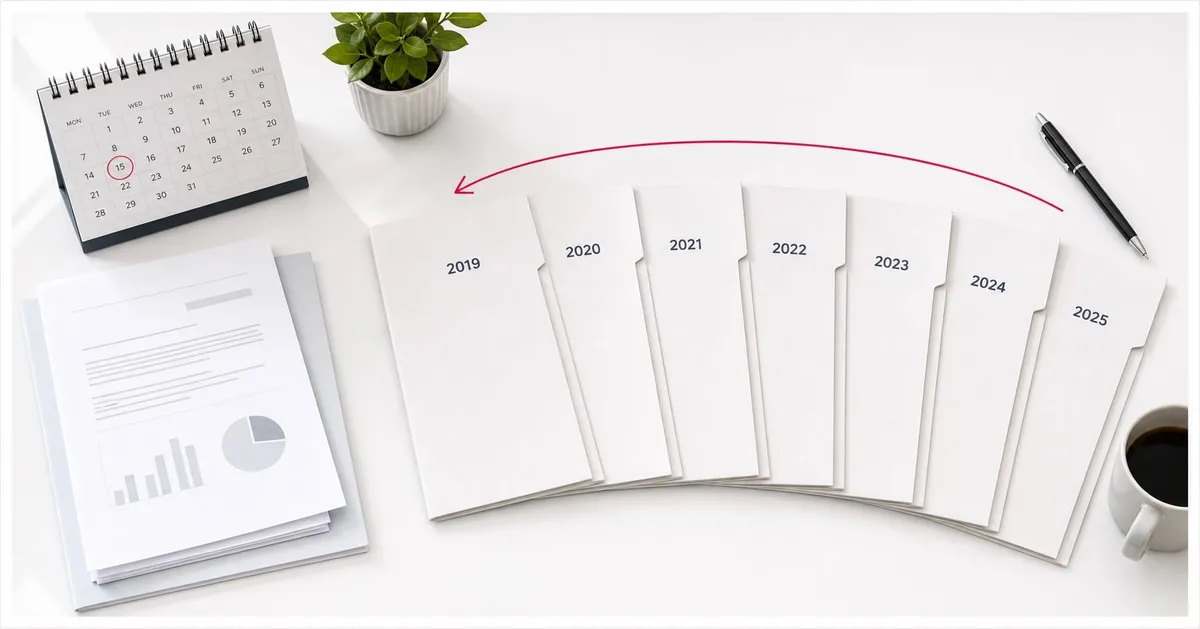
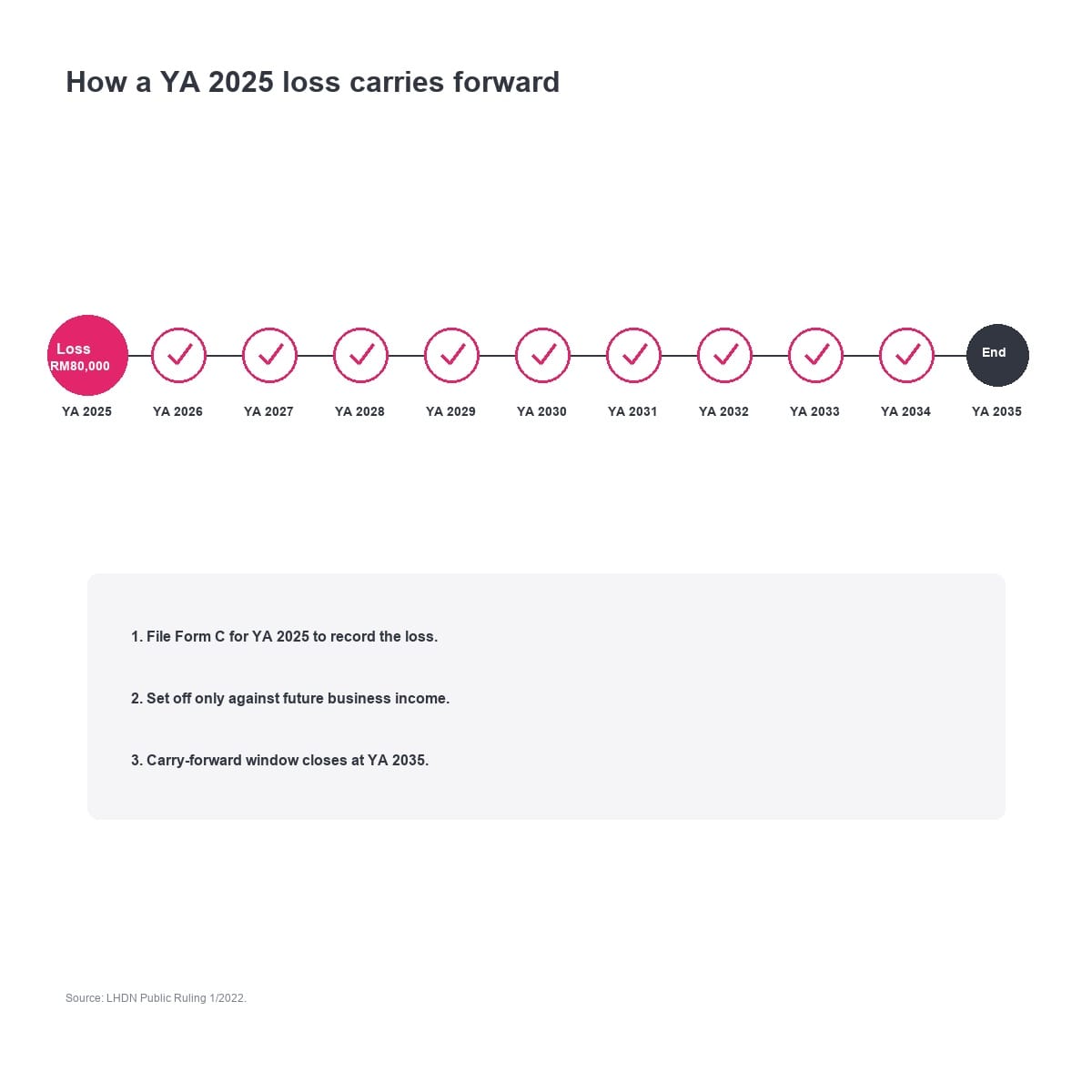
This is where filing turns from chore into asset. Public Ruling 1/2022 confirms that an unabsorbed adjusted business loss can be carried forward for 10 consecutive Years of Assessment, starting from YA 2019. The loss can only be set off against future business income, not against employment income, dividend income, or rental income earned through a non-business source.
Two ideas matter here.
Current-year set-off comes first. In the loss year itself, an adjusted business loss can be set off against your aggregate income from other sources for that same year, in line with Section 44(2) of the Income Tax Act 1967. Anything still unabsorbed becomes the carry-forward figure.
Carry-forward is what the next ten Years of Assessment can use. Capital allowances follow a separate rule and can be carried forward indefinitely against the same business source.
For groups of related companies, Public Ruling 2/2025 introduces group relief. A surrendering company in its first 3 Years of Assessment of operation may surrender up to 70% of its adjusted loss to a related claimant company, subject to a related-companies test. This is a useful planning tool for new ventures inside a holding structure.
A business loss is not the same as a capital loss on property, which has its own regime. If you also dispose of property or shares during a loss year, the capital gains tax vs RPGT Malaysia guide explains why those rules sit outside the business loss carry-forward.
How to file a loss-year tax return correctly
The mechanics of filing a loss return are the same as filing a profit return. The difference is in the numbers and in remembering to record the unabsorbed loss for future use. Here is the practical sequence.
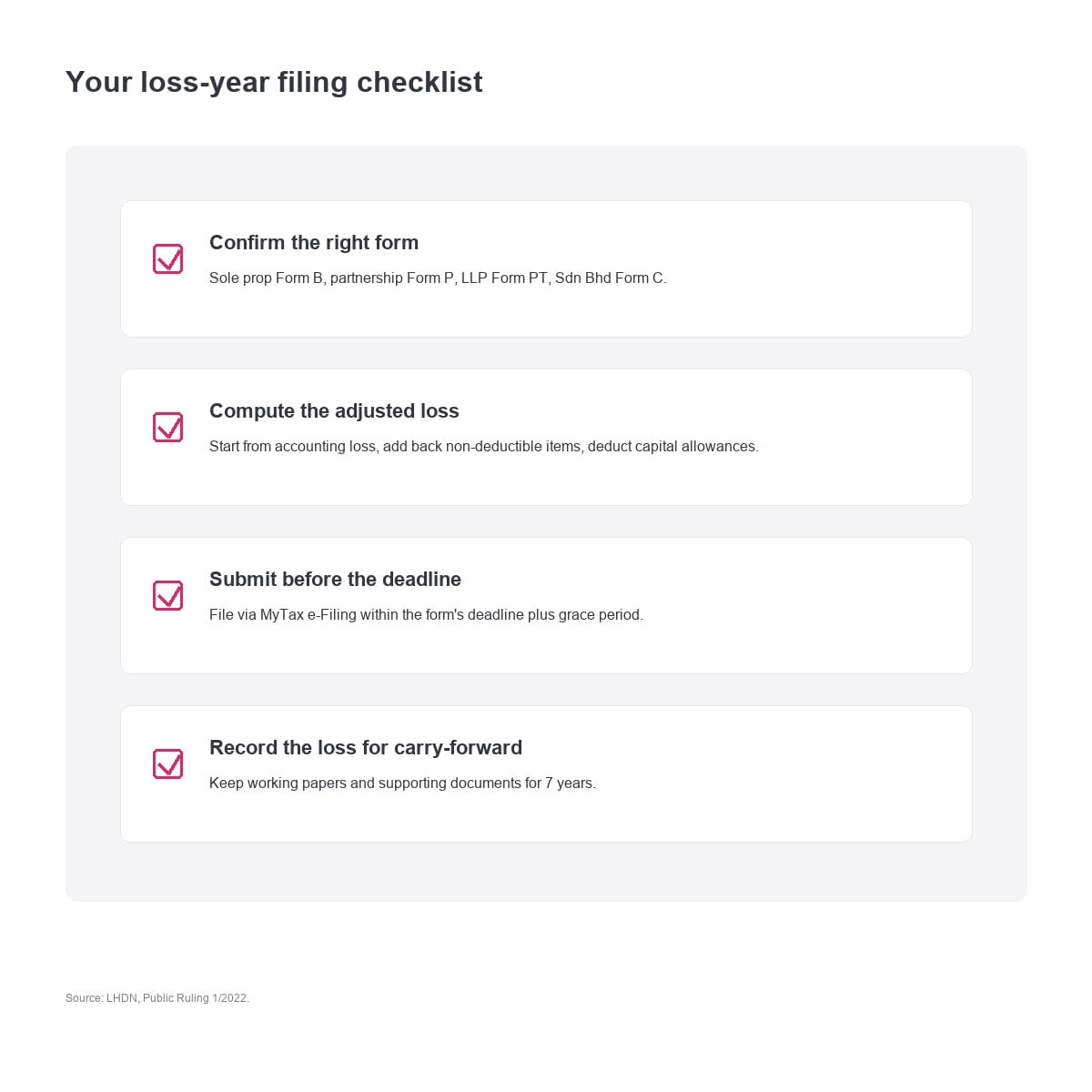
Step 1. Pick the correct form
- Sole proprietor: Form B.
- Partnership: Form P (the partnership) and Form B for each partner.
- LLP: Form PT.
- Sdn Bhd: Form C.
- Dormant Sdn Bhd: Form C with NIL income declared.
Step 2. Compute the adjusted loss
Start from your accounting loss, then apply the same tax adjustments you would apply for a profit return. Add back non-deductible expenses, deduct capital allowances, and arrive at the adjusted business loss. Capital allowances do not absorb beyond the available statutory income, so any excess capital allowance is recorded separately and carried forward indefinitely against the same business source.
Step 3. Submit on time through MyTax e-Filing
- Form B: 30 June, with e-Filing grace until 15 July (per the RF Filing Programme 2026).
- Form C: within 7 months after the financial year end, with e-Filing grace adding 1 month. e-Filing has been mandatory for companies since 2022.
- Form P: 30 June, with e-Filing grace until 15 July.
- Form PT: within 7 months after the financial year end.
- Form CP204: still required for active companies as a tax estimate, even if you expect a loss. Dormant companies are not required to submit CP204.
- Form E: for employers, with the e-Filing grace period applied per the same RF Filing Programme.
If you are also rolling out new tax-related processes for the year, the what is e-invoicing Malaysia guide covers the supporting documentation rules that affect how loss-year expenses are evidenced.
Step 4. Record the loss for carry-forward
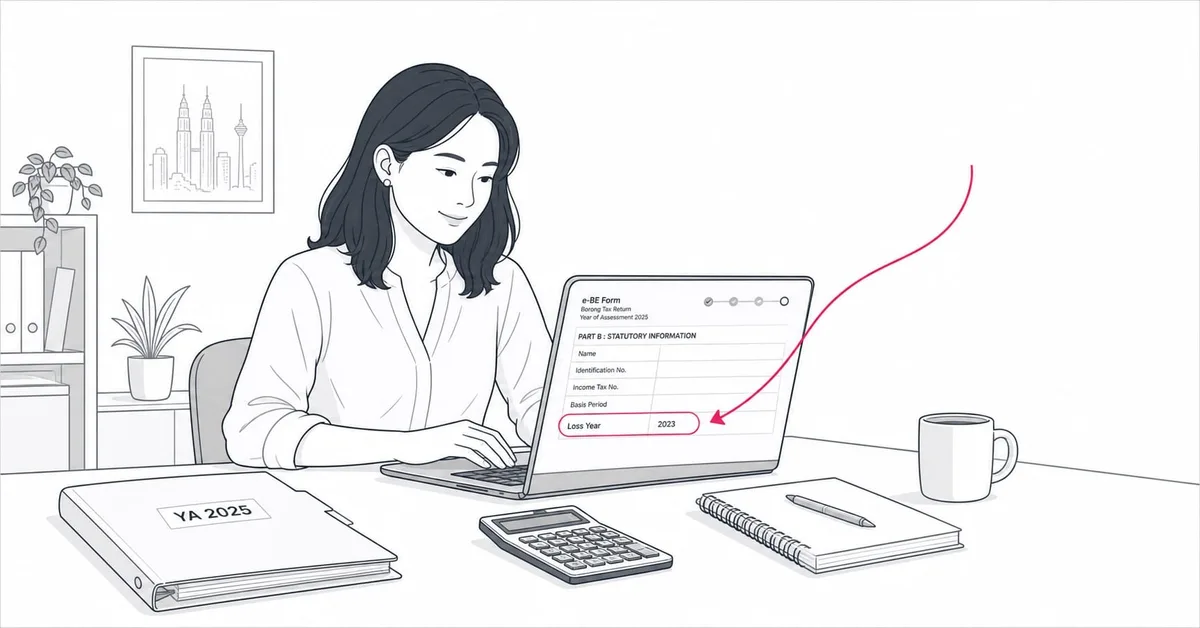
Inside Form C and Form B, the unabsorbed adjusted business loss is reported in a dedicated section. Keep your computation, working papers, and supporting documents for at least 7 years. LHDN can review historical filings within that window and ask you to substantiate any claim, including a loss carry-forward.
Why dormant Sdn Bhds must still file Form C
Dormant means a company that did not carry on any business operations during the basis period. Many directors assume "no business, no filing". LHDN's "Other Situation" guidance is clear that dormant companies, dormant LLPs, trust bodies, and co-operatives must still furnish their return forms, including Form E for employer reporting where applicable. A dormant Sdn Bhd that had no operations is not required to submit Form CP204 for that year.
A dormant company may also be eligible for audit exemption, subject to conditions in the Companies Act 2016 and the SSM Practice Directive on audit exemption. The conditions include not being a holding or subsidiary company in a group required to prepare consolidated accounts, and not being listed. Audit exemption does not remove the tax filing obligation. The Form C still goes in.
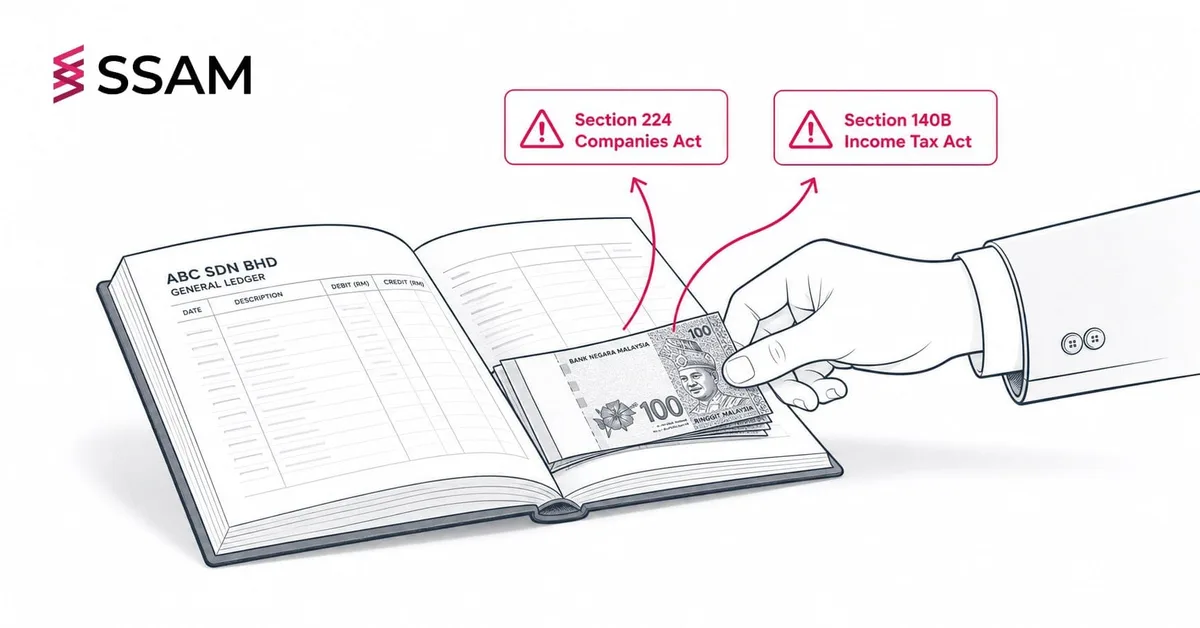
This is also a high-risk area for owners who quietly draw funds from a dormant Sdn Bhd. A debit balance in the director's account can trigger deemed interest and other tax adjustments. The advance to director Malaysia tax explainer covers what LHDN looks for and how to clean up the position before filing.
What LHDN does to repeat non-filers
Section 112(1A) is the part of the law that catches owners who have not filed for two or more Years of Assessment. The minimum fine moves up to RM1,000, with a maximum of RM20,000, plus a penalty equal to triple the tax payable. Importantly, the tax payable is determined on a best-judgement basis by the Director General, which means LHDN can estimate your income from any data it holds, including bank deposits, e-invoice records, and prior returns.
LHDN typically works backwards from your most recent activity using the 7-year record-keeping rule, then aligns the assessment with the Operational Guidelines on penalties under Section 112(3). If you have missed two or more years, the right move is to file the missing returns voluntarily before LHDN raises an assessment. Voluntary disclosure usually softens the penalty position.
If you are unsure how far back to go, the LHDN 7 year audit Malaysia guide explains the records you must keep, in what format, and how the lookback works in practice.
What to do if you are active, dormant, or behind
If your business is active and made a loss, you file your form by its deadline, you record the unabsorbed loss, and you protect your right to use it for up to 10 years against future business income. If your business is dormant, you still file the Form C with NIL declared, and you keep the structure compliant so that the company can be revived later without an audit trail of unfiled years.
If you are a director who has missed two or more Years of Assessment, the right step now is to gather your records, work backwards, and file voluntarily before LHDN issues a best-judgement assessment. The cost of cleaning up early is almost always lower than the cost of being caught.
If you would like a second pair of eyes on which form applies to your structure, or you want help reconstructing a loss year for an older filing, you can rely on SSAM's tax filing and compliance in Kuala Lumpur. Our team operates as an MOF licensed tax agent through TSE Taxation Services Sdn Bhd, with 40 years of experience and 1,000+ Malaysian SMEs supported through compliance milestones. WhatsApp the team on +6011-6529 9879 or email tax@ssam-group.com for a quick review.
Frequently asked questions about loss-year tax filing
Do I have to file tax if my business made no money at all this year?
Yes. Even with zero revenue, your business is still required to submit its annual income tax return on the correct form by the deadline. A NIL declaration is treated as a valid filing. Skipping it triggers Section 112 penalties even though the tax owed is zero.
How long can I carry forward unabsorbed business losses in Malaysia?
Up to 10 consecutive Years of Assessment under Public Ruling 1/2022, starting from YA 2019. The carry-forward can only be set off against future business income from the same source, not against employment, dividend, or non-business rental income. Capital allowances follow a separate rule and can be carried forward indefinitely against the same business source.
What is the penalty for not filing tax returns in Malaysia?
Section 112(1) carries a fine of RM200 to RM20,000, imprisonment of up to 6 months, or both. A best-judgement assessment under Section 112(3) adds a penalty equal to triple the tax payable. If the missed period covers two or more Years of Assessment, Section 112(1A) raises the floor fine to RM1,000.
Can a sole proprietor offset a business loss against salary in the same year?
In the loss year itself, a sole proprietor can set off the adjusted business loss against aggregate income from other sources for the same year under Section 44(2). Anything still unabsorbed becomes the carry-forward figure used against future business income only. Once carried forward, the loss cannot be set off against employment salary in later years.
What if I forgot to file my business tax for the past two years?
You should file the missing returns voluntarily as soon as possible. Section 112(1A) applies once two or more Years of Assessment are missed, with a higher minimum fine and a triple-tax penalty raised on a best-judgement basis. Voluntary disclosure usually softens the penalty position. Speak to a tax agent if the underlying records are incomplete.
Data Sources / References
- LHDN Offences, Fines and Penalties: https://www.hasil.gov.my/en/legislation/offences-fines-and-penalties/
- LHDN Public Ruling 1/2022 (Time Limit for Unabsorbed Adjusted Business Losses Carried Forward): https://phl.hasil.gov.my/pdf/pdfam/PR_01_2022.pdf
- LHDN Public Ruling 2/2025 (Group Relief for Companies): https://www.hasil.gov.my/media/aftjylxw/pr-2-2025-group-relief-for-companies.pdf
- IRB Bernama statement, 8 April 2025: https://www.hasil.gov.my/media/0b3p3yr1/20250408_bernama_business-owners-must-report-income-even-if-suffer-losses-irb.pdf
- LHDN Other Situation (dormant companies): https://www.hasil.gov.my/en/company/other-situation/
- LHDN RF Filing Programme 2026: https://www.hasil.gov.my/media/fqog1423/rf-filing-programme-for-2026.pdf
- LHDN Company filing process: https://www.hasil.gov.my/en/company/
The information in this article is provided for general informational purposes only and does not constitute tax, accounting, financial or legal advice. Tax laws change frequently and may not apply to your situation. Always consult a qualified professional before acting on any information here.