

Key Takeaways
- Every withdrawal from your Sdn Bhd that lands in the "amount owing by director" account is a regulated transaction under both the Companies Act 2016 and the Income Tax Act 1967.
- Section 224 of the Companies Act 2016 prohibits most loans to directors. A director who authorises a prohibited loan can face imprisonment of up to 5 years, a fine of up to RM3 million, or both.
- Section 140B of the Income Tax Act 1967 imposes deemed interest income on the company at the BNM Average Lending Rate, taxed at the corporate rate, whenever the loan is funded from internal funds.
- Salary, director's fee, dividend, expense reimbursement, or a properly approved formal loan are the five clean ways to take money out of your Sdn Bhd.
- A long-standing director's account is one of the first ledgers LHDN reviews during a tax audit, so cleaning it up before year end is far cheaper than fixing it after a notice arrives.
An advance to director in Malaysia looks harmless on the books, but Malaysian tax law treats it as a taxable event for your Sdn Bhd from the moment the money leaves the company account. If you have ever transferred company cash to your personal account, paid your credit card bill from the business, or quietly let an "amount owing by director" balance grow at year end, two separate laws are already counting against you. This guide walks you through what an advance to director really is, how Section 224 of the Companies Act 2016 and Section 140B of the Income Tax Act 1967 work together, the audit triggers LHDN looks for, and how to clean up an existing balance without panic.
What is an advance to director in a Sdn Bhd?
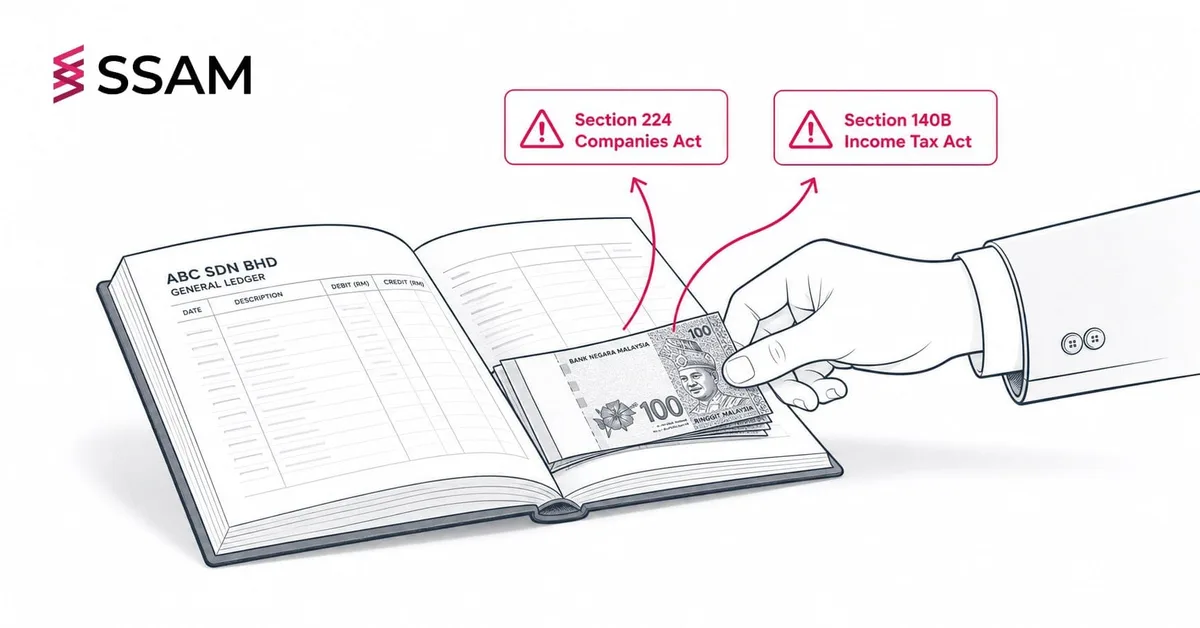
An advance to director is any company money that ends up in a director's hands without first being recorded as salary, director's fee, dividend, or a documented expense reimbursement. In your books, it usually sits in the account labelled "amount owing by director" or the director's current account. The cash can leave the company in three shapes: a direct cash advance, a payment made on the director's behalf such as paying a personal credit card bill from the company account, or a formal loan with a written agreement. All three are caught by the same rules, even if you fully intend to repay every ringgit.
Why advances to directors are a regulated transaction
Two laws sit on top of every withdrawal you make from your Sdn Bhd, and they answer two different questions.
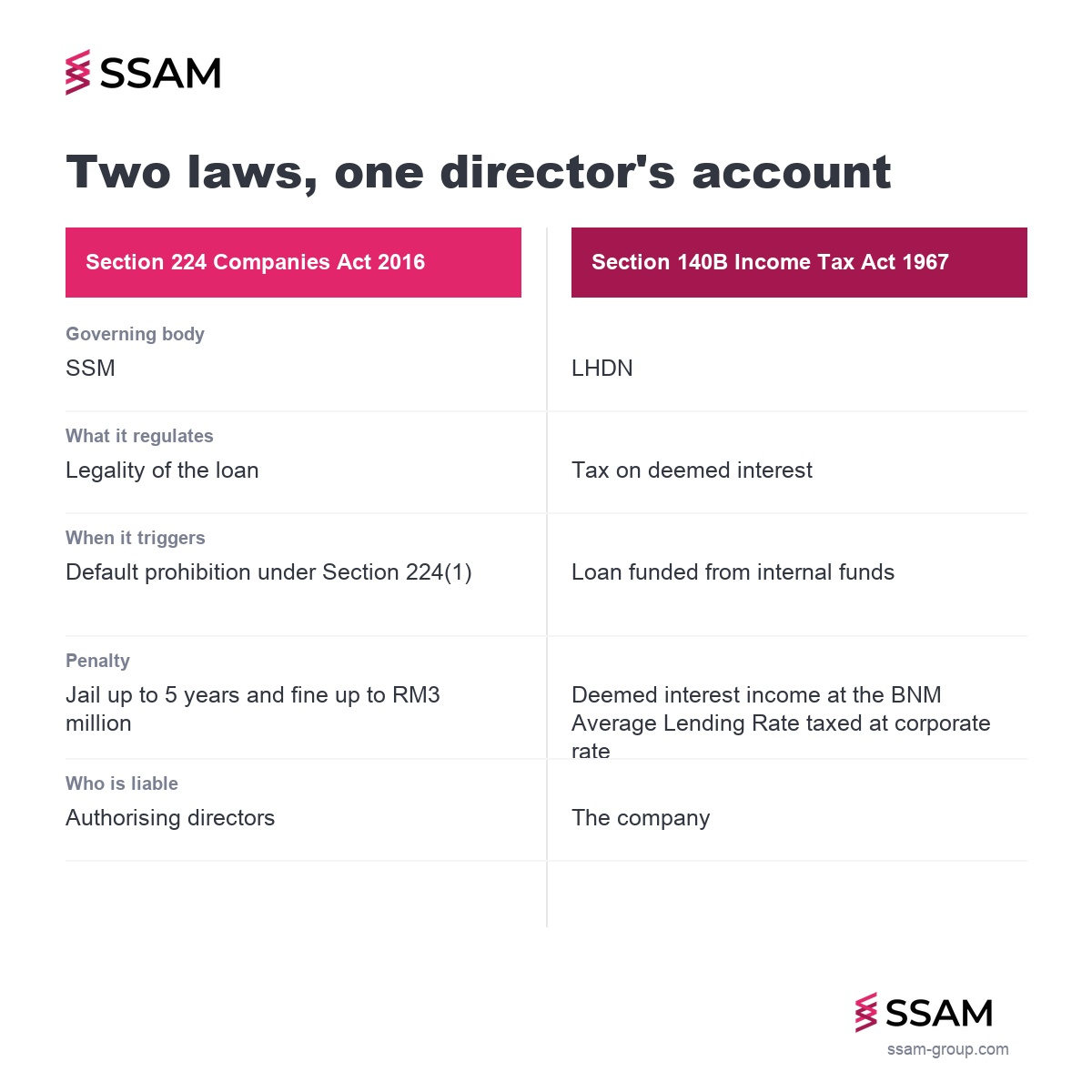
The Companies Act 2016 asks whether the loan is even legal in the first place. The Income Tax Act 1967 asks how much tax to charge you for it. The Companies Commission of Malaysia (SSM) enforces the first. LHDN enforces the second. You can be compliant under one and still in trouble under the other, which is why most casual director withdrawals are riskier than they look on the balance sheet.
The intention to repay does not protect you. An interest-free transfer that you plan to settle next month is still treated as a loan in both laws and is still measured against both tests.
Section 224 Companies Act 2016: the legal limit on director loans
Section 224 of the Companies Act 2016 is the rule that decides whether your Sdn Bhd is even allowed to lend money to you in the first place.
Default prohibition under Section 224(1)
Section 224(1) starts from a hard rule. A company must not, directly or indirectly, make a loan to a director, or give a guarantee or provide security in connection with a loan made to a director by anyone else. The same prohibition extends to directors of related companies under Section 7 of the Act.
In plain English, the default answer is no.
Statutory exceptions
Parliament built four narrow exceptions into Section 224 so that the rule does not break ordinary commerce.
- A loan that has been approved by the company's members at a general meeting, where the purpose and amount are disclosed in advance.
- Funds advanced to meet expenditure incurred by the director for the purposes of the company, for example a director paying a supplier on the spot and then being reimbursed.
- Loans to a director who is also a full-time employee, made under a staff loan scheme that is open to other employees on the same terms and approved by the members.
- A licensed financial institution making a loan to a director in the ordinary course of its banking business.
If your withdrawal does not fit cleanly into one of these four boxes, the safer assumption is that Section 224(1) applies.
Section 225: persons connected with directors
Section 225 closes the obvious loophole. A loan to your spouse, parent, child, or to a company you control through shareholding is treated the same way as a loan to you. SSM and the courts read connected-person rules broadly, so transferring the issue to a family member or a related Sdn Bhd does not solve it.
Penalties for breach
A director who authorises a prohibited loan or security commits an offence under Section 224(10). On conviction, the director is liable to imprisonment of up to 5 years, a fine of up to RM3 million, or both. The company can also recover the funds and hold the authorising directors jointly and severally liable for any loss.
These are not theoretical figures. They sit on the public face of the statute, and they apply to the directors who signed off, not just to the company.
Section 140B Income Tax Act 1967: how LHDN taxes director advances
Even when a loan is legal under Section 224, LHDN still wants its share. Section 140B sits inside the broader Section 140 anti-avoidance framework of the Income Tax Act 1967, which empowers the Director General of Inland Revenue to disregard or vary any transaction that has the effect of altering the incidence of tax. Section 140B is the specific lever that turns this anti-avoidance power on director loans, and Public Ruling No. 8/2015 explains how it is enforced.
Public Ruling No. 8/2015 in plain English
Public Ruling 8/2015, "Loan or Advances to Director by a Company", was issued by LHDN on 30 November 2015. It tells your Sdn Bhd that whenever it lends money to a director and the funds come from inside the company, the company must declare interest income on the loan, even if not a single ringgit of real interest is charged. LHDN deems the interest income, taxes it at the corporate rate, and adds it to your Form C.
Internal funds versus external funds
Section 140B only fires when the loan is funded from internal funds. The Public Ruling defines internal funds as the company's capital injection, retained earnings, or accumulated reserves. If your company instead borrows from a bank and on-lends to the director, the funds are external and Section 140B does not apply, although the Section 224 question still remains.
For most owner-managed Sdn Bhds, the cash sitting in the company account is internal funds by default. Assume the section applies unless you have clear evidence of bank-sourced funds.
The deemed interest formula
The formula is set out in the Public Ruling.
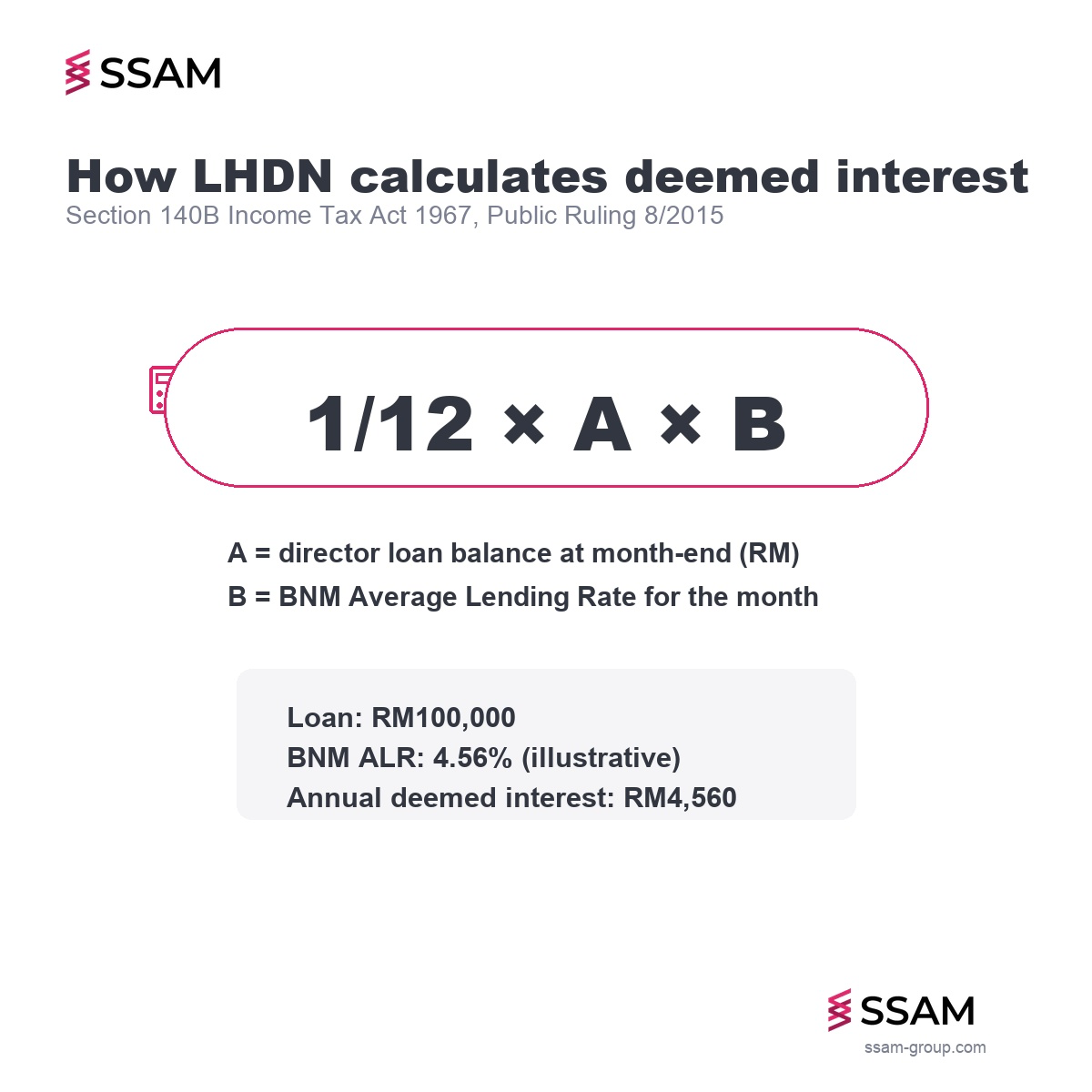
Monthly deemed interest = 1 ÷ 12 × A × B
A is the balance of the loan or advance to the director at the end of the calendar month, after any new advances and any repayments in that month. B is the Average Lending Rate of commercial banks published by Bank Negara Malaysia for the same month.
The deemed interest is calculated month by month, added together for the basis year, and disclosed as interest income under paragraph 4(c) of the Income Tax Act 1967.
Worked example with a RM100,000 advance
Imagine your Sdn Bhd advances RM100,000 to you on 1 January, funded entirely from retained earnings, with no repayments during the year. Take the BNM Average Lending Rate at roughly 4.56 percent, the figure most recently published by Bank Negara Malaysia in early 2026. Always reconfirm the current rate against the LHDN Section 140B Schedule before you finalise your own computation.
Monthly deemed interest = 1 ÷ 12 × RM100,000 × 4.56 percent = RM380 per month
Annual deemed interest = RM380 × 12 = RM4,560
Your company adds RM4,560 to its taxable income for that year of assessment. At the SME rate of 15 percent on the first RM150,000 of chargeable income, the extra tax is about RM684. At the standard 24 percent corporate rate, the extra tax is about RM1,094.
The amounts look small in isolation. Run them across two or three directors over five years on a balance that quietly grows, and the cumulative bill becomes meaningful, especially when LHDN catches it during a back-year audit.
Three other tax outcomes most owners do not see coming
Section 140B is the one most accountants flag. The next three are quieter but show up in real audits.
Reclassification as the director's perquisite
If LHDN sees a sustained pattern of advances that look more like an extra wage than a genuine loan, the officer can reclassify the benefit as a perquisite under paragraph 13(1)(a) of the Income Tax Act 1967. That moves the tax from the company to the director's personal income, often at a higher marginal rate, and triggers PCB and Form EA adjustments at the same time.
Loan waiver as a deemed dividend or taxable benefit
When the company eventually writes off the director's loan, the waiver is not a clean accounting entry. LHDN can treat the waived amount as a benefit assessable on the director or as a deemed distribution to a shareholder. Either way, the year of waiver becomes a taxable event for the director, often without any cash at hand to pay the tax with.
Dormant company exposure
Many owners assume a dormant Sdn Bhd is invisible to LHDN. It is not. Section 140B has no carve-out for dormant companies. If retained earnings remain on the balance sheet and a director continues to draw from the account, the deemed interest still applies for every month the balance is open. A dormant entity also has fewer running expenses to absorb the additional income, so the tax outcome can be sharper.
Transfer pricing scrutiny on related-party loans
A loan from your Sdn Bhd to a director, or to a connected entity in another country, is a related-party transaction. Once the balance grows, transfer pricing rules apply, and LHDN can ask for documentation showing an arm's-length interest rate. Charging zero or below market rate creates a fresh adjustment risk on top of Section 140B.
What triggers an LHDN audit on a director's account
LHDN does not need to see fraud to open a file. A few patterns are enough to put your director's current account at the front of the audit queue.
Large or growing balance year on year
An "amount owing by director" balance that climbs every year, especially without a repayment plan, is the single most common red flag during an LHDN tax audit. Auditors are trained to compare the balance to the company's distributable reserves and the director's declared income.
Round-sum withdrawals with no documentation
Round numbers like RM10,000 or RM50,000 transferred at month end with no invoice, no resolution, and no narration look like personal drawings rather than business transactions. The pattern is easy to spot in the bank statement.
Director living costs paid from the company account
Personal credit card payments, school fees, holiday bookings, or grocery runs paid from the company account are treated as advances to the director, not company expenses. They can also be reclassified as perquisites and pulled into the director's personal assessment.
Mismatch between declared income and lifestyle
When a director declares a modest income but funds a comfortable lifestyle, LHDN's risk-profiling system flags the mismatch. The director's account is usually where the gap shows up, which is why your director's ledger is one of the first records pulled when LHDN's 7-year audit lookback begins.
Where the decision framework lives
This article is the compliance lens on advances to directors, focused on what the law says, how LHDN reads your director's account, and how to clean up an existing balance. The decision on which payout method to use next sits in the Tax Planning cluster, not here. Once your director's account is clean, read the companion guide Advance to Director vs Director's Salary vs Dividend: Which Is Safest for Your Sdn Bhd? for the full comparison across salary, director's fee, dividend, reimbursement, and a properly documented Section 224 loan, including the tax, EPF, and PCB implications for your profit position and personal tax bracket.
How to clean up an existing director's loan account
Many SMEs reach a point where the director's account has been quietly growing for years. The good news is that voluntary cleanup before LHDN initiates an audit is almost always cheaper than waiting for a notice.
Review the ledger and reconcile every entry
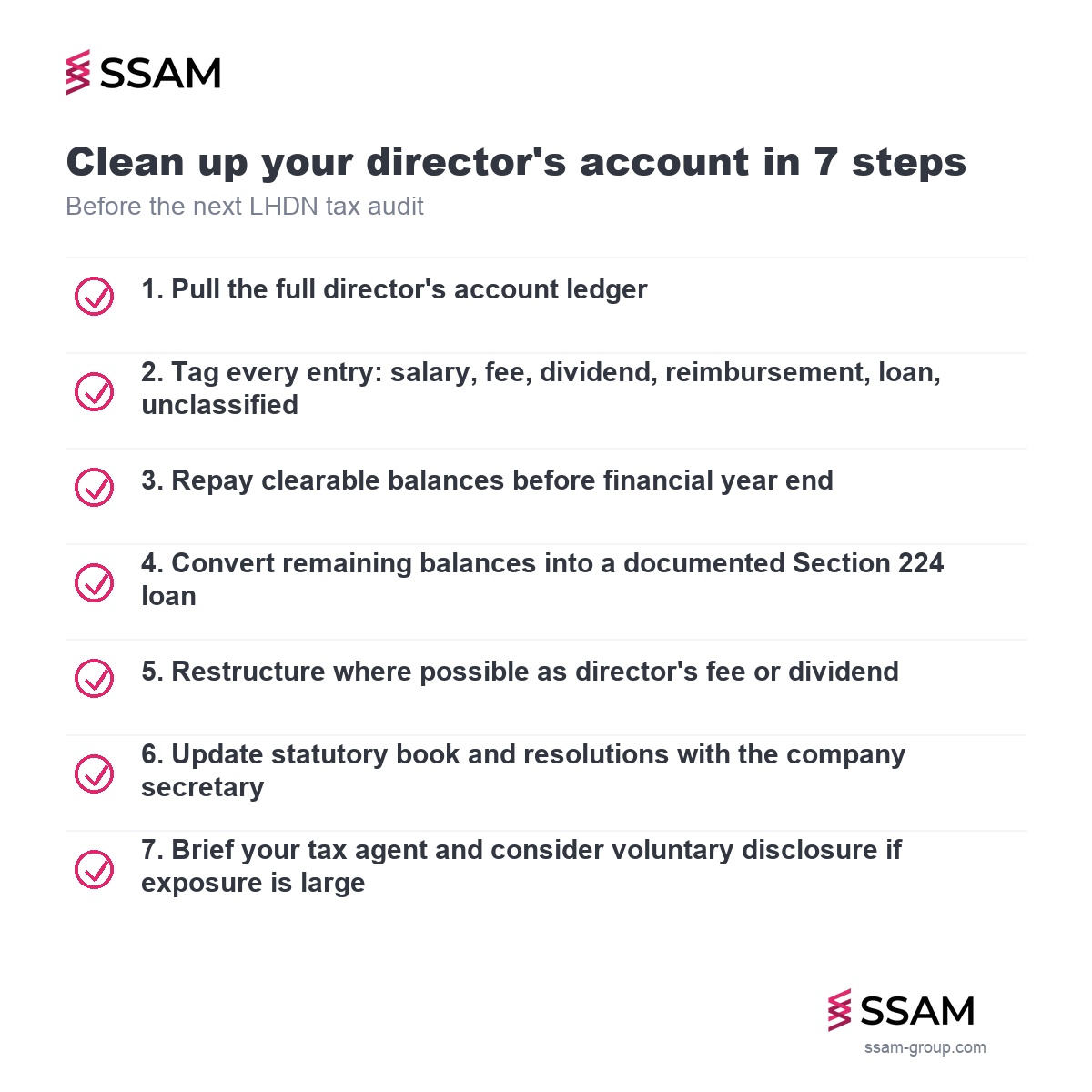
Pull the full director's account history from your accounting software. Tag every entry as salary, fee, dividend, reimbursement, loan, or unclassified. Anything in the unclassified pile is your remediation list.
Repay before financial year end where possible
A clean repayment before year end stops the Section 140B clock for that month and reduces the next year's deemed interest. A repayment in the new year still helps but is less efficient because the interest already accrued in the prior year remains taxable.
Convert to a formal loan with a member resolution
For balances that cannot be cleared in cash, paper them over properly. Pass a member resolution under Section 224, sign a loan agreement, and charge market interest. This does not erase the past, but it stops fresh Section 224 exposure from the resolution date forward.
Restructure as director's fee or dividend
Where the company has profits and reserves, the cleanest cure is often to declare a one-off director's fee or dividend that legally replaces the unrecorded drawings. The board and shareholders must approve it through proper resolutions, and the company secretary should record it in the statutory book. Bear in mind that some businesses also need to file tax returns even when the company makes a loss in any given year, so coordinate the cleanup entries with your year-end tax computation.
Disclose voluntarily before LHDN initiates an audit
If the exposure is large, voluntary disclosure under LHDN's published programmes is often available and usually carries lower penalties than waiting for a notice. Speak to a licensed tax agent before approaching LHDN, so the disclosure is structured correctly and your tax compliance checklist for the Sdn Bhd stays consistent across the disclosure year and the rest of your filing history.
When to bring in a tax and compliance partner
The Section 224 and Section 140B rules are not difficult to understand on their own. The complexity sits at the intersection: matching director drawings to clean payment categories, keeping resolutions and statutory books current, and timing dividends and director's fees so the company stays inside both laws at once.
If your director's account has been growing without a clear plan, or if you are about to take a meaningful sum out of your Sdn Bhd, the cheapest move is to map the cleanest route before the cash leaves the company. A tax and compliance partner working alongside your company secretary will scope the exposure, recommend the right mix of salary, fee, dividend, reimbursement, and formal loan, and help you sleep through the next audit notice.
If your Sdn Bhd also holds property, sells assets during the year, or is preparing to invoice through the new MyInvois system, the same engagement is the right place to read your director's account against your wider compliance map. Ask your tax agent to look at your capital gains tax versus RPGT exposure and your readiness for e-invoicing in Malaysia in the same conversation, since these areas tend to surface the same documentation gaps as a long-running director's loan account.
SSAM Group has supported more than 1,000 Malaysian businesses across 40 years of practice, with MOF-licensed tax agents, MIA-registered accountants, and MAICSA-qualified secretarial staff working under one roof. If you would like a calm second opinion on your director's account, rely on SSAM's tax compliance services in Kuala Lumpur or message the team on WhatsApp.
Frequently asked questions about advance to director Malaysia
Is a director's loan taxable in Malaysia?
The loan itself is not income to the director, but the company is taxed on deemed interest under Section 140B if the loan is funded from internal funds. Where LHDN reclassifies the advances as a perquisite, or the loan is later waived, the director is also taxed on the benefit in the relevant year of assessment.
What is the difference between an advance to director and a director's loan?
An advance is any unrecorded movement of company money to a director. A director's loan is a specific type of advance with a written agreement, repayment schedule, and member approval. Both are caught by Section 140B if funded internally. Only the formal loan is safer under Section 224.
Can a Sdn Bhd legally lend money to its director?
Only inside the four exceptions in Section 224 of the Companies Act 2016: a member-approved loan, a loan to fund company-related expenditure, a loan to a director who is also a full-time employee under an approved staff scheme, or a loan from a licensed financial institution in the ordinary course of business. Outside those four boxes, Section 224(1) prohibits the loan.
How is deemed interest under Section 140B calculated?
Monthly deemed interest equals 1 divided by 12, multiplied by A, multiplied by B, where A is the loan balance at the end of the calendar month after repayments and new advances, and B is the BNM Average Lending Rate for that month. Add the monthly amounts together for the basis year and report the total as interest income on the company's Form C.
What happens if the director never repays the company?
The eventual write-off can be treated as a perquisite or a deemed distribution to the director, taxable in the year of waiver. The company also loses the receivable. Both outcomes usually arrive together, often during an LHDN tax audit triggered by the long-standing balance.
Does Section 140B apply if my Sdn Bhd is dormant?
Yes. Public Ruling 8/2015 does not exempt dormant companies. As long as retained earnings or capital sit on the balance sheet and a director draws from the account, the company must compute and disclose deemed interest each month for as long as the balance is open.
Data sources and references
- Public Ruling No. 8/2015, Loan or Advances to Director by a Company, Lembaga Hasil Dalam Negeri Malaysia. https://phl.hasil.gov.my/pdf/pdfam/LOAN_OR_ADVANCES_TO_DIRECTOR.pdf
- Public Ruling No. 2/2019, Director's Liability, Lembaga Hasil Dalam Negeri Malaysia. http://lampiran1.hasil.gov.my/pdf/pdfam/PR_02_2019.pdf
- Average Lending Rate Bank Negara Malaysia Schedule, Section 140B, LHDN. https://www.hasil.gov.my/en/international/average-lending-rate-bank-negara-malaysia-schedule-section-140b/
- Companies Act 2016 (Akta 777), Suruhanjaya Syarikat Malaysia. https://www.ssm.com.my/Pages/Legal_Framework/Document/Companies%20Act%202016_Akta%20777_BI%20(1.8.2022).pdf
- Bank Negara Malaysia interest rates and volumes. https://www.bnm.gov.my/interest-rates-volumes
The information in this article is provided for general informational purposes only and does not constitute tax, accounting, financial or legal advice. Tax laws change frequently and may not apply to your situation. Always consult a qualified professional before acting on any information here.