

Key Takeaways
- A restructuring can trigger up to four taxes in Malaysia: corporate income tax, capital gains tax, real property gains tax, and stamp duty. Knowing which one bites at each step is the whole game.
- Since 1 January 2024, capital gains tax applies to disposals of unlisted shares in Malaysian companies, so many transfers that used to be tax-free now need careful handling.
- Reliefs exist. Intra-group transfers can qualify for capital gains tax exemption and stamp duty relief, but only if the conditions are met and the paperwork is filed.
- Even when a gain is exempt, you usually still need to file a capital gains tax return within 60 days of the disposal.
- Plan the structure before you move. The order and form of a deal often decide the tax, and that is far cheaper to get right in advance than to fix afterwards.
If you are reshaping how your companies are owned or run, the tax implications of business restructuring in Malaysia deserve attention before you sign anything, not after. A restructuring that looks clean on an organisation chart can quietly trigger several different taxes, and the order in which you do things often decides how much you pay.
This guide maps the four taxes a restructuring can trigger and the reliefs that can switch them off when a deal is structured correctly. It is written for SME owners with more than one company, founders setting up a holding structure, and anyone buying or selling a business. Tax rules here changed materially in 2024, so treat older advice with caution and confirm the detail for your own situation.
What Counts as Business Restructuring?
Business restructuring covers any change to how your business is owned, grouped or operated. Common forms include mergers and acquisitions, selling or buying shares in a company, transferring assets or a business from one entity to another, setting up a holding company over existing companies, and reorganising a group so that the right activities sit in the right entity.
Each of these is treated differently for tax. A share sale moves ownership of the company itself, so the company keeps its history and liabilities. An asset sale moves selected assets out of one entity into another, which can be cleaner commercially but often carries more transactional tax. Recognising which type you are doing is the first step, because it determines which taxes you need to plan for.
Which Taxes Apply When You Restructure?
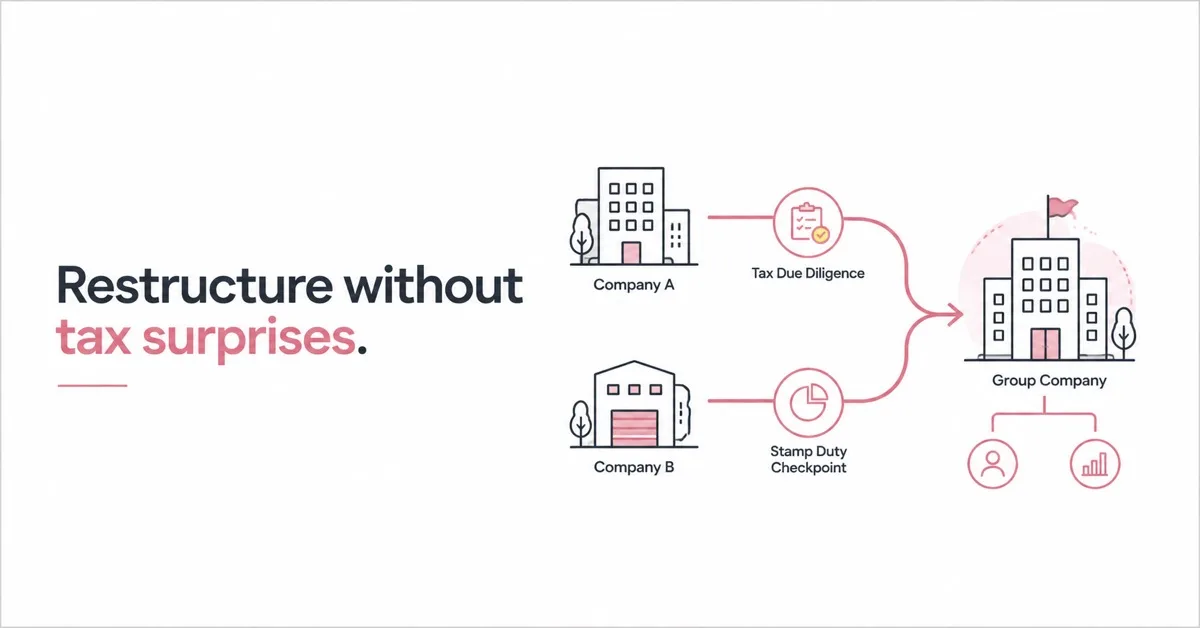
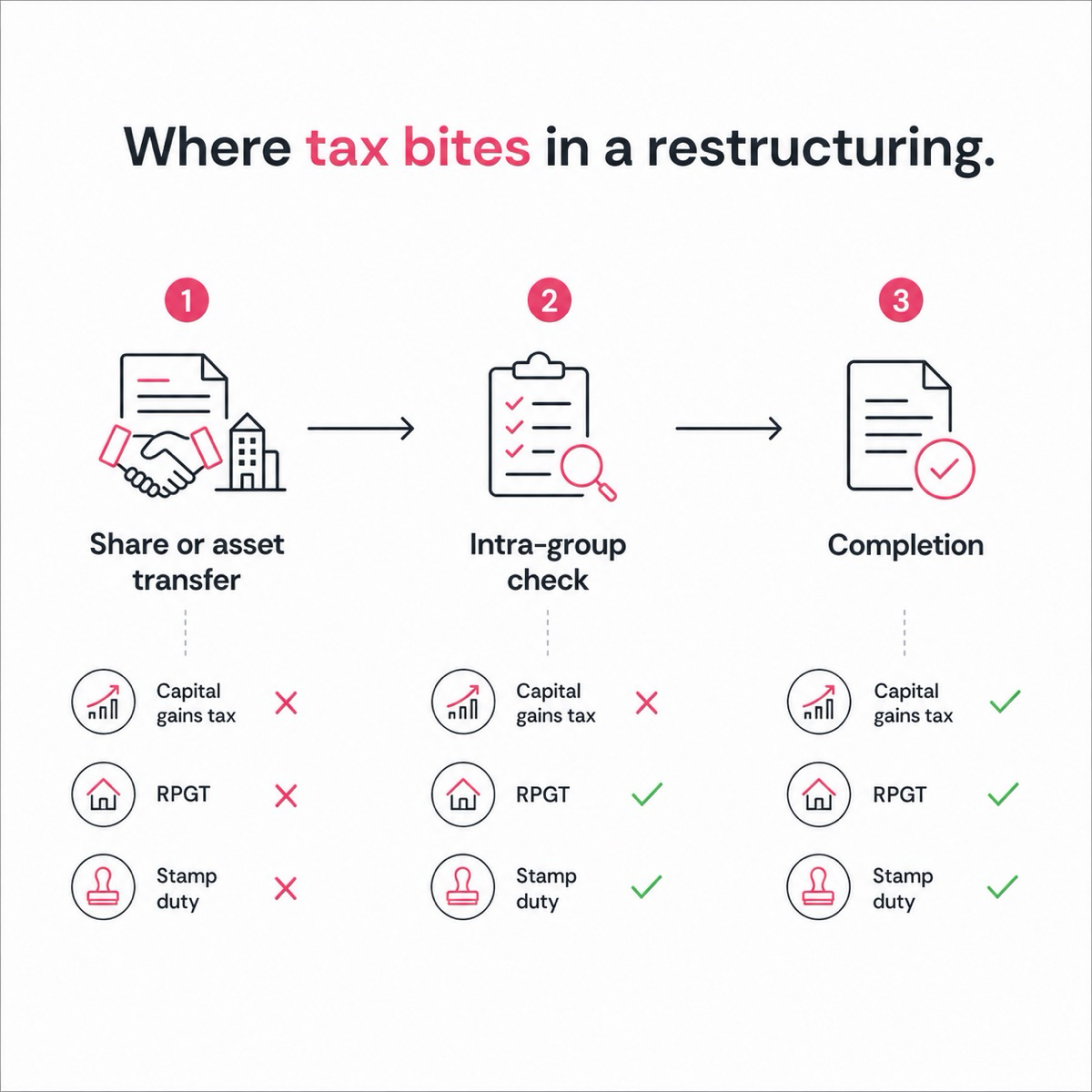
A restructuring in Malaysia can trigger four main taxes: corporate income tax on any trading gains, capital gains tax on disposals of unlisted shares, real property gains tax on disposals of real property or shares in property-rich companies, and stamp duty on the transfer of shares or property. Which ones apply depends on whether you move shares or assets, and whether the transfer stays within your group.
| Restructuring type | Taxes most likely to apply |
|---|---|
| Sale of unlisted shares | Capital gains tax, stamp duty on the share transfer |
| Sale of assets or a business | Real property gains tax (if property), stamp duty, balancing charge on capital allowances |
| Intra-group transfer | Capital gains tax (may be exempt), stamp duty (relief may apply), return still required |
| Amalgamation or reconstruction | Stamp duty relief possible, with capital gains tax and RPGT depending on what moves |
Income Tax vs Capital Treatment
The first question on any gain is whether it is income or capital. Gains from a genuine restructuring are usually capital in nature, which means they sit outside corporate income tax and instead fall under the capital gains tax or real property gains tax rules. The trap is that costs of the transfer, such as professional and legal fees, are generally not deductible against income under the Income Tax Act, so the expense side rarely gives you relief. If a transaction looks more like trading than restructuring, LHDN may treat the gain as income, so the commercial substance matters.
Capital Gains Tax on Share Disposals
The biggest change for restructurings is capital gains tax. From 1 January 2024, disposals of unlisted shares in Malaysian companies by companies, limited liability partnerships, trusts and co-operatives fall within the capital gains tax net. The headline treatment is 10 percent on the net gain, with an alternative of 2 percent on gross consideration for shares acquired before 1 January 2024. Just as important, the definition of disposal was widened, so events that cause a loss or cessation of share ownership can count even when there is no straightforward sale.
The practical effect is that many internal share movements that were previously tax-free now need to be checked. Confirm the current rate, the election between net and gross, and the exact scope before you proceed.
CGT Exemption for Group Restructuring
There is relief for genuine group reorganisations. An intra-group restructuring exemption can remove the capital gains tax charge where conditions are met, typically including that the acquiring company is incorporated or resident in Malaysia and that the transfer is part of a real reorganisation rather than an exit. There is one detail that catches people out. Even when the exemption applies, the disposer usually still has to file a capital gains tax return within 60 days of the disposal and claim the exemption. Missing that filing can turn an exempt transaction into a penalty.
RPGT and Stamp Duty on Asset Transfers
When a restructuring moves real property, or shares in a company that is rich in real property, real property gains tax comes into play. The rate a company pays depends on how long the property was held before disposal, under the relevant schedule of the Real Property Gains Tax Act, and the balance of tax is due within a set period after the disposal. Asset transfers can also crystallise a balancing charge or allowance where capital allowances were previously claimed on the asset.
Stamp duty is the other transactional tax. Transfers of shares and of property are both chargeable, and the duty is calculated on value, so a large transfer can carry a meaningful cost. From 2026, stamp duty moves to a self-assessment basis, which puts more responsibility on businesses to get the valuation and duty right.
Stamp Duty Relief for Reconstructions
The Stamp Act 1949 provides relief for certain reconstructions and amalgamations, and for transfers between associated companies, under sections 15 and 15A. These reliefs can remove stamp duty on a qualifying intra-group transfer, but they come with conditions, including that the transferee is a company incorporated in Malaysia and that the association between the companies is maintained for a required period. Break the conditions later and the relief can be clawed back, so the ongoing structure matters as much as the transaction itself.
Group Relief, Losses, and Capital Allowances
Restructuring is not only about taxes you trigger. It can also affect reliefs you already rely on. Malaysia allows group relief, where a company can surrender up to 70 percent of its adjusted loss for a year to related companies that meet the conditions. A reorganisation can either protect or break that grouping, so it is worth checking before you move companies in or out.
Accumulated tax losses and unabsorbed capital allowances also need care. Changes in shareholding can restrict the carry-forward of these reliefs, and asset transfers between connected parties may fall under controlled-transfer rules that pass the asset across at its tax written-down value rather than at market price. Handled well, this preserves allowances. Handled carelessly, it can waste them.
Transfer Pricing and Anti-Avoidance Risks
This is the part generic merger guides tend to skip. When you move assets, shares or a business between companies you control, the price you use matters. Related-party transfers should be on arm's length terms, supported by reasoning and documentation, or they can attract transfer pricing adjustments. On top of that, the general anti-avoidance rule in Section 140 of the Income Tax Act lets LHDN disregard arrangements whose main purpose is to obtain a tax benefit without commercial substance.
The lesson is not to avoid restructuring. It is to make sure each step has a genuine commercial reason and a defensible value, and to keep the records that show it. If a deal only makes sense because of the tax it saves, expect questions. Cross-border reorganisations add another layer: check how the foreign-sourced income tax rules treat repatriated profits, how the relevant double tax agreements allocate taxing rights, and whether withholding tax on foreign vendors applies to any new intra-group service or financing flows.
Here is a short example of why the filing point matters. Suppose you transfer shares in one of your trading companies to a new holding company you also own. The transfer may qualify for the intra-group capital gains tax exemption, so no tax is payable. You still need to file the capital gains tax return within 60 days and claim the exemption, and you still need to consider stamp duty relief on the share transfer. The tax can be nil and the obligations can still be real.
Plan the Structure Before You Move
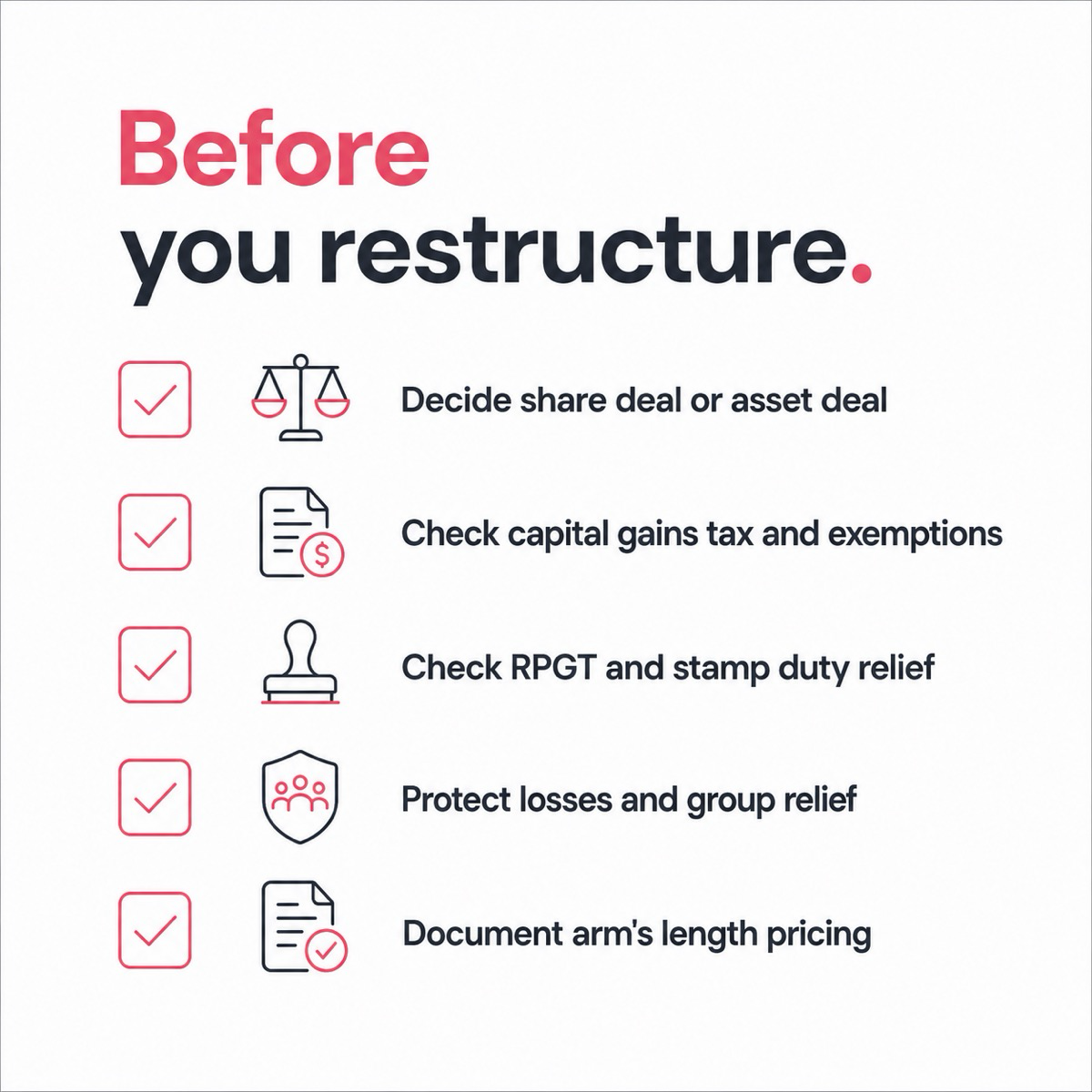
The cost of a restructuring is rarely the tax itself. It is the tax you trigger by accident because the steps were done in the wrong order or the reliefs were missed. Decide whether you are doing a share deal or an asset deal, map which of the four taxes each step touches, confirm which exemptions and reliefs you can claim, and line up the filings before you complete.
This is exactly the kind of work where a second pair of expert eyes pays for itself. If you are weighing a restructuring, the signs in our guide on hiring a professional tax consultant can help you judge when to bring one in, and you can check credentials in our explainer on choosing an approved tax agent. If your plan involves buying a company rather than reshaping your own group, pair it with thorough tax due diligence on the target. SSAM Group is a licensed tax agent whose tax advisory in Kuala Lumpur covers M&A and restructuring, and the team can map your restructuring tax position before you commit. Speak to SSAM for a clear view.
Frequently Asked Questions
Is business restructuring taxable in Malaysia?
It can be. A restructuring may trigger capital gains tax on share disposals, real property gains tax on property, and stamp duty on transfers. Genuine reorganisations are often capital rather than income, and reliefs may apply, but no restructuring is automatically tax-free, especially after the 2024 capital gains tax changes.
Does transferring shares between my own companies trigger tax?
It can fall within capital gains tax, because disposals of unlisted shares are now within scope. An intra-group exemption may remove the charge if conditions are met, but you usually still file a capital gains tax return within 60 days and claim the exemption. Stamp duty relief may also apply to the transfer.
Can I avoid stamp duty on a group transfer?
Relief for transfers between associated companies and for reconstructions is available under the Stamp Act 1949, sections 15 and 15A, subject to conditions such as the transferee being incorporated in Malaysia and the association being maintained. If the conditions are later broken, the relief can be clawed back.
Do I still file a CGT return if the gain is exempt?
In most cases yes. The exemption does not remove the filing obligation. You generally need to submit the capital gains tax return within 60 days of the disposal and claim the exemption there. Treating an exempt transaction as if nothing happened is a common and avoidable mistake.
What is the difference between an asset deal and a share deal for tax?
A share deal transfers ownership of the company and its history, and tends to involve capital gains tax and stamp duty on shares. An asset deal moves selected assets, which can trigger real property gains tax, stamp duty on property, and balancing adjustments on capital allowances, but leaves historical company liabilities behind.
Data Sources and References
- Lembaga Hasil Dalam Negeri (LHDN), RPGT and capital gains tax guidance: https://www.hasil.gov.my
- PwC Worldwide Tax Summaries, Malaysia (capital gains, RPGT, stamp duty, group taxation): https://taxsummaries.pwc.com/malaysia
- Income Tax (Exemption) Orders P.U.(A) 289/2024 and 290/2024 on capital gains tax exemptions
The information in this article is provided for general informational purposes only and does not constitute tax, accounting, financial or legal advice. Tax laws change frequently and may not apply to your situation. Always consult a qualified professional before acting on any information here.