


Key Takeaways
- An LHDN tax audit is a routine compliance check under Malaysia's Self-Assessment System, not an accusation of wrongdoing.
- The 2025 Tax Audit Framework on Income Tax and Employer (TAF ITE), effective 15 March 2025, now governs how income tax, employer, and withholding tax audits run.
- Your response clock matters. Document submission is usually due in around 14 days, and the formal objection window is 30 days from the notice of assessment.
- Penalty exposure can range from 15 percent up to 100 percent of tax undercharged under Section 113(2), with tiered framework rates of 15, 30, and 45 percent based on your prior penalty record.
- Engage an approved (MOF-licensed) tax agent before responding. Only an approved tax agent may formally represent you in an audit.
What is an LHDN tax audit and why were you selected?
An LHDN tax audit in Malaysia is a structured review by the Inland Revenue Board of Malaysia (LHDN, also known as IRBM) of your tax returns, supporting records, and tax computation. Under the Self-Assessment System, the audit is how LHDN verifies that the position you filed is accurate, complete, and supported by evidence.
Selection does not mean you are accused of evasion. Many audits are part of routine cycles, sector-based sweeps, or follow-ups to data mismatches. The point of the audit is to confirm that your declared income, deductions, and reliefs are supported by records and consistent with the Income Tax Act 1967.
The 2025 Tax Audit Framework, in plain English
Since 15 March 2025, audits have been governed by a single consolidated document: the Tax Audit Framework on Income Tax and Employer (TAF ITE). It replaced several older frameworks at once, including the 2022 Tax Audit Framework (general), the 2022 Tax Audit Framework on Finance and Insurance, the 2022 Tax Audit Framework on Petroleum, the 2021 Employer Tax Audit Framework, and the 2015 Tax Audit Framework on Withholding Tax.
For most Malaysian SMEs, three things matter:
- One framework now covers your income tax, your obligations as an employer (PCB, EPF, SOCSO, EIS, Form E), and your withholding tax position on payments to non-residents.
- The audit officer follows a standardised process for selection, notification, document review, interview, and findings.
- The penalty regime sits inside this framework, including the tiered rates of 15, 30, and 45 percent and the voluntary disclosure ladder.
Desk audit vs field audit: which one are you facing?
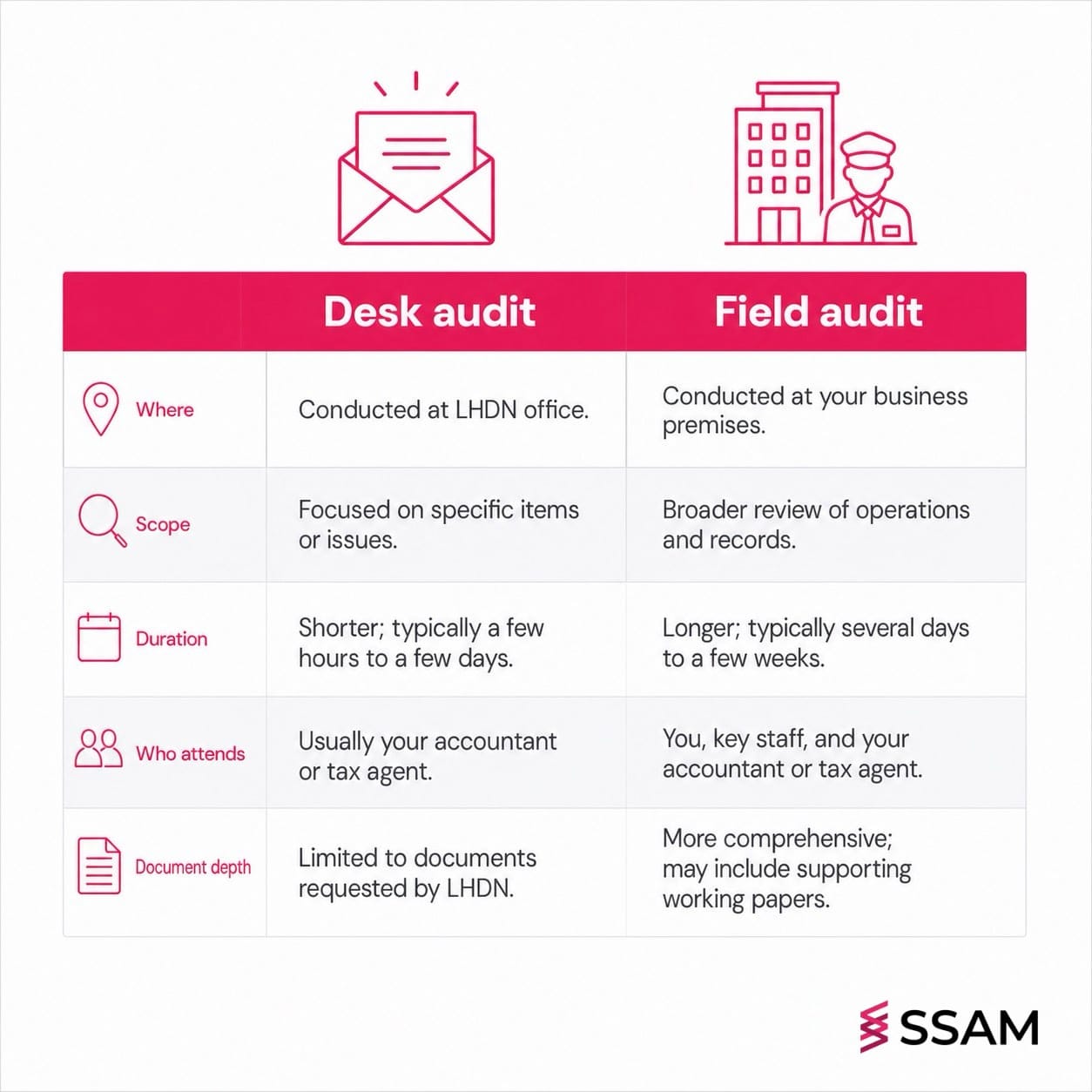
LHDN runs two main audit formats. Knowing which one you are dealing with sets the tone for your whole response.
| Factor | Desk audit | Field audit |
|---|---|---|
| Where it happens | At the LHDN branch office, by post or email exchange | At your business premises, including a site visit |
| Typical scope | Specific items on a single year of assessment | Full review across multiple years of assessment |
| Typical duration | Weeks to a few months | Several months, sometimes longer |
| Who attends | Officer reviews documents, may call you in | One or more officers visit, may interview directors and staff |
| Document depth | Targeted requests on specific items | Books, ledgers, contracts, payroll, bank statements, invoices |
General review vs comprehensive review
Under the 2025 TAF ITE, audits are also classified as a general review (focused on specific risk areas) or a comprehensive review (a full look at your tax position). A field audit is more likely to be comprehensive. A desk audit is more often general.
What triggers an LHDN tax audit?
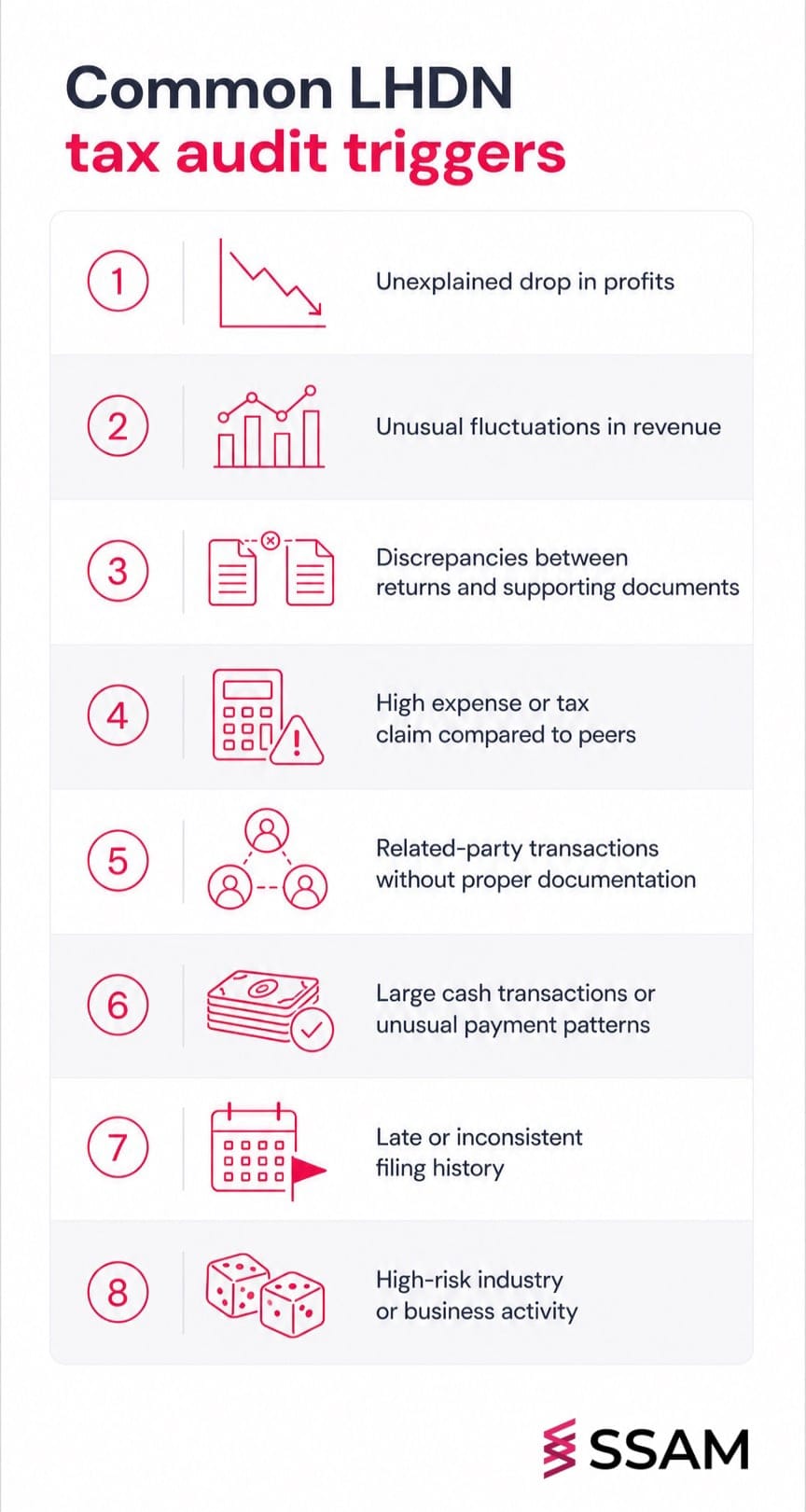
There is no public list of triggers, but practitioners consistently see the same patterns. Knowing them helps you reduce your exposure long before any letter arrives.
- Recurring losses across several years, especially if the business keeps trading. If you keep filing at a loss, our companion guide on whether you must file a tax return at a loss is worth a quick read.
- Large year-on-year fluctuations in revenue, gross profit, or expenses without a clear commercial reason.
- Mismatches between the data you file and third-party data LHDN already holds (CP58 commissions, customs data, withholding tax forms, e-invoice records).
- Aggressive deduction positions, including unusual director's remuneration or large director advances. Read more on advance to director Malaysia tax risks.
- Related-party transactions without supporting transfer pricing documentation. If you trade with a related entity, see how to prepare for an LHDN transfer pricing audit.
- Cash-heavy sectors, where the audit officer expects more documentary substance.
- Late, incomplete, or repeatedly amended submissions. Some of the most common errors are covered in our note on tax filing mistakes Malaysia SME owners regularly make.
- Disposals of unlisted shares, real property, or other capital assets where the capital gains tax vs RPGT Malaysia treatment is unclear or poorly documented.
- Random selection. A clean record does not exempt you from being chosen.
How far back can LHDN go?
A standard LHDN tax audit usually covers up to three years of assessment. The statutory open period under the Income Tax Act 1967 is five years from the relevant year of assessment. In cases of negligence, fraud, or wilful default, LHDN can re-open assessments beyond five years, with no statutory cap.
That is why your record-keeping window matters. For the practical detail on what to keep and how long, our LHDN 7 year audit Malaysia lookback guide breaks it down.
Your rights as a taxpayer during an audit
The TAF ITE sets out a clear set of rights you can rely on. They are not favours. They are part of the framework.
- Right to be notified. LHDN must give you written notice of an audit, including the years of assessment, the audit officers' names, and the planned visit date.
- Right to have a tax agent present. You can engage an approved tax agent to represent you, attend interviews, and correspond with LHDN.
- Right to fair, transparent, and impartial treatment. The officer must treat you courteously, explain findings in writing, and give you a chance to respond.
- Right to escalate. If you feel an officer is not following the framework, you can escalate to the Branch Audit Manager and then the Branch Director.
- Right to object and appeal. If the audit results in additional assessment, you have a 30-day window from the date of the notice of assessment to file a Form Q objection.
Your responsibilities during an audit
Rights cut both ways. You are expected to:
- Be courteous, fair, and honest with the audit officer.
- Provide reasonable access to your premises during a field audit.
- Respond to all queries within the timeframes LHDN sets, usually around 14 days.
- Produce the records requested, including ledgers, invoices, contracts, payroll files, and bank statements.
- Cooperate with interviews on business and, where relevant, personal financial matters.
Cooperation does not mean handing over more than asked. It means providing exactly what is requested, on time, with proper context.
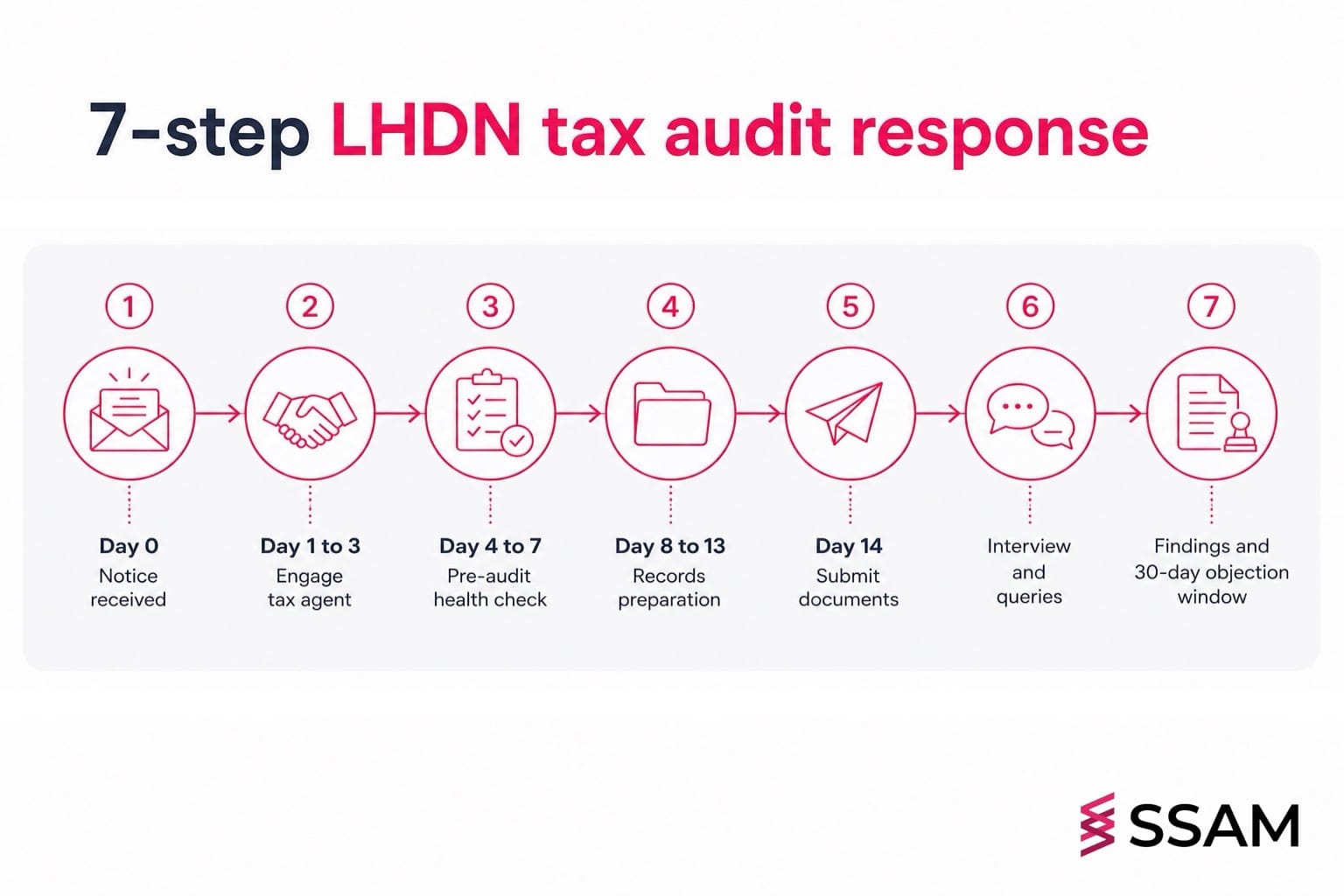
The 7-step LHDN tax audit response playbook
When the notice arrives, the next two weeks set the tone of the entire audit.
Step 1. Read the notice and confirm the scope
Note the years of assessment, the audit officers' names, the document list, and the deadline. Within the first 24 hours, brief the directors, lock down the relevant files, and stop any informal email chains that touch the audited years.
Step 2. Engage an approved tax agent before responding
Do not reply directly until you have spoken to a tax agent. An approved tax agent Malaysia businesses appoint can review the notice, identify the underlying risk areas, and shape the tone of your reply.
Step 3. Run an internal pre-audit health check
Reconcile revenue to bank deposits, substantiate major expenses, check capital allowance schedules, and review your director loan account, foreign-sourced income, and CP204 estimates. Our tax compliance checklist Sdn Bhd Malaysia owners can reuse is a practical starting frame even for established businesses.
Step 4. Gather and organise records
Pull together statutory accounts, management accounts, general ledger, sales and purchase invoices, contracts, payroll registers, EPF, SOCSO, EIS, PCB submissions, and e-invoice UUIDs. If e-invoicing is new to you, our plain-English guide on what is e-invoicing Malaysia covers the data trail LHDN now has.
Step 5. Submit documents within the deadline
LHDN typically allows around 14 days for the first submission. If you cannot meet it, request an extension in writing before the deadline lapses, with reasons.
Step 6. Manage the interview and follow-up queries
Interviews can be in person or virtual. Keep answers factual, short, and consistent with the documents already submitted. Do not speculate. If you do not know, say so and follow up in writing.
Step 7. Review the letter of findings
When LHDN issues its findings, you and your tax agent decide whether to accept, negotiate, or formally object via Form Q within 30 days of the notice of additional assessment.
LHDN audit penalties: how much are you exposed to?
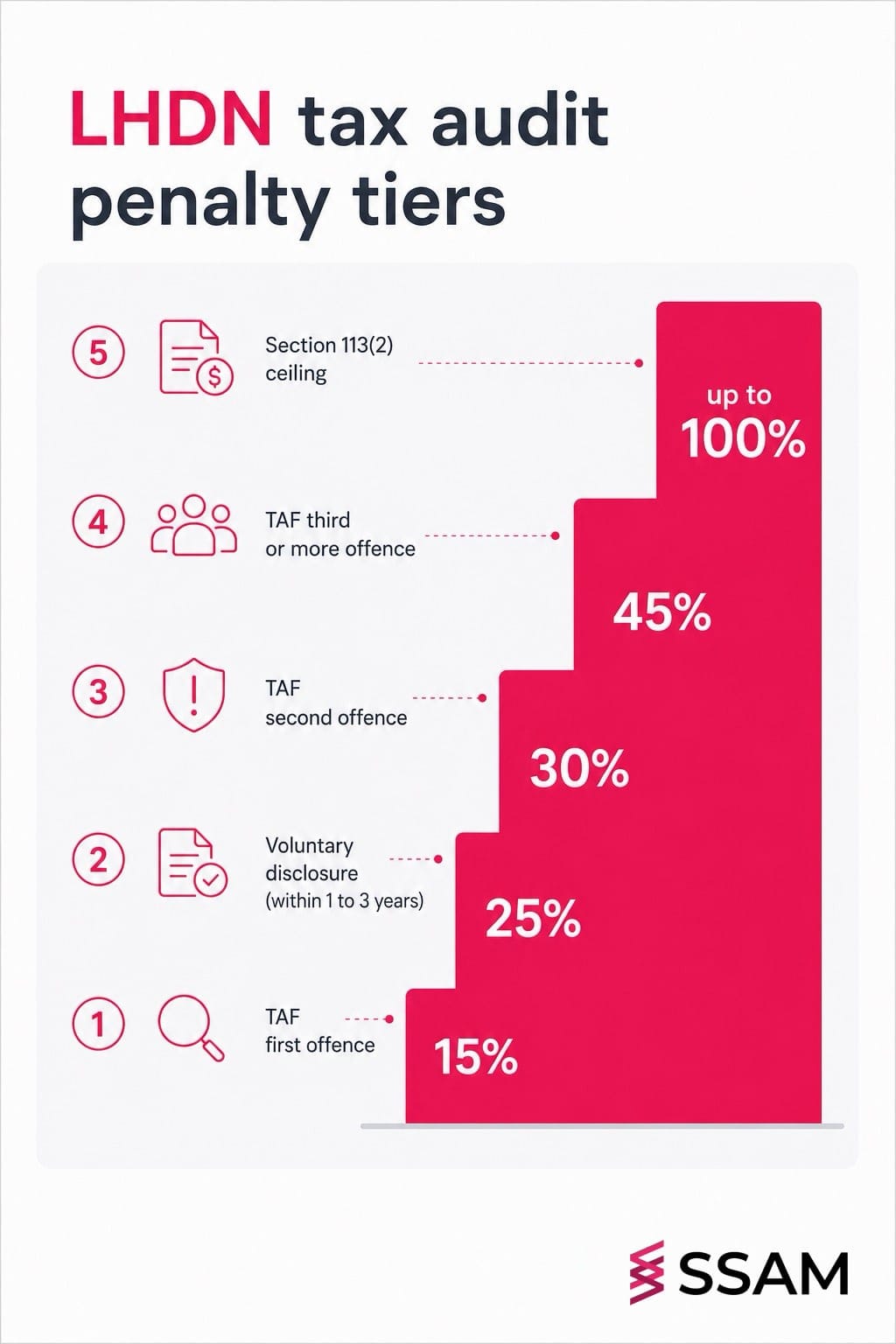
The penalty number you see at the end of an audit depends on which provision LHDN applies and your prior record.
| Trigger | Provision or framework | Penalty rate |
|---|---|---|
| Tax undercharged found in audit | Section 113(2), Income Tax Act 1967 | Up to 100 percent of tax undercharged |
| First TAF offence | TAF ITE 2025 | 15 percent |
| Second TAF offence | TAF ITE 2025 | 30 percent |
| Third and subsequent TAF offences | TAF ITE 2025 | 45 percent |
| Voluntary disclosure, less than 1 year late | IRB Guide on Tax Audit | 15 percent |
| Voluntary disclosure, 1 to 3 years late | IRB Guide on Tax Audit | 25 percent |
| Voluntary disclosure, 3 to 5 years late | IRB Guide on Tax Audit | 40 percent |
| Voluntary disclosure, more than 5 years late | IRB Guide on Tax Audit | 50 percent |
| Voluntary disclosure after audit notification | IRB Guide on Tax Audit | 50 percent |
| Incorrect return under Section 113(1) | Income Tax Act 1967 | Fine RM1,000 to RM10,000 plus 200 percent of tax undercharged |
| Wilful evasion under Section 114(1) | Income Tax Act 1967 | Fine RM1,000 to RM20,000 plus 300 percent of tax undercharged, possible imprisonment up to 3 years |
These figures are separate from late filing penalties. For that side of the picture, see our note on LHDN penalty late tax filing cases.
How LHDN decides your penalty rate: the record window
Two SMEs with the same audit finding can end up with very different penalty rates. The reason is the penalty record window.
The TAF tier (15, 30, or 45 percent) is determined by your record of past Section 113(2) penalties. If LHDN has not previously raised a Section 113(2) penalty against you, the audit officer typically applies the first-offence rate of 15 percent. A second Section 113(2) penalty within the relevant tracking window pushes you to 30 percent, and a third or more pushes you to 45 percent.
Two practical consequences for SMEs:
- A clean record is itself a soft asset. Voluntary disclosure of a known issue before audit selection can keep you within the 15 to 25 percent band and protect your record going forward.
- Once a penalty has been raised against you, your next audit, even on an unrelated issue, starts from a worse baseline. That makes proactive compliance work cheaper than reactive penalty work.
When to bring in an approved tax agent
Only an approved tax agent licensed by the Ministry of Finance can formally represent you in an LHDN audit, file objections, and engage with audit officers on your behalf. An in-house accountant can prepare working papers, but the formal correspondence and audit positioning sit with the licensed agent.
SSAM Group has been supporting Malaysian businesses with tax compliance for 40 years through TSE Taxation Services Sdn. Bhd. (198401012049 / 124590-A), a MOF-licensed tax agent. As a 1-stop centre across secretarial, accounting, tax, HR, and advisory, the team works with you from notification through to document preparation, interview management, letters of findings, objections, and appeals. Over 1,000 businesses currently rely on SSAM, with 99 percent client satisfaction reported across feedback and results.
If you have just received an audit notice, or you suspect one is on its way, get advice early through SSAM's tax filing and compliance in Kuala Lumpur. Speak to SSAM via tax@ssam-group.com or WhatsApp +6011-6529 9879. For a wider view of how an audit response fits into the rest of your tax workload, see our tax consultant services in Kuala Lumpur overview.
Frequently asked questions about LHDN tax audits
How will LHDN notify me of a tax audit?
LHDN sends a written notification, usually by post or through your registered tax agent, stating the years of assessment under review, the names of the audit officers, the document list, and a proposed visit or submission date.
How long does an LHDN tax audit take?
A desk audit can wrap up in a few weeks to a few months. A field audit often runs for several months and can stretch longer if the records are incomplete or the issues are technical. Responsive document submission and a clean paper trail shorten the timeline.
Can I appeal an LHDN audit finding?
Yes. If you disagree with the additional assessment, you may file a Form Q objection within 30 days of the notice of assessment. If the matter is not resolved, the appeal can be escalated to the Special Commissioners of Income Tax and, eventually, the High Court.
Do I still have to pay the assessed tax even if I am appealing?
Generally, yes. The pay-first-appeal-later principle applies in Malaysia. The tax assessed becomes payable on the due date in the notice of assessment regardless of an ongoing objection, unless LHDN agrees to a deferral or instalment.
What happens if I ignore an LHDN audit letter?
Ignoring the notice does not stop the audit. LHDN can proceed on the information already on hand, raise additional assessments, apply higher penalty rates, and take recovery action including travel restriction orders against directors. Always respond, even if the response is to request more time.
Is being audited the same as being investigated by LHDN?
No. A tax audit is a civil compliance review under the TAF ITE. A tax investigation is a separate, criminal-track process used when LHDN suspects fraud or wilful evasion. Investigations follow a different framework and usually begin with simultaneous visits and document seizure.
Data Sources / References
- Grant Thornton Malaysia, Tax Audit and Investigation: https://www.grantthornton.com.my/insights/articles-and-publications/tax-audit-investigation-malaysia/
- PwC Malaysia, Stay Audit-Ready: https://www.pwc.com/my/en/perspective/tax/231027-stay-audit-ready-tax-guide.html
- EY Malaysia, Tax Alert on Updated Tax Audit Frameworks: https://www.ey.com/en_my/technical/tax-alerts/updated-tax-audit-frameworks
- IRBM, IRB Guide on Tax Audit: https://www.hasil.gov.my/pdf/pdfam/BI_PanduanAuditCukai.pdf
- IRBM, Offences, Fines and Penalties: https://www.hasil.gov.my/en/legislation/offences-fines-and-penalties/
- IRBM, Frameworks hub: https://www.hasil.gov.my/en/legislation/framework/
- IRBM, Tax Audit Framework on Income Tax and Employer (effective 15 March 2025): https://www.hasil.gov.my/media/wgpombsp/20250315_tax-audit-framework-on-income-tax-and-employer.pdf
The information in this article is provided for general informational purposes only and does not constitute tax, accounting, financial or legal advice. Tax laws change frequently and may not apply to your situation. Always consult a qualified professional before acting on any information here.