

Key Takeaways
- Form C is the corporate tax return filed by your Sdn Bhd, Form E is the annual employer return filed by the company, and Form B is an individual return for people with business income.
- Most Sdn Bhd directors file Form BE, not Form B, because they draw a salary and dividends rather than run a personal sole proprietorship.
- Your Sdn Bhd still needs to file Form E every year while the employer file is open, even if headcount is zero or only the director is on payroll.
- For year of assessment 2025 filed in 2026, the main deadlines are Form EA on 28 February, Form E on 30 April, Form BE on 15 May, Form B on 15 July, and Form C within 8 months of your financial year end.
- Filing the wrong form, late, or not at all can trigger penalties under the Income Tax Act 1967, including a fine of up to RM20,000 under Section 120(1)(b) for Form E offences.
If you run a Sdn Bhd in Malaysia, Form B, Form C, and Form E are three different LHDN tax forms that cover three different roles you hold at the same time: the company, the company as an employer, and you as an individual. Knowing which form belongs to which role is the simplest way to avoid missed deadlines, wrong submissions, and unnecessary penalties from LHDN.
This guide walks you through each form in plain English, with the 2026 deadlines, the documents you need, and a quick decision table so you can see everything at a glance.
What Form B, Form C, and Form E cover
Each LHDN form is tied to one specific taxpayer.
- Form C is the corporate income tax return filed by a company, including Sdn Bhd and Berhad entities. It reports the company's chargeable income, allowable deductions, and tax payable for the year of assessment.
- Form E is the annual employer return. Every company registered with SSM must file it, and it reports headcount, total remuneration, and monthly tax deductions (PCB) for your employees.
- Form B is an individual income tax return for resident individuals who earn business income, such as sole proprietors and partners of a conventional partnership.
- Form BE is the sibling of Form B. It is for resident individuals who earn only non-business income, such as salary, director fees, dividends, rental, or interest.
If you are a director of a Sdn Bhd, you are almost always dealing with Form C, Form E, and Form BE at the same time. Form B usually only enters the picture if you also run a sole proprietorship or partnership on the side.
Who files each form: the three-hat Sdn Bhd owner
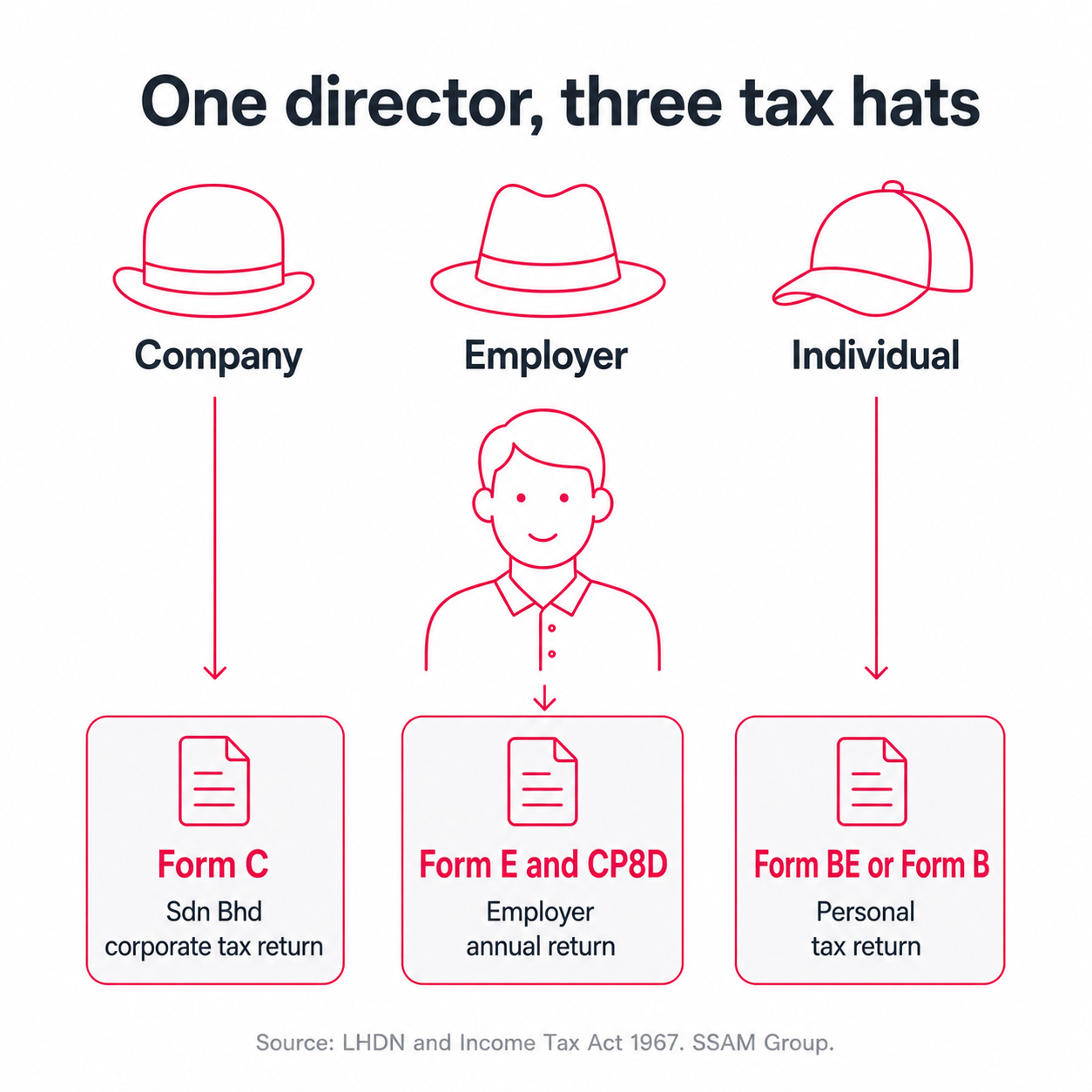
A Sdn Bhd director wears three tax hats at once, and each hat matches one form.
- The company hat: your Sdn Bhd is a separate legal person. It pays its own corporate tax and files its own Form C.
- The employer hat: the moment your Sdn Bhd has at least one person on payroll, including yourself as a director, it is considered an employer. It files Form E with CP8D and issues Form EA to each employee.
- The individual hat: you are a taxpayer in your own right. You file Form BE on the salary, director fees, and dividends you take out of the company. You only switch to Form B if you also have business income from outside the company.
This is where many first-time owners get stuck. They know the company has tax. They forget the company is also an employer. They also assume their personal return is the same as their company's return. Separating the three hats keeps each filing clean and on time.
When a director also runs a sole proprietorship
If you still have a sole proprietorship or a partnership registered under your own name, that income is treated as business income. You then file Form B personally (15 July deadline), not Form BE. Your Sdn Bhd still files its own Form C and Form E separately.
When the Sdn Bhd has zero employees
A dormant or very early-stage Sdn Bhd often has no staff on payroll. Form E is still required while the company is registered as an employer with LHDN. If you genuinely have no employees and no director salary for the year, you can file a nil Form E. Skipping Form E quietly is not an option.
Form C: the Sdn Bhd corporate tax return
Form C is how your Sdn Bhd reports its taxable income to LHDN for the year of assessment. It covers chargeable income, allowable deductions, capital allowances, and the final tax payable or refundable.
Form C must be e-Filed through MyTax. A qualifying SME may pay the preferential corporate tax rate of 15% on the first RM150,000 of chargeable income, with the remainder taxed at rates scaling up to 24%. Companies that do not meet the SME conditions pay the flat corporate rate of 24%. Always check the latest qualifying rules before you rely on the SME rate.
Before Form C, your Sdn Bhd must also submit Form CP204, the yearly tax estimate. For a walk-through, see our guide on CP204 tax estimate Malaysia.
Form C filing deadline and grace period
Form C is due within 8 months from the end of your financial year. If your company closes its accounts on 31 December 2025, Form C is due by 31 August 2026. Missing this triggers penalties under Section 112(3) of the Income Tax Act 1967, which can stack up with late payment interest on any tax owed.
Documents you need before filing Form C
Before you submit Form C, have these ready:
- Audited financial statements for the year
- Tax computation with supporting schedules
- Form CP204 that was submitted earlier, plus any CP204A revisions
- Capital allowance schedules for fixed assets
- Prior year assessment notices and any tax instalment records
Form E: the annual employer return
Form E is your company's annual declaration of employees and PCB to LHDN. Every Sdn Bhd registered with SSM must file Form E, even in a year where payroll is small or zero, unless the employer file has been formally closed.
Form E comes with a mandatory attachment called CP8D, which lists each employee's name, IC, income, PCB, EPF, SOCSO, and EIS. e-Filing of Form E has been mandatory for companies since the remuneration year 2016.
Form E deadline and CP8D requirement
Form E is due on 30 April every year, and CP8D must be submitted by the same date. Both are filed through the employer's MyTax account. If a tax agent files on your behalf, the same deadline still applies.
Form E vs Form EA: what employees receive
Form E goes from the company to LHDN. Form EA is a statement the company hands to each employee by 28 February, so the employee can then file their own Form BE or Form B. CP8D is the employee-level dataset that backs Form E. In short: EA is for the employee, E and CP8D are for LHDN.
For the full calendar of dates that fall on Malaysian businesses each year, see our roundup of Malaysia tax filing deadlines 2026.
Should a Sdn Bhd director file Form B or Form BE?
Most Sdn Bhd directors file Form BE, not Form B. Form BE is for resident individuals with only non-business income, such as salary, director fees, dividends, rental, and interest. You only switch to Form B if you also earn personal business income, for example from a sole proprietorship, partnership, or freelance work invoiced outside your Sdn Bhd.
Form BE is due 30 April each year, with an e-Filing grace period to 15 May. Form B is due 30 June, with an e-Filing grace period to 15 July.
What counts as business income for Form B
Business income under the Income Tax Act 1967 is income from a trade, profession, vocation, or business carried on in your personal name. This includes sole proprietorships registered with SSM, partnerships, and freelance or consulting income invoiced personally rather than through your Sdn Bhd. Salary, director fees, and dividends paid by your Sdn Bhd to you are not business income for you personally.
Common mistake: filing Form B when you only draw a director salary
Some directors file Form B out of habit because they "run a business". LHDN treats you as an employee of your own Sdn Bhd when you draw a salary from it, which puts you on Form BE. Filing Form B when you have no personal business income creates mismatched records, often triggers follow-up letters from LHDN, and can delay refunds.
For a deeper walkthrough of everything a new director needs to get right, read our Sdn Bhd director tax obligations guide.
2026 filing deadlines at a glance
Use this quick table to bookmark the year of assessment 2025 deadlines you will handle in 2026.
| Form | Who files | What it covers | 2026 deadline (YA 2025) |
|---|---|---|---|
| Form EA | Employer to employee | Employee remuneration statement | 28 February 2026 |
| Form E and CP8D | Sdn Bhd or company | Employer annual return | 31 March 2026 (30 April e-Filing) |
| Form BE | Individual with non-business income | Salary, director fees, dividends, rental | 30 April 2026 (15 May e-Filing) |
| Form B | Individual with business income | Sole proprietor, partner | 30 June 2026 (15 July e-Filing) |
| Form C | Sdn Bhd or Berhad | Corporate tax return | Within 8 months of FYE |
| Form CP204 | Sdn Bhd or Berhad | Tax estimate for the year | 30 days before start of basis period |
Penalties for filing the wrong form or filing late
LHDN treats each form separately, so penalties also stack separately.
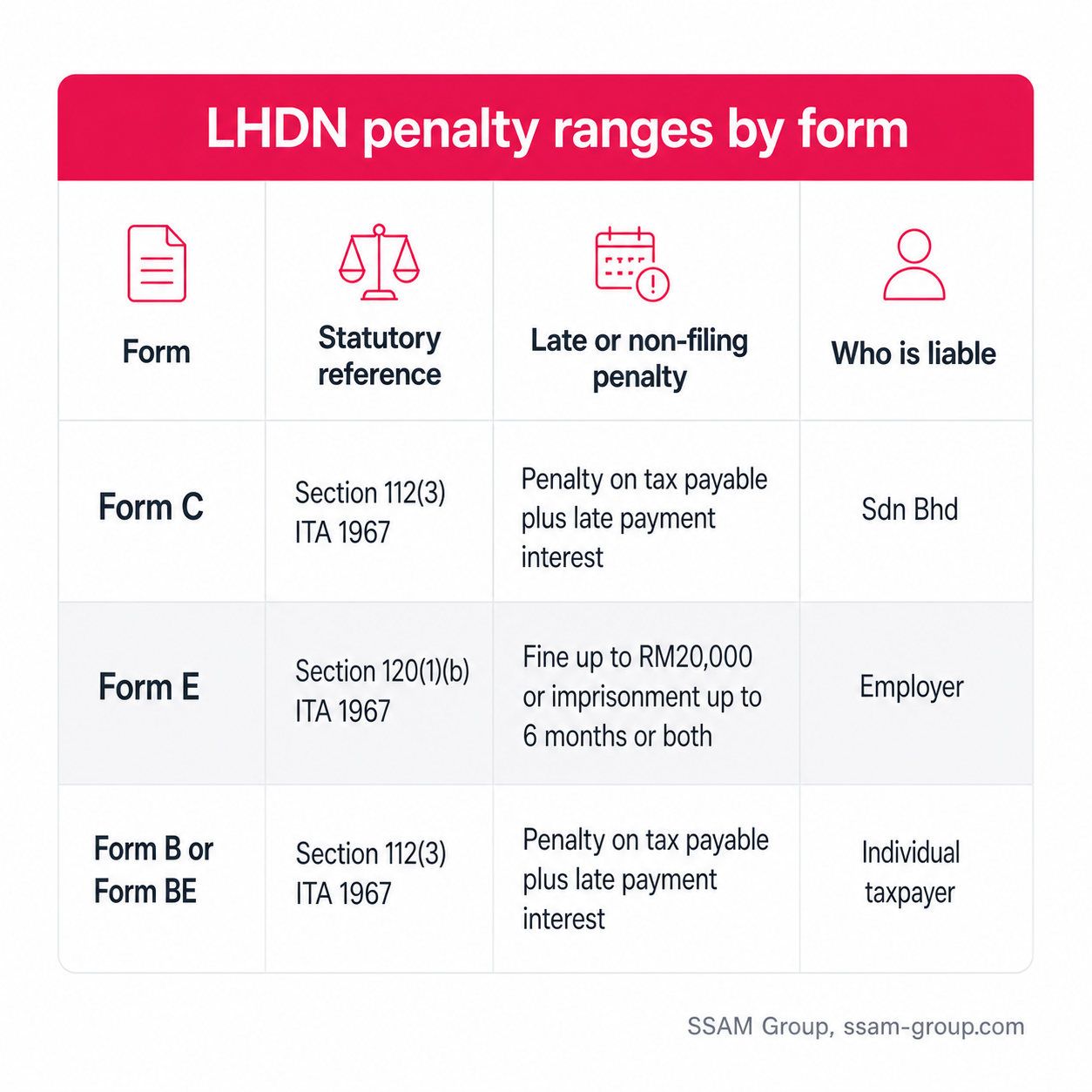
- Late filing of Form C can trigger a penalty under Section 112(3) of the Income Tax Act 1967, calculated as a percentage of the tax payable. Underestimated tax instalments under Section 107C can add a 10% penalty on the shortfall above the allowed margin.
- Non-compliance with Form E can result in a fine of up to RM20,000, imprisonment of up to 6 months, or both, under Section 120(1)(b) of the Income Tax Act 1967.
- Late filing of Form B or Form BE can also trigger Section 112(3) penalties, plus late payment interest on any tax owed.
Treat these as ranges rather than fixed outcomes. LHDN exercises discretion, and penalties can sometimes be reduced on appeal, especially for first-time errors that are corrected quickly.
For more ways SMEs trip up during filing season, see tax filing mistakes Malaysian SMEs make and our detailed note on the LHDN penalty for late tax filing.
Map your three tax hats and file on time
Start by mapping your own three hats. Write down which company entities you own, whether you draw a director salary, and whether you have any personal business income. From there, Form C belongs to the company, Form E belongs to the company as an employer, and Form BE (or Form B) belongs to you as an individual. Add the 2026 dates from the table above to your calendar the moment you finish reading this article.
If any of your roles overlap, or if you are unsure whether a stream of income counts as business income, speak to a licensed tax agent before you file. SSAM Group is a MOF licensed tax agent and handles Form C, Form E, CP8D, Form EA, and director personal returns under one roof, so you do not have to juggle three deadlines across three providers. WhatsApp the SSAM team or call +6011-6529 9879 to talk through your specific setup.
Frequently asked questions about Malaysian tax forms
Does a Sdn Bhd with no employees still file Form E?
Yes. Once your Sdn Bhd is registered as an employer with LHDN, Form E is required every year until the employer file is officially closed. If you had no staff and no director salary for the year, you can file a nil Form E. Ignoring the form quietly is what triggers Section 120(1)(b) penalties.
When is Form C due for a Sdn Bhd with a 31 December year-end?
Form C is due within 8 months of the financial year end. For a 31 December 2025 year-end, Form C must be e-Filed on or before 31 August 2026. CP204 tax estimates for the following year are separate and due 30 days before the start of the new basis period.
Do Sdn Bhd directors file Form B or Form BE?
Most directors file Form BE. Form BE is for individuals with only non-business income, such as salary, director fees, dividends, rental, and interest. You only switch to Form B if you also run a sole proprietorship, a partnership, or earn other personal business income outside your Sdn Bhd.
What happens if I miss the Form E deadline?
Late or missing Form E can lead to a fine of up to RM20,000, imprisonment of up to 6 months, or both, under Section 120(1)(b) of the Income Tax Act 1967. LHDN may also issue a compound offer. File as soon as you realise the miss, and keep a clean record of any correspondence with LHDN.
Is CP8D the same as Form E?
No. Form E is the summary employer return. CP8D is the mandatory attachment that lists each employee's name, IC number, income, PCB, EPF, SOCSO, and EIS. Both must be submitted together by the 30 April deadline.
Does a dormant Sdn Bhd still file Form C?
Yes. A dormant Sdn Bhd still has filing obligations, typically in the form of a nil return. Form C remains due until the company is formally struck off or liquidated. Always consult your tax agent to confirm if your specific file can be set to "No Filing Required" status.
The information in this article is provided for general informational purposes only and does not constitute tax, accounting, financial or legal advice. Tax laws change frequently and may not apply to your situation. Always consult a qualified professional before acting on any information here.