
Key Takeaways
- E-invoicing in Malaysia is a structured digital invoice that LHDN validates through the MyInvois platform in near real time before it reaches the buyer.
- The mandate rolls out by annual turnover band. Above RM100 million went live on 1 August 2024, RM25 million to RM100 million on 1 January 2025, and RM5 million to RM25 million on 1 July 2025.
- The RM1 million to RM5 million band has been deferred to 1 January 2027, and businesses with turnover below RM1 million are currently exempted as of the 7 December 2025 IRBM update.
- From 1 January 2026, every transaction over RM10,000 needs an individual e-invoice rather than a consolidated one.
- You must keep your validated e-invoices for seven years and adjust your accounts workflow for TIN collection, validation lag, and QR codes on receipts.
If you are wondering what is e-invoicing Malaysia and whether it applies to your business yet, this guide explains how the system works, who must comply, who is currently exempt, and what your accounts team should be doing now. The rules have shifted twice in the last six months, and the latest IRBM update has changed which Malaysian SMEs need to act in 2026 and which can wait.
What is e-invoicing in Malaysia?
E-invoicing in Malaysia is a structured digital invoice that the Inland Revenue Board (IRBM, also called LHDN) validates through the MyInvois platform before it reaches the buyer. It replaces paper and PDF invoices for tax purposes, applies to business-to-business (B2B), business-to-consumer (B2C), and business-to-government (B2G) transactions, and is validated in near real time.
Once MyInvois approves the submission, IRBM returns a Unique Identifier Number (UIN) and a QR code that the buyer can scan to verify the invoice on the MyInvois portal. The validated e-invoice replaces the traditional paper or PDF invoice as the legal record for tax purposes.
Why LHDN introduced e-invoicing in Malaysia
The mandate sits inside the broader push to digitalise tax administration set out in the 12th and 13th Malaysia Plans. LHDN wants a near real time view of business transactions so it can reduce tax leakage, narrow the gap between reported and actual revenue, and bring Malaysia in line with the Continuous Transaction Control (CTC) approach already used in Italy, India, Brazil, and Mexico. For your business, the practical effect is that invoices are no longer a private record between you and your buyer. They are reviewed by LHDN at the moment of issuance.
How the MyInvois e-invoice flow works in 5 steps
Most Malaysian SMEs do not need to understand the technical schema in depth. You do, however, need to understand the five-step flow so your accounts team and ERP supplier can map it correctly.
Step 1: Supplier creates the invoice
You generate the invoice from your own ERP, accounting software, or directly inside the MyInvois Portal. Micro-SMEs without a billing system can use MyInvois e-POS, a free point-of-sale tool released by LHDN.
Step 2: Submit to MyInvois for validation
The invoice is submitted in Universal Business Language 2.1 (UBL 2.1) format as XML or JSON. The schema includes 55 data fields, of which 37 are mandatory. Your buyer's Tax Identification Number (TIN) and identification number (MyKad, business registration, or passport) must be on the file before submission.
Step 3: LHDN returns a validated e-invoice
If the file passes validation, MyInvois returns a Unique Identifier Number (UIN) and a QR code. If it fails, you receive an error and the invoice is not legally valid until the data is corrected and the invoice resubmitted.
Step 4: Supplier shares the validated e-invoice with the buyer
You then share the validated invoice with the buyer, with the QR code clearly visible. For B2C transactions, this can be a printed receipt with the QR code embedded.
Step 5: Both parties store the e-invoice for 7 years
You and the buyer must retain the validated e-invoice for at least seven years, in line with the existing record-keeping rules under the Income Tax Act 1967. This aligns with the wider LHDN 7 year audit Malaysia record retention rule.
Find your e-invoicing phase: which deadline applies to your business
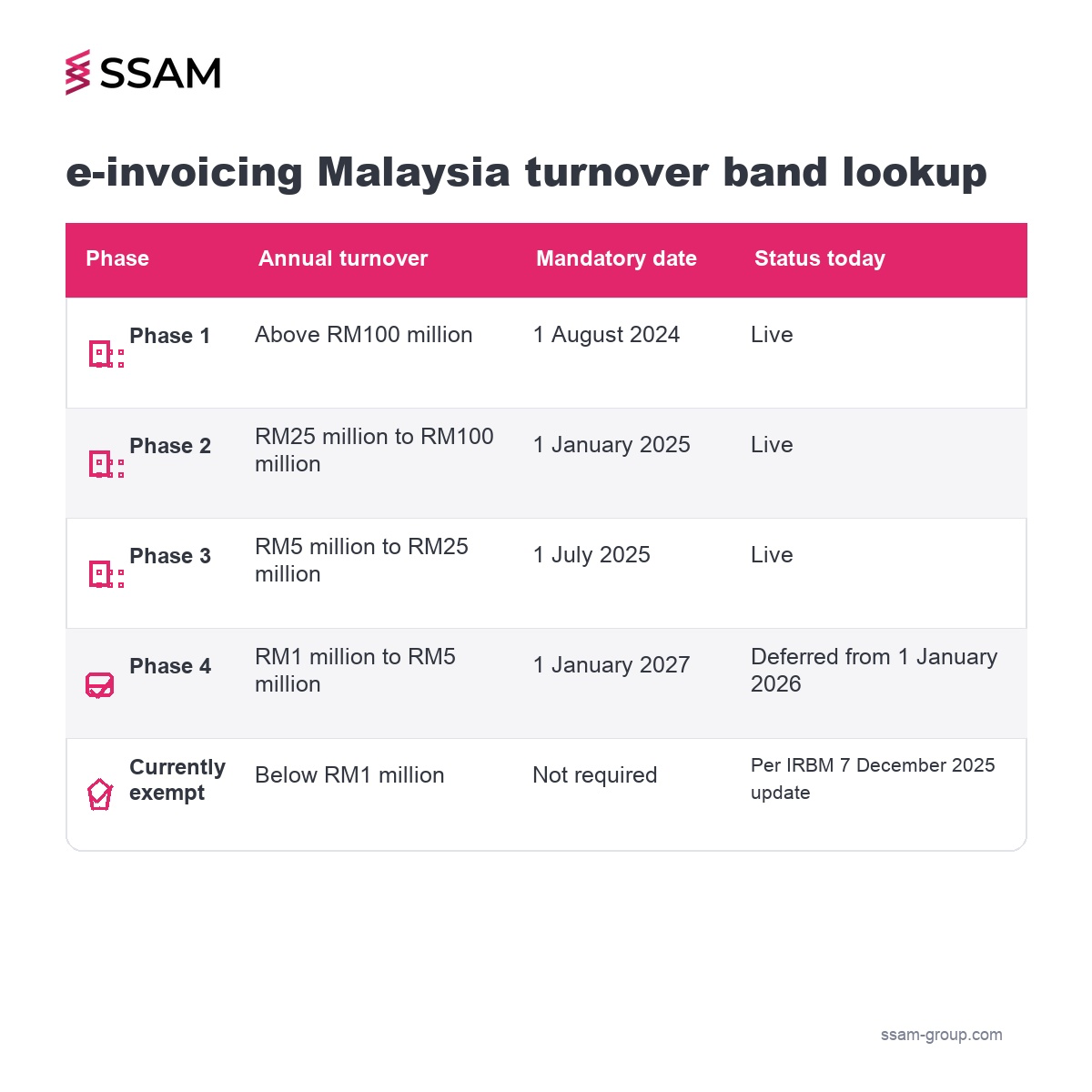
Most older guides still show the original five-phase rollout that started with a RM100 million turnover threshold. The IRBM timeline was updated on 7 December 2025 and adjusted again with the 5 January 2026 announcement. The current position is set out below.
| Phase | Annual turnover | Mandatory date | Status today |
|---|---|---|---|
| Phase 1 | Above RM100 million | 1 August 2024 | Live |
| Phase 2 | RM25 million to RM100 million | 1 January 2025 | Live |
| Phase 3 | RM5 million to RM25 million | 1 July 2025 | Live |
| Phase 4 | RM1 million to RM5 million | 1 January 2027 | Deferred from 1 January 2026 per 5 January 2026 announcement |
| Currently exempt | Below RM1 million | Not required at present | Per IRBM update 7 December 2025 |
The exemption for businesses below RM1 million in turnover is described by IRBM as a current position rather than a permanent carve-out. If your turnover sits close to that line or is growing, treat the exemption as a short window to prepare, not a long-term immunity. SSAM regularly works with clients in the tax compliance checklist Sdn Bhd Malaysia bracket who cross the threshold within a single financial year.
Look at your last audited revenue or your most recent set of management accounts. Map your turnover to the table. If your phase has already gone live and you are not yet on MyInvois, you are operating in the soft launch grace period that LHDN extends for six months from each phase's start date, but you should not rely on that indefinitely. If you are in the deferred RM1 million to RM5 million band, the wider Malaysia tax filing deadline 2026 calendar should already be on your radar so the e-invoice rollout aligns with your other 2026 and 2027 obligations.
What e-invoicing means for your day-to-day operations
E-invoicing is not just an IT project. It changes how your accounts team collects data, issues receipts, and stores records.
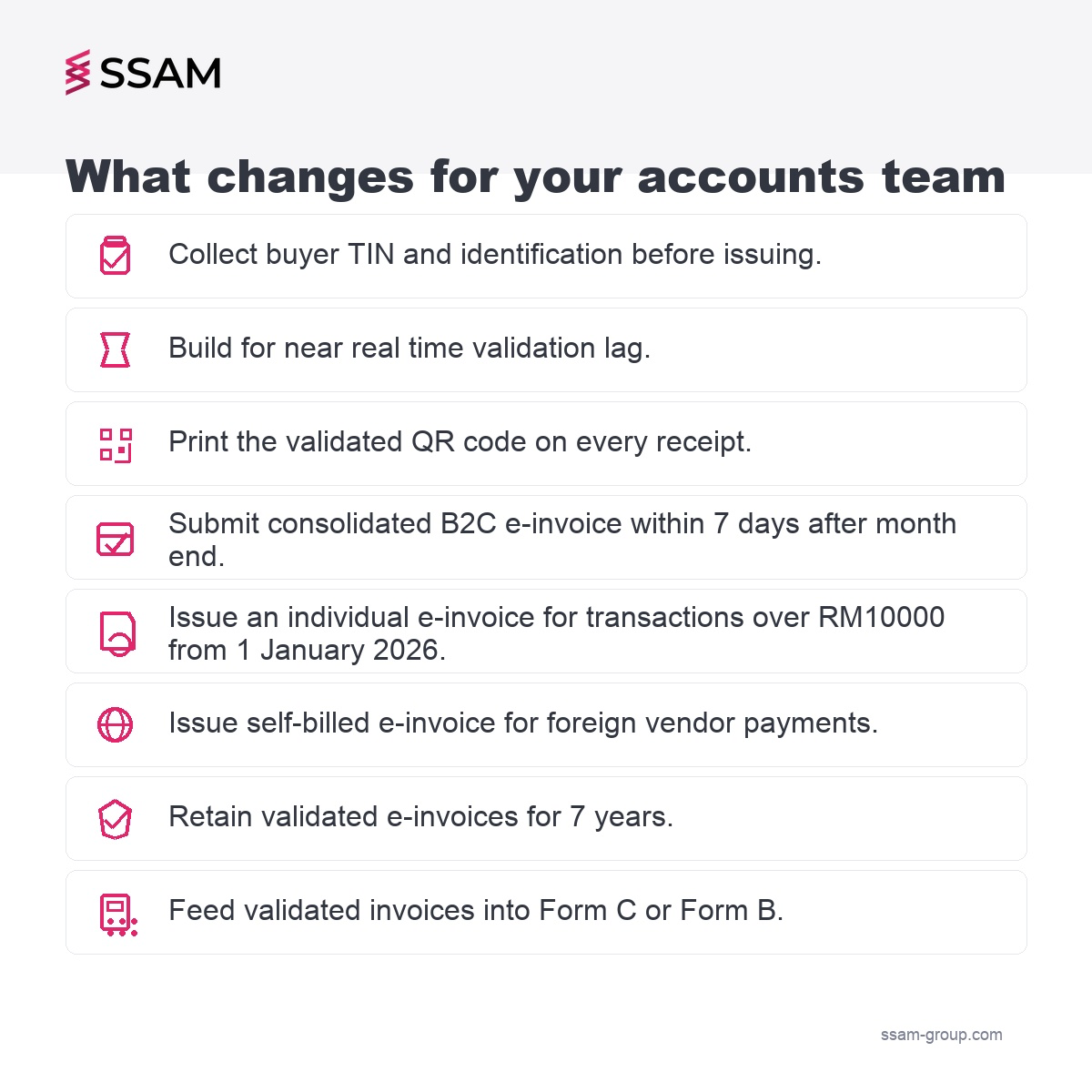
The shifts that catch most SMEs by surprise:
- Buyer TIN and ID collection. You now need the buyer's TIN, MyKad number, business registration number, or passport on file before you can issue an e-invoice. For walk-in B2C buyers who do not provide a TIN, LHDN allows a generic buyer TIN to be used.
- Validation lag. Even though MyInvois validates in near real time, you cannot guarantee an instant return. Your billing flow must handle the case where a customer is waiting at the counter or goods are about to be dispatched.
- QR code on receipts. Once validated, the QR code must appear on the customer-facing invoice or receipt. Buyers can scan it to verify the invoice on MyInvois.
- Consolidated e-invoice rules. For B2C transactions where the buyer does not request an individual e-invoice, you may issue a consolidated e-invoice covering all such transactions within seven days after month end. From 1 January 2026, transactions exceeding RM10,000 must be issued as an individual e-invoice and cannot sit inside a consolidated batch.
- Self-billed e-invoice. When you pay a foreign vendor, an unregistered local supplier, or in other defined scenarios, you must issue a self-billed e-invoice on the supplier's behalf. The same flow can apply to expense items such as a director's claim, which connects to the wider advance to director Malaysia tax rules.
- 7-year retention. Validated e-invoices, rejection notices, and amendment trails must be kept for seven years.
- Filing impact. The validated invoice still feeds your monthly and yearly tax returns. If your business is loss-making, you must still report. Read more on whether you need to file tax return loss Malaysia.
Budget for the upfront ERP integration and ongoing accounting overhead alongside your other Sdn Bhd running cost Malaysia line items so the rollout does not surprise the cash flow.
What happens if you do not comply
The penalty framework is general rather than headline-grabbing, but the operational risk is significant.
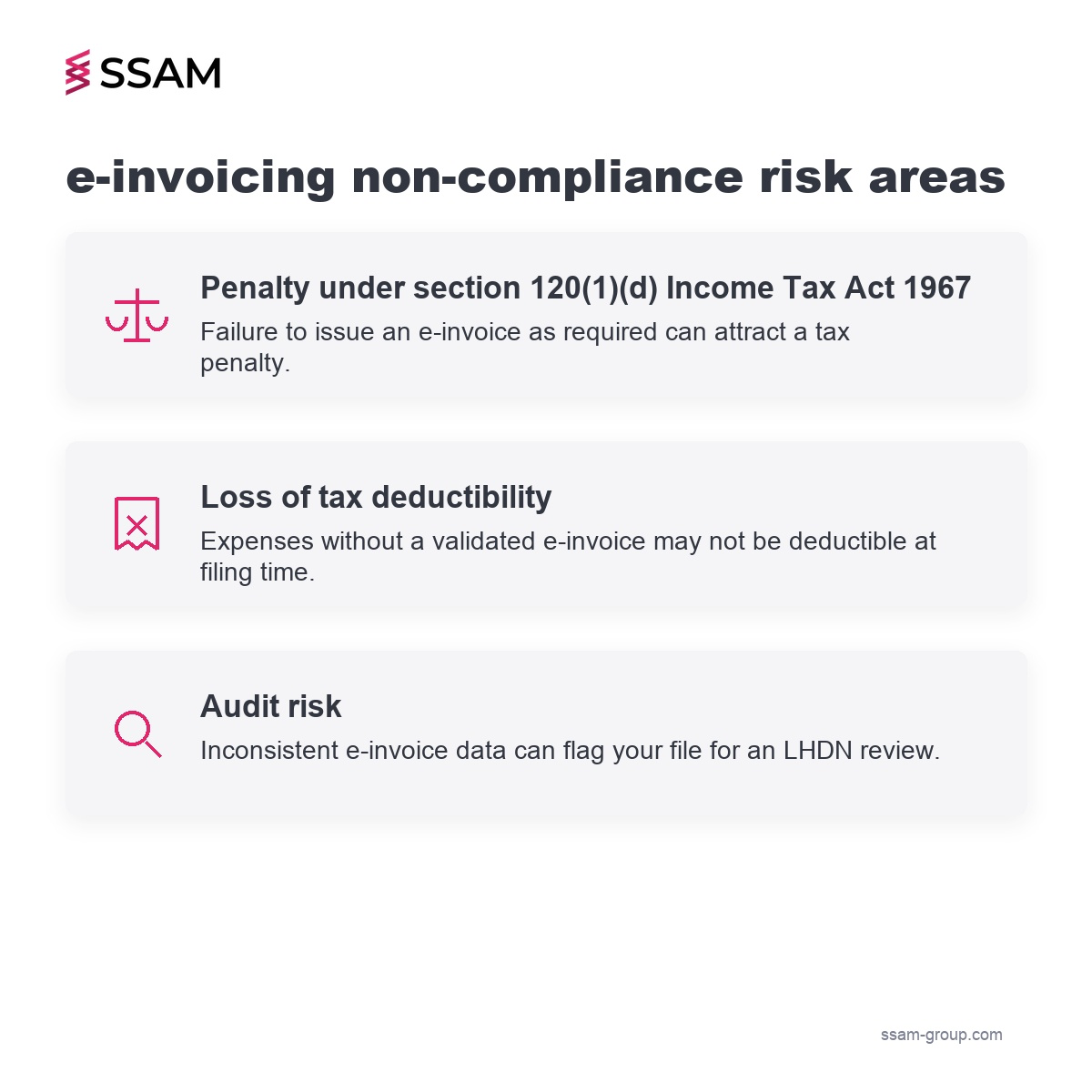
Three areas to watch:
- Penalty under section 120(1)(d) of the Income Tax Act 1967. Failure to issue an e-invoice as required may attract a penalty. The framing here is general because the IRBM guideline cross-references the Act rather than publishing a flat rate. A registered tax agent can model the exposure for your specific case.
- Loss of tax deductibility. If your supplier does not issue a validated e-invoice and you cannot produce one in your records, the underlying expense may not be deductible when you file Form C or Form B. That hits your tax bill directly.
- Audit risk. Once the system is fully bedded in, anomalies in transaction data feed LHDN's risk-scoring model. Inconsistencies between e-invoice volumes and reported revenue can trigger an LHDN tax audit Malaysia review.
The soft launch grace period of six months from each phase's start date should not be read as no enforcement. It buys time to get the technical setup right, not a free pass on the underlying obligation.
How SSAM Group helps Malaysian SMEs go live on e-invoicing
We work with Malaysian SMEs that need a calm, end-to-end view of compliance rather than a software pitch. SSAM Group is a 1-stop centre covering tax, accounting, secretarial, and advisory work, and our tax filing and compliance in Kuala Lumpur is backed by 40 years of experience and over 1,000 client relationships. Our tax agents are licensed by the Ministry of Finance, our accountants are registered with the Malaysian Institute of Accountants, and we work with your existing ERP rather than asking you to switch.
If you want a structured starting point, the tax consultant services in Kuala Lumpur overview is a good first read. To speak to the team:
- WhatsApp or call: +6011-6529 9879
- Email: tax@ssam-group.com
- Office hours: Monday to Friday, 8:30 to 17:30
Frequently asked questions about e-invoicing in Malaysia
Who is exempt from e-invoicing in Malaysia?
As of the 7 December 2025 IRBM update, businesses with annual turnover below RM1 million are not required to issue e-invoices, and the RM1 million to RM5 million band has its mandatory date deferred to 1 January 2027. IRBM also lists a small set of specifically exempted persons (such as certain government departments and ruler-related entities) inside the e-invoice guideline. Treat the SME exemption as a current position rather than a permanent rule.
Do I need to issue an e-invoice for B2C transactions?
Yes. B2C transactions are inside the scope. If the consumer does not request an individual e-invoice, you may issue a consolidated e-invoice covering all such transactions within seven days after month end. From 1 January 2026, any transaction exceeding RM10,000 must be issued as an individual e-invoice and cannot be lumped into a consolidated submission.
What is the difference between MyInvois Portal and MyInvois e-POS?
The MyInvois Portal is the LHDN web platform where any registered taxpayer can submit, validate, and view e-invoices manually or via API. MyInvois e-POS is a free point-of-sale system released by LHDN for micro-SMEs that do not have an existing billing system. It is suitable for hawker stalls, small retailers, and home-based businesses.
How long must I keep my e-invoice records?
Seven years. This applies to validated e-invoices, rejection notices, and amendment trails. Keep them in a format that lets you produce the original XML or JSON file on request, not just a printed PDF.
What happens if my e-invoice is rejected by MyInvois?
The invoice is not legally valid for tax purposes. You must correct the underlying data (typically a missing TIN, a wrong tax code, or a schema error) and resubmit. The buyer cannot claim a tax deduction on the underlying expense until a validated e-invoice exists. Build a same-day correction workflow so a rejection does not block your payment cycles.
Next steps for your business
The decision logic for most Malaysian SMEs is straightforward. Identify which turnover band you sit in, confirm your phase against the table above, and prepare your accounts workflow for the QR code, validation lag, and 7-year storage rules. If your business is in the deferred RM1 million to RM5 million band, use 2026 to get the technical setup right rather than wait until the last quarter of 2026. If you are exempt today, watch your turnover trend so you do not cross the threshold mid-year without a plan. For complex cases involving foreign vendors, related-party transactions, group structures, or asset disposals where you also need to weigh capital gains tax vs RPGT Malaysia implications, bring in a licensed tax agent early.
Data sources and references
- IRBM e-Invoice landing page: https://www.hasil.gov.my/en/e-invoice/
- IRBM e-Invoice Implementation Timeline (updated 7 December 2025): https://www.hasil.gov.my/en/e-invoice/implementation-of-e-invoicing-in-malaysia/e-invoice-implementation-timeline/
- IRBM e-Invoice Guidelines and Specific Guidelines: https://www.hasil.gov.my/en/e-invoice/reference-for-the-implementation-of-e-invoice/guidelines/
- MyInvois Portal: https://www.hasil.gov.my/en/e-invoice/myinvois-portal/
- MyInvois e-POS: https://www.hasil.gov.my/en/myinvoisepos/
- BDO Malaysia e-Invoicing guide: https://www.bdo.my/en-gb/insights/featured-insights/guide-to-e-invoicing-in-malaysia
- PwC Malaysia e-Invoicing: https://www.pwc.com/my/en/services/tax/e-invoicing.html
- Crowe Malaysia latest timeline: https://www.crowe.com/my/news/latest-e-invoice-implementation-timeline
The information in this article is provided for general informational purposes only and does not constitute tax, accounting, financial or legal advice. Tax laws change frequently and may not apply to your situation. Always consult a qualified professional before acting on any information here.