

Key Takeaways
- A tax compliance checklist Sdn Bhd Malaysia owners follow in year one is mostly set-up work: LHDN registration, secretary appointment, employer and SST registrations, record-keeping, and e-Invoice readiness.
- Register your company with LHDN through MyTax e-Daftar as soon as your secretary is appointed, and before your first sales invoice or first hire.
- Register EPF, SOCSO and EIS within seven days of your first staff hire, and check SST thresholds on a rolling 12-month basis.
- Keep tax records for at least seven years under Section 82 of the Income Tax Act 1967, in a format LHDN can audit.
- e-Invoicing applies to Sdn Bhds with annual turnover above RM1 million from 1 January 2026, with a grace period to 31 December 2026 for the RM1 million to RM5 million bracket.
- For filing deadlines and forms (CP204, Form C, Form E, Form EA), refer to the companion guide on first-time Sdn Bhd director tax obligations.
A tax compliance checklist Sdn Bhd Malaysia founders can actually use in year one is rare. Most lists you find online mix registration tasks, recurring filings, and rate tables into one long page, which makes it hard to know what to do first. The real risk for a new Sdn Bhd is not the rules you already know about. It is the registrations and records you did not realise had started counting from the day you were incorporated.
This guide focuses on the set-up side of compliance: the registrations, the systems, and the records every Sdn Bhd needs in its first 12 months. By the end you should be able to map your own first-year set-up calendar from your incorporation date and know exactly which authority each task belongs to. For filing deadlines and forms, see the companion guide on first-time Sdn Bhd director tax obligations.
What is a Sdn Bhd tax compliance checklist?
A Sdn Bhd tax compliance checklist is a structured list of statutory registration, set-up, and record-keeping tasks every Malaysian private limited company must complete to operate within the law. It covers registrations with LHDN, EPF, SOCSO, EIS and the Royal Malaysian Customs Department, plus the secretarial appointments and record systems required by the Companies Act 2016 and the Income Tax Act 1967.
For a new Sdn Bhd, a checklist matters because most obligations are anchored to events you control: the date your secretary is appointed, the date you commence business, the date you hire your first staff, and the date you cross a registration threshold. Track those four dates and the rest of the set-up falls into place.
First-year set-up milestones at a glance
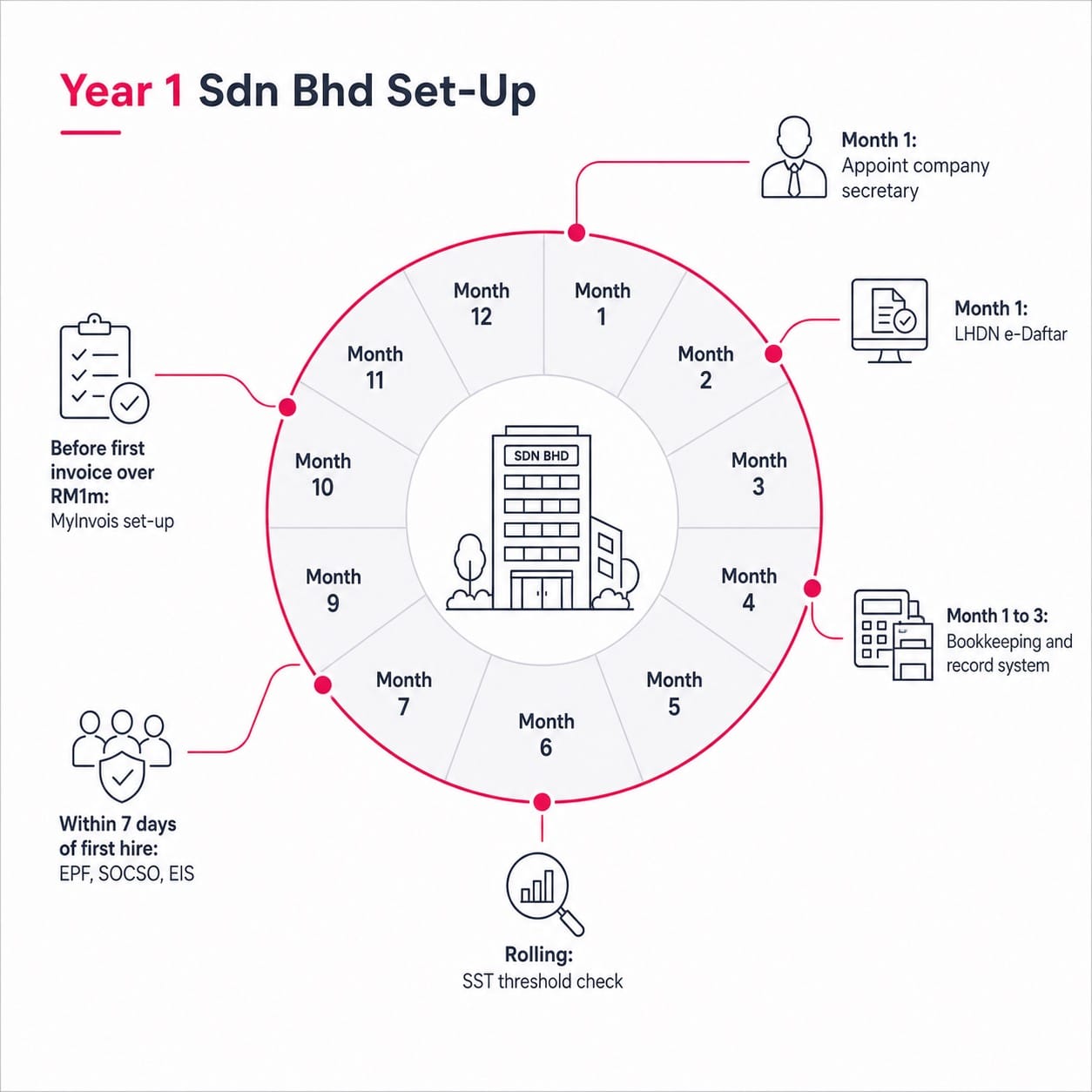
The table below maps the registration and set-up tasks a brand new Sdn Bhd faces in its first 12 months. Use it as the spine of your internal calendar. Adjust the dates against your own commencement date and financial year end (FYE).
| Timing | Task | Authority | Risk if missed |
|---|---|---|---|
| Within 30 days of incorporation | Appoint a licensed company secretary | SSM | Fine and director liability |
| Within 30 days of incorporation (and before first transaction) | Register the company with LHDN and obtain a tax file number (C number) | LHDN | Compounds and audit risk |
| Within first quarter | Set up bookkeeping system, chart of accounts, and document storage | Internal | Audit exposure and weak Form C support later |
| Within 7 days of first hire | Register with EPF, SOCSO and EIS as an employer | KWSP, PERKESO | Compounds and back-payments |
| Rolling 12-month review | Check SST registration thresholds and register if applicable | RMCD | Back-tax and compound |
| Before first invoice (if turnover may exceed RM1m) | Set up MyInvois account and integrate with accounting system | LHDN | Hard enforcement from 1 January 2027 |
| Within 18 months of incorporation | Lodge first Annual Return with SSM | SSM | Strike-off risk and director fines |
| Ongoing | Maintain tax and accounting records for at least 7 years | LHDN (Section 82, ITA 1967) | Compound and adverse audit findings |
Register your Sdn Bhd with LHDN immediately
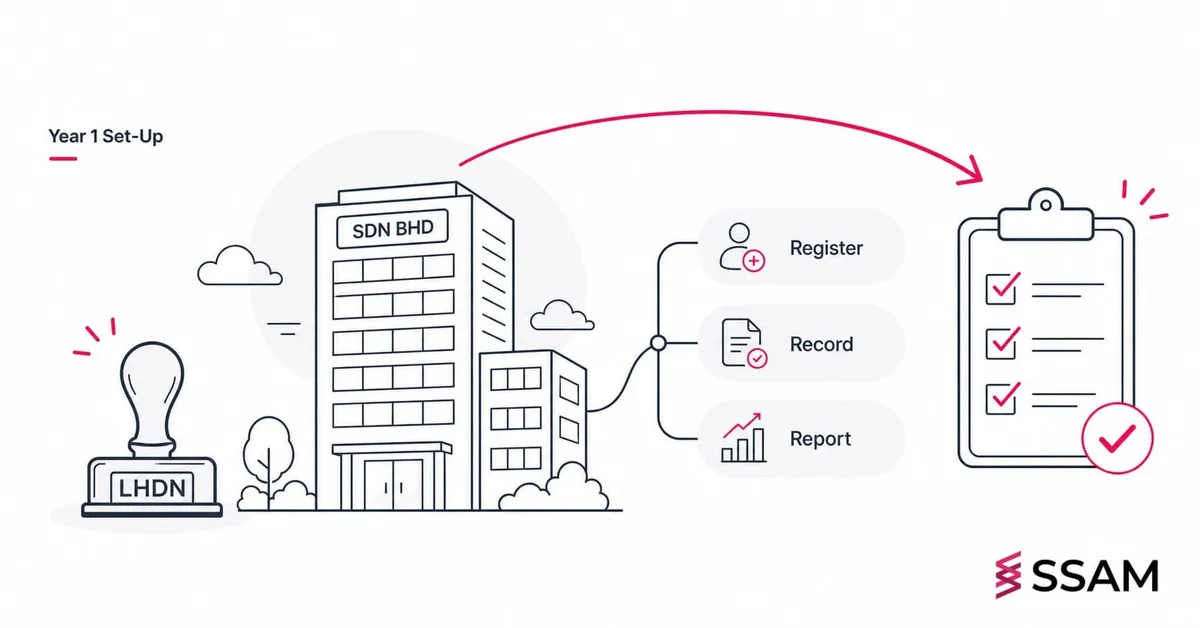
LHDN registration is the first tax task after your secretary is appointed. Without a tax file number, you cannot operate any payroll, e-Invoice, or future filing system in your company name.
Apply for the company tax file through MyTax e-Daftar
Since 1 January 2024, LHDN requires all new companies to register their tax file online through MyTax e-Daftar. You will need your SSM Notice of Registration (Section 17), the company constitution if you adopted one, and director and secretary identification details. The tax file number issued is a "C" number for Sdn Bhd entities.
Confirm your C number with your secretary
Your secretary should record the C number in your statutory register and on every future submission. Errors in the C number are a common source of misallocated payments and follow-up letters from LHDN.
Set the financial year end before month 12
You can choose any FYE within the first 18 months of incorporation. The most common choices are 31 December (aligned to the calendar year) or 30 June (eases workload during the post-Form C peak period). Once set, changing the FYE later requires LHDN approval and may extend or shorten your basis period.
Appoint a licensed company secretary and complete SSM set-up
SSM compliance and LHDN compliance are tightly linked. Your secretary is the gatekeeper for both.
Appoint a company secretary within 30 days
Under the Companies Act 2016, every Sdn Bhd must appoint a licensed company secretary (a MAICSA member or SSM-licensed individual) within 30 days of incorporation. The secretary handles your statutory register, board resolutions, and SSM filings, and is often the person who reminds you that LHDN deadlines are approaching.
File your first Annual Return within 18 months
Your first Annual Return must reach SSM within 18 months of incorporation. Subsequent annual returns are due within 30 days of each anniversary date. Late or missed annual returns can lead to fines and, in serious cases, a strike-off proceeding.
Reconcile SSM accounts with LHDN figures
If your Sdn Bhd does not meet the audit exemption conditions, audited accounts must be circulated to shareholders and lodged with SSM via MBRS. The accounts you submit to SSM and the financial statements behind your future Form C tax computation should reconcile cleanly. Discrepancies between the two are a frequent trigger for LHDN follow-up letters and audits.
Register EPF, SOCSO and EIS within seven days of your first hire
Employer registration is a one-time set-up task. The recurring monthly contributions and PCB filings are covered separately in the director guide.
Register on i-Akaun and PERKESO Assist
The Employment Act 1955 and the EPF, SOCSO and EIS Acts each require employer registration within seven days of the first hire. Use KWSP's i-Akaun (Employer) for EPF and the PERKESO Assist Portal for SOCSO. EIS registration is processed alongside SOCSO.
Set up the payroll system before staff onboard
A new Sdn Bhd should have its payroll software, employer contribution schedule, and PCB tables configured before the first staff member starts. This avoids late-payment compounds when the first 15th-of-the-month deadline arrives. Most local payroll platforms (such as PayrollPanda, Kakitangan, and SQL Payroll) support EPF, SOCSO, EIS and PCB out of the box.
Document foreign worker compliance separately
If your Sdn Bhd hires foreign workers, register with the Department of Labour for levy and immigration compliance. This is outside LHDN scope but often becomes a record-keeping issue at audit time, so capture it in your set-up checklist from the start.
Decide if SST registration applies to your Sdn Bhd
Sales and Service Tax (SST) is administered by the Royal Malaysian Customs Department, separate from LHDN. SST registration is part of your set-up checklist; SST returns (SST-02) are a recurring filing covered in the director guide.
Sales tax threshold
If your company manufactures or imports taxable goods and your taxable turnover exceeds RM500,000 over a rolling 12-month period, you must register for sales tax through the MySST portal.
Service tax thresholds by category
Service tax thresholds depend on the service category. The general threshold is RM500,000. Rental and leasing services and financial services use RM1 million. Construction and private healthcare use RM1.5 million. Private education uses RM60,000 per student per year.
2026 service tax rate change for rental and leasing
From 1 January 2026, service tax on rental and leasing services is set at 6 percent (down from 8 percent). For new MSMEs, the rental and leasing exemption window covers the first year from registration date if annual taxable rental income stays below RM1.5 million. For your first-year planning, this means you can budget for 6 percent on landlord-billed service tax where applicable, and check whether you qualify for the MSME exemption.
Set up record-keeping from day one
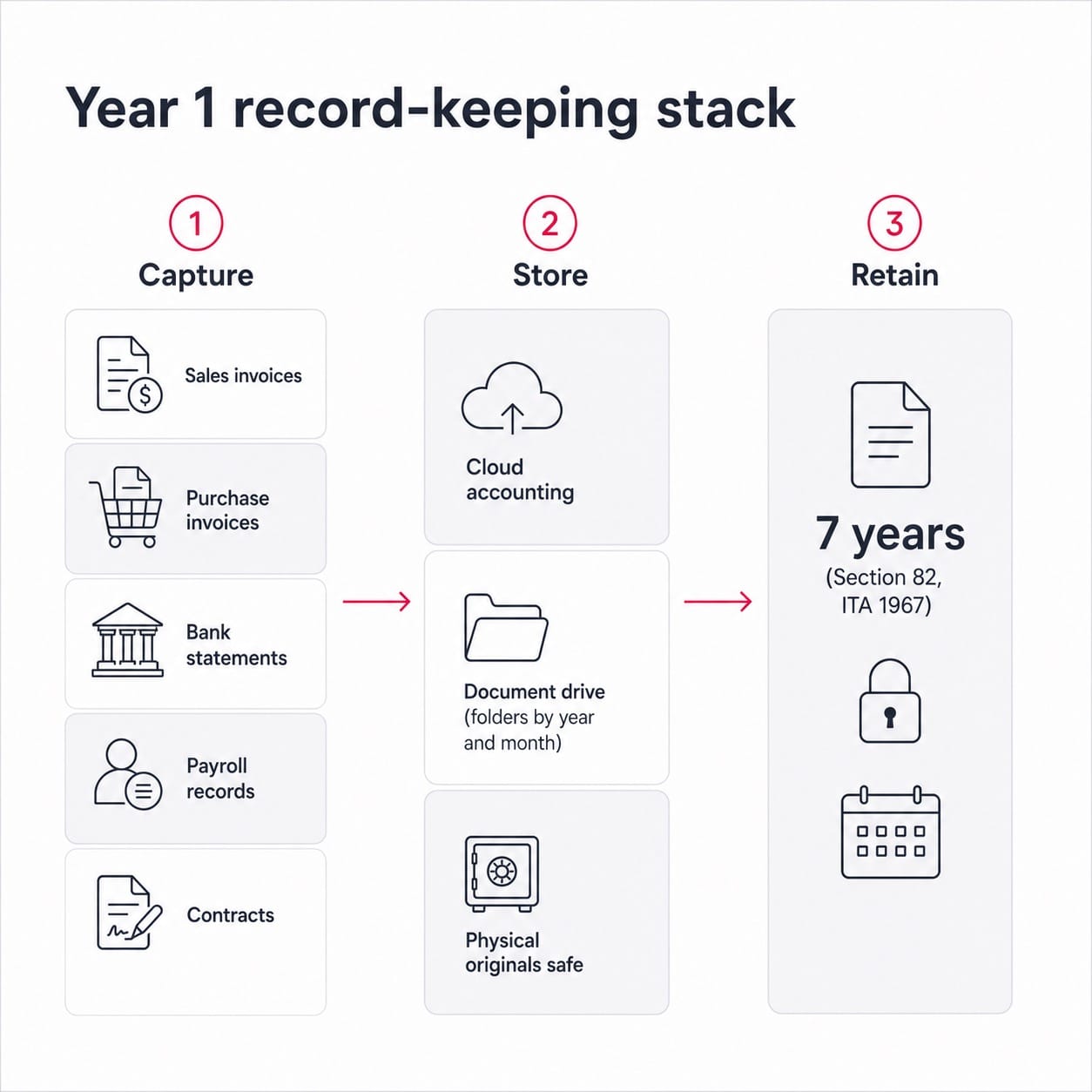
Record-keeping is the part of compliance most founders treat as optional in year one and regret in year three. LHDN, SSM and RMCD all require you to keep documentation, and the cost of reconstructing records during an audit is far higher than building good systems from the start.
Seven-year retention rule under Section 82 of the Income Tax Act 1967
Section 82 of the Income Tax Act 1967 requires every business to keep "sufficient records" of income and expenses for at least seven years after the end of the relevant year of assessment. This is the rule behind the LHDN 7-year lookback and the reason audits can reach back that far. Records must be in Malay or English, and must be available for inspection in Malaysia.
What documents to keep
At a minimum, your Sdn Bhd should retain:
- Sales invoices, credit notes, and debit notes (issued and received)
- Purchase invoices and supplier statements
- Bank statements, cheque butts, and remittance advices
- General ledger, sales ledger, and purchase ledger
- Payroll records, PCB schedules, and employment contracts
- Board resolutions, shareholder agreements, and director current account ledgers
- Asset register and supporting documents for capital allowance claims
- Stock records and inventory counts (where applicable)
- Contracts, leases, and intercompany agreements
Digital versus physical storage
LHDN accepts digital records, provided they are legible, complete, and reproducible on demand. Cloud accounting platforms (Xero, SQL Account, AutoCount, Million) satisfy this requirement when paired with a structured document storage system such as Google Drive, SharePoint, or Dropbox. Keep originals of physical documents that bear wet signatures or official seals (audited accounts, share transfer forms, stamped agreements).
Build the audit folder while transactions are fresh
The single biggest record-keeping mistake is filing documents only when an audit is announced. Build a year-by-year audit folder during normal operations, indexed by month and document type. When the LHDN tax audit letter arrives, you will be supplying documents within days rather than scrambling for weeks.
Get e-Invoice ready before enforcement bites
e-Invoicing is the newest layer of tax compliance, and the one most likely to catch a new Sdn Bhd off guard. SSAM's plain-English explainer on e-Invoicing in Malaysia covers the basics if you are just starting to read about it.
Phase 4 grace period to 31 December 2026
Phase 4 covers companies with annual turnover between RM1 million and RM5 million. The mandatory date was 1 January 2026, with a grace period extended to 31 December 2026. Hard enforcement begins 1 January 2027. During the grace window, LHDN expects "reasonable effort" rather than perfect compliance, but missing the window entirely is not advisable.
The RM1 million exemption threshold from 1 January 2026
In December 2025, LHDN raised the e-Invoice exemption threshold from RM500,000 to RM1 million in annual turnover. If your new Sdn Bhd will not cross RM1 million in year one, you are exempt for now, but you should still set up a MyInvois account so you are ready as revenue scales.
How to register on MyInvois
Registration is free through the MyInvois portal. You need your tax file (C number), authorised representative details, and a digital certificate. Most accounting software providers in Malaysia now offer integrated e-Invoice modules, so the practical decision is whether to issue invoices directly through MyInvois or via your accounting platform.
Avoid the most common first-year compliance mistakes
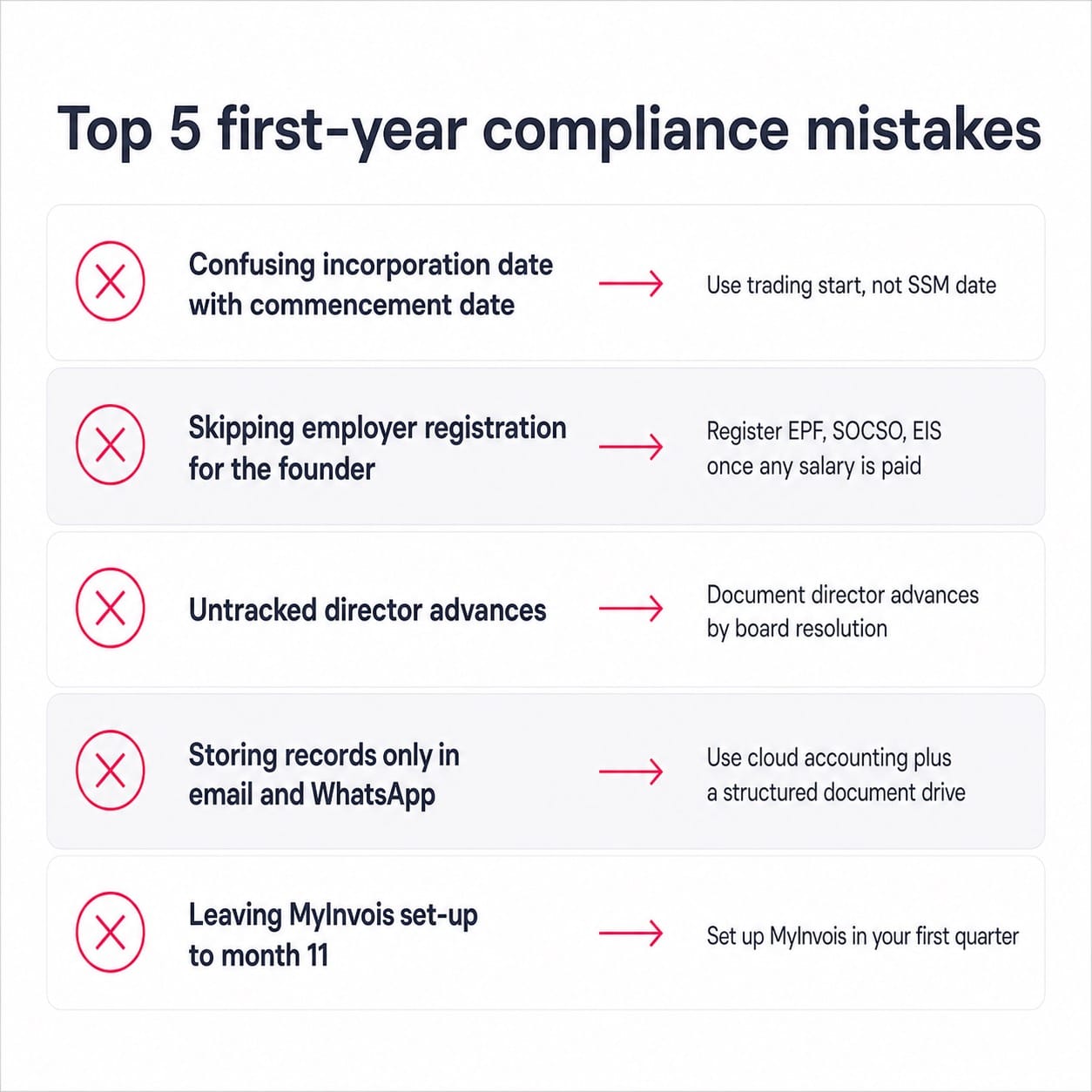
These are the recurring set-up mistakes SSAM sees with new Sdn Bhd clients in their first 12 months.
Treating incorporation date as commencement date
Several registrations key off commencement, not incorporation. If you incorporated in January but did not start trading until April, your registration clocks restart from April. Get this wrong and you may register too early on guesswork details, or far too late and trigger a non-compliance flag.
Skipping employer registration because the founder is the only "employee"
A founder drawing a director's fee or salary is still a person being paid by the company. Once any payment of salary or director's fee begins, EPF, SOCSO, EIS and PCB registrations apply. Founders often delay employer registration until they hire a second person, which creates back-dated compounds.
Mixing director loans with company funds
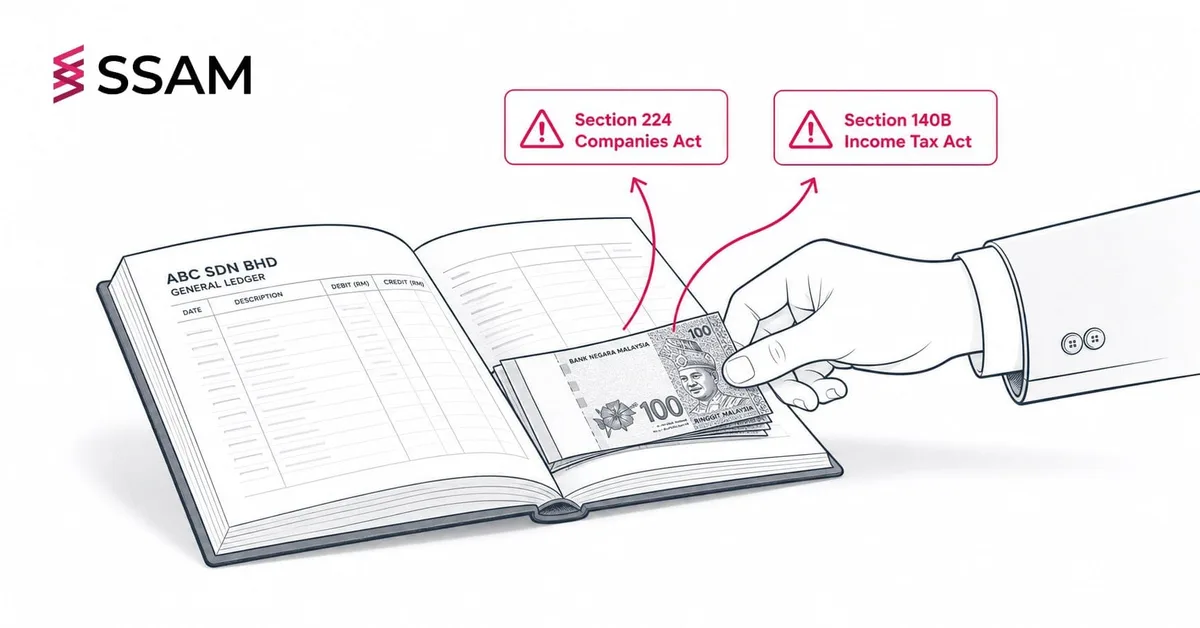
Founders often top up the company bank account from a personal account or take out funds without proper documentation. Untracked director advances can trigger deemed-interest tax under Section 140B of the Income Tax Act 1967 and create advance to director Malaysia tax exposure. Keep a clean board resolution and director current account from day one.
Storing records only in personal email and WhatsApp
Invoices, contracts, and statements that live only in a founder's personal email or WhatsApp are not a record-keeping system. They are a single point of failure. Move documents into a shared accounting platform and document drive in the first quarter, while transaction volume is still small.
Leaving e-Invoice readiness to month 11
Setting up MyInvois, mapping your invoice templates, and training staff takes longer than most founders expect. Plan for it in your first quarter rather than the last.
Tax compliance checklist FAQ for new Sdn Bhd owners
How long after incorporation must I register my Sdn Bhd with LHDN?
Register through MyTax e-Daftar as soon as your secretary is appointed and your SSM Notice of Registration is issued. Practically, this should happen within the first 30 days, and certainly before your first sales invoice or first staff hire.
Do I need to register EPF, SOCSO and EIS if I am the only person in the company?
Yes, if you are paying yourself a salary or director's fee. Registration is required within seven days of the first payment. If the company has not yet paid any remuneration, registration can wait until just before the first payroll run.
How long do I need to keep my Sdn Bhd's tax records?
At least seven years after the end of the relevant year of assessment, under Section 82 of the Income Tax Act 1967. Records must be kept in Malay or English and be available for inspection in Malaysia.
Is e-Invoicing mandatory for my new Sdn Bhd in 2026?
It depends on annual turnover. If your turnover is RM1 million or below, you are exempt as of 1 January 2026. Between RM1 million and RM5 million, you fall into Phase 4: mandatory from 1 January 2026, with a grace period to 31 December 2026 and hard enforcement from 1 January 2027.
Do I need to register for SST in my first year?
Only if you cross the relevant threshold on a rolling 12-month basis. The general threshold is RM500,000 in taxable turnover, with higher thresholds for rental and leasing, financial services, construction, healthcare, and private education. Track your rolling turnover monthly so you can register on time when you approach the threshold.
Can a new Sdn Bhd change its Financial Year End later?
Yes, but you need LHDN approval and the change can extend or shorten the basis period for that year of assessment. Most companies that wish to change their FYE do so once, early on, then keep it stable.
Where can I find the actual filing deadlines for CP204, Form C, Form E and Form EA?
Filing deadlines and forms are covered in the companion guide on first-time Sdn Bhd director tax obligations. This article focuses on the registration and set-up side of compliance.
What to do next
Build the set-up milestones above into your accounting and document systems in your first quarter. Cross-check them monthly against your bank reconciliation, payroll run, and contract pipeline. If you are unsure which registrations apply to your business model or whether you have crossed an SST threshold, SSAM's tax filing and compliance in Kuala Lumpur can guide you. Our MOF-licensed tax agents have helped over 1,000 Malaysian businesses set up compliant first-year processes that hold up to LHDN scrutiny later.
You can WhatsApp the SSAM team on +6011-6529 9879 or email tax@ssam-group.com for a no-obligation conversation about your first-year tax set-up.
Data Sources and References
- LHDN, Tax File Registration: https://www.hasil.gov.my/en/company/tax-file-registration/
- LHDN, Record-Keeping Requirements (Section 82, ITA 1967): https://www.hasil.gov.my/en/legislation/act/income-tax-act-1967/
- LHDN, e-Invoice Implementation Timeline: https://www.hasil.gov.my/en/e-invoice/implementation-of-e-invoicing-in-malaysia/e-invoice-implementation-timeline/
- KWSP, Employer Registration: https://www.kwsp.gov.my/employer/responsibilities/registration
- PERKESO, Employer Registration: https://www.perkeso.gov.my/en/our-services/employer-employee/registration.html
- MySST, Registering your Business: https://mysst.customs.gov.my/registerbussiness
- KPMG Malaysia, 6 percent service tax rate for rental and leasing services: https://kpmg.com/us/en/taxnewsflash/news/2026/03/tnf-malaysia-6-percent-service-tax-rate-for-rental-or-leasing-services.html
- KPMG Malaysia, Updated and expanded service tax exemptions for rental and leasing services: https://kpmg.com/us/en/taxnewsflash/news/2026/01/tnf-malaysia-updated-and-expanded-service-tax-exemptions-for-rental-and-leasing-services.html
- SSM, Companies Act 2016: https://www.ssm.com.my/Pages/Legal_Framework/Companies-Act-2016.aspx
The information in this article is provided for general informational purposes only and does not constitute tax, accounting, financial or legal advice. Tax laws change frequently and may not apply to your situation. Always consult a qualified professional before acting on any information here.