

Key Takeaways
- Malaysia has 4 main business structures: sole proprietorship, conventional partnership, LLP and Sdn Bhd.
- Only Sdn Bhd and LLP protect your personal assets. Sole proprietors and conventional partners have unlimited personal liability.
- Only Malaysian citizens and permanent residents can register a sole proprietorship or conventional partnership.
- Do not choose based on cost alone. Choose a structure that fits where you want the business to be in the next few years.
Choosing the wrong business structure can expose your savings or create costs you did not expect. In Malaysia, you can choose from 4 main business structures: sole proprietorship, partnership, LLP and Sdn Bhd.
This guide explains each option in plain English. You will see the differences in liability, tax, cost and compliance, so you can choose the structure that fits your plans.
What are the main business structures in Malaysia?
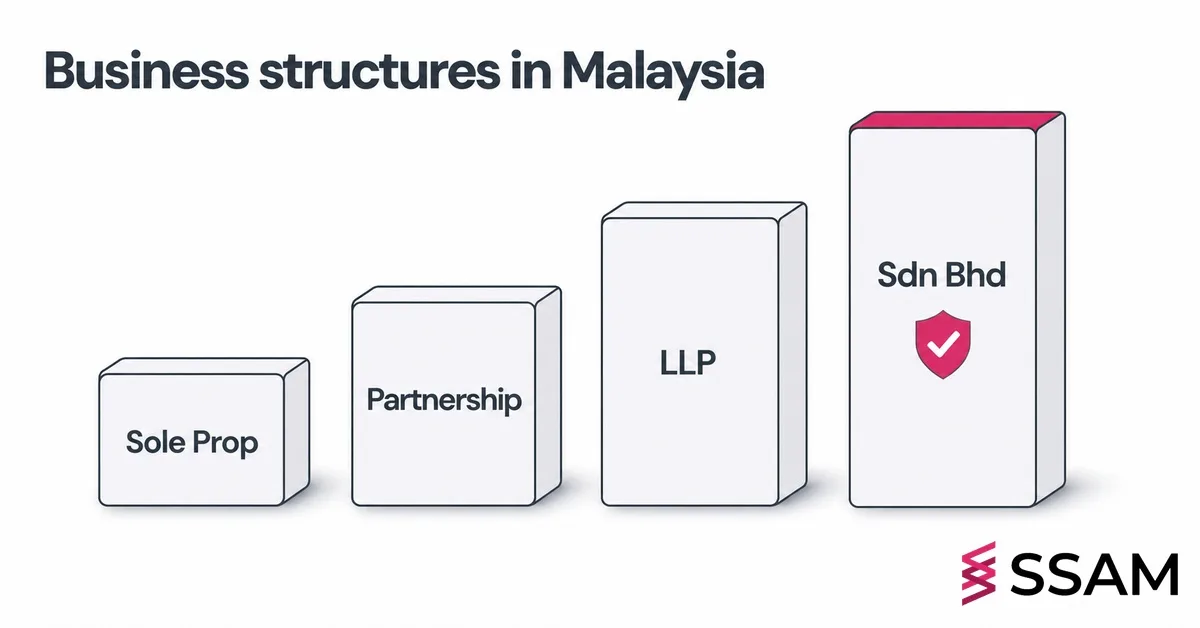
The 4 main business structures in Malaysia are sole proprietorship, conventional partnership, limited liability partnership (LLP) and Sdn Bhd. They differ in personal liability, tax, setup cost, who can register and yearly compliance. Each is governed by a different Malaysian law.
Sole proprietorship: simple but personal
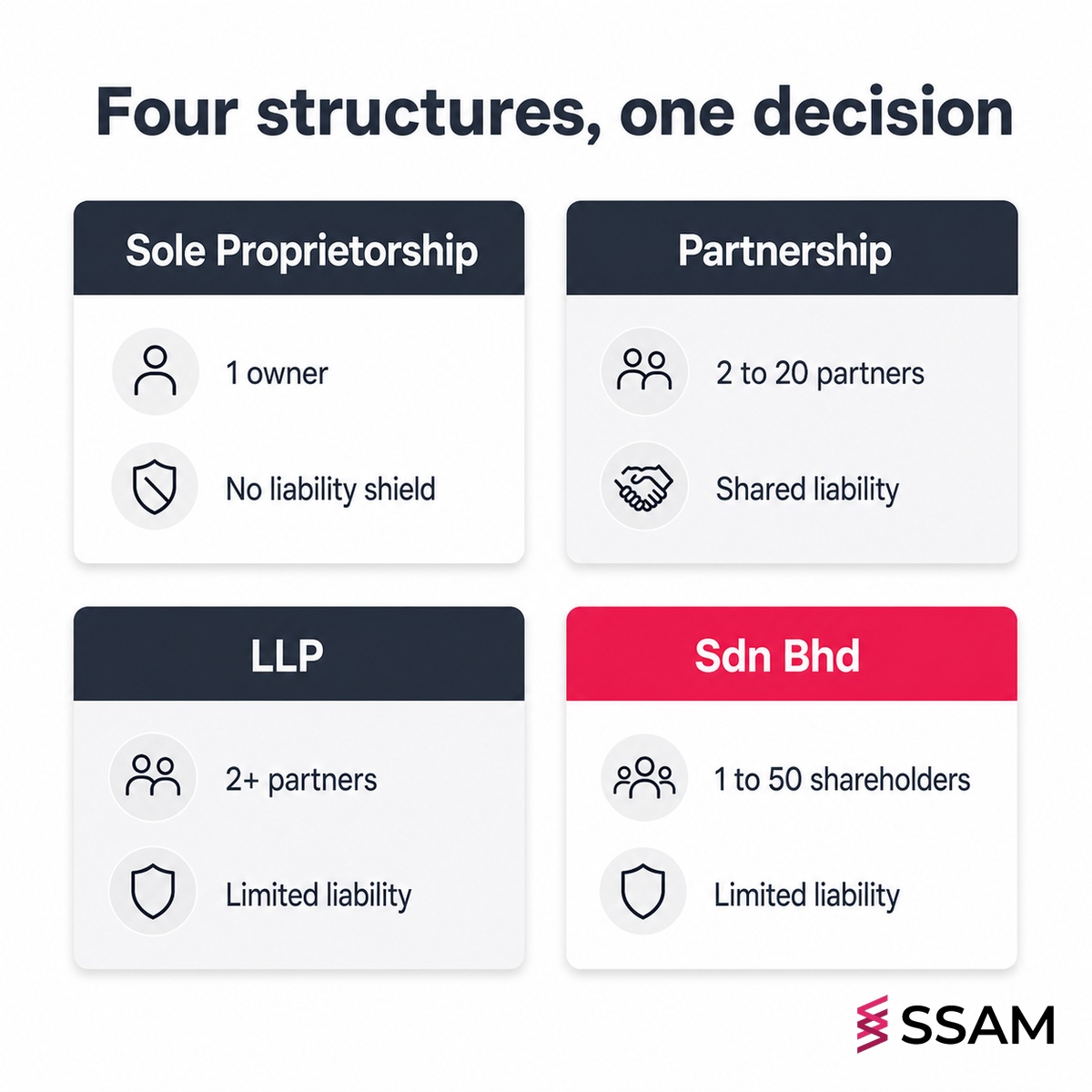
A sole proprietorship, often called an enterprise, is the simplest option. It has 1 owner, costs RM30 to RM60 to register and must be renewed every year. Its profit is taxed as the owner's personal income. Setup is fast, and the owner makes every decision.
However, there is no legal separation between you and the business. Business debts are your personal debts. It can also be harder to get financing or investors. Only Malaysian citizens and permanent residents can register this structure. It can still be a practical way to test a small, low-risk business idea.
Conventional partnership: shared and unlimited
A conventional partnership has 2 to 20 owners and is only for Malaysian citizens and permanent residents. Partners share profits and duties. They also share the risks. There is no liability protection, so each partner can be held responsible for the partnership's debts.
This structure can suit professional practices and family businesses where the partners bring different skills. Put a written partnership agreement in place. It should cover each person's role, how profits are shared and how disputes will be handled.
LLP: the hybrid with limited liability
An LLP combines a partnership's flexibility with limited liability. It is a separate legal entity, so it can own property, sign contracts and be sued in its own name. Partners are generally protected from each other's mistakes beyond their own contributions.
An LLP has lighter compliance than a Sdn Bhd. It does not need a statutory audit and files an annual declaration with SSM. However, some banks and investors are less familiar with LLPs, so financing can be harder. An LLP also cannot issue shares, which makes it unsuitable for equity fundraising. Our limited liability partnership in Malaysia overview and LLP registration in Malaysia guide explain more.
Sdn Bhd: the structure built to scale
A Sdn Bhd is a private limited company under the Companies Act 2016. It is often the better choice for a business that plans to grow. It is a separate legal entity with 1 to 50 shareholders, and shareholder liability is limited to their shares.
This structure lets the company open bank accounts and apply for financing in its own name. It can bring in investors by issuing shares, continue even when shareholders change, and offer the credibility that many corporate clients and tenders expect. Qualifying SMEs currently pay 15% on the first RM150,000 of chargeable income, with higher bands up to 24%, subject to conditions.
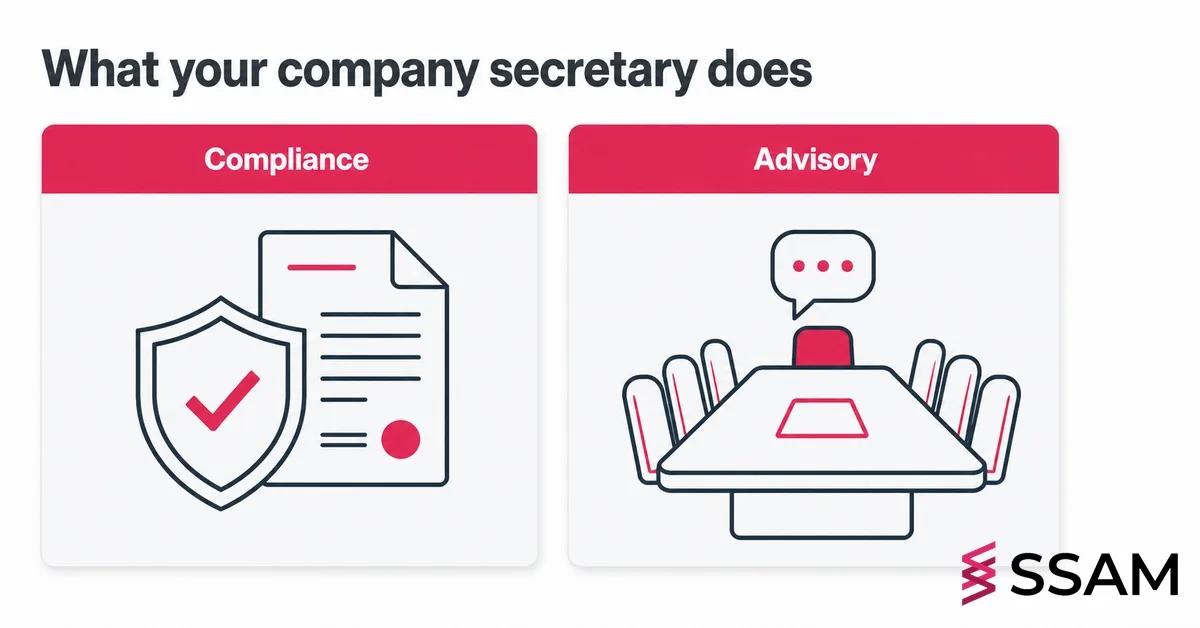
However, a Sdn Bhd has more compliance duties. It must appoint a licensed company secretary within 30 days, file an annual return, keep proper accounting records and complete an audit unless it qualifies for exemption. When you are ready, our guide explains how to register a Sdn Bhd in Malaysia.
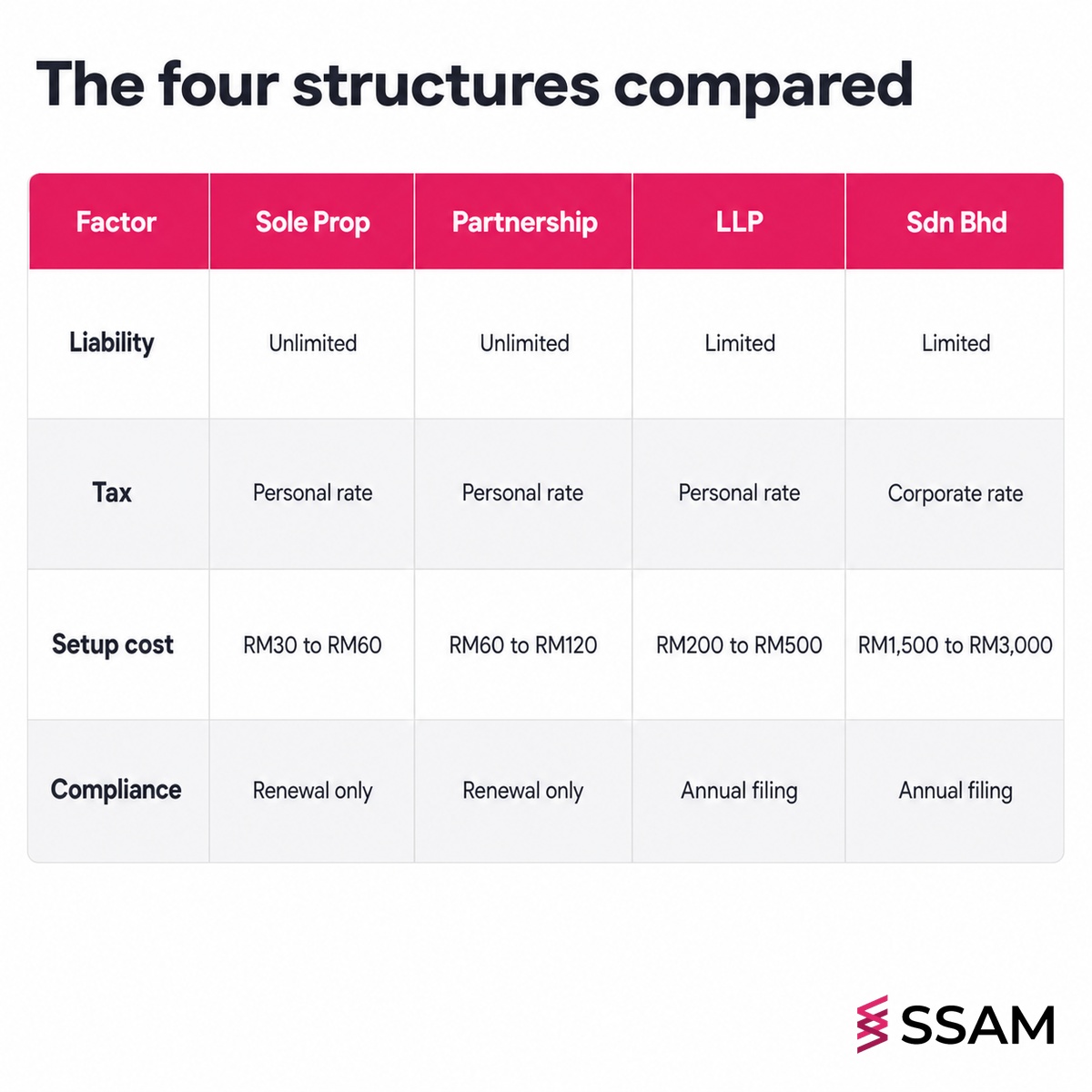
Liability, tax, cost and compliance compared
| Sole proprietorship | Conventional partnership | LLP | Sdn Bhd | |
|---|---|---|---|---|
| Governing law | Registration of Businesses Act 1956 | Partnership Act 1961 | LLP Act 2012 | Companies Act 2016 |
| Legal identity | None | None | Separate entity | Separate entity |
| Personal liability | Unlimited | Unlimited, joint | Limited | Limited to shares |
| Owners | 1 | 2 to 20 | 2 or more | 1 to 50 |
| Who can register | Malaysians and PRs | Malaysians and PRs | Open, incl. foreigners | Open, incl. foreigners |
| Tax treatment | Owner's personal rate | Partners' personal rates | Corporate-style rates | 15% to 24% SME scale |
| Setup cost | RM30 to RM60 | RM60 class | Moderate | RM1,000 SSM fee |
| Annual compliance | Renewal only | Renewal only | Annual declaration | Secretary, annual return, accounts |
The table shows the main trade-off. More protection and business credibility usually come with more compliance duties.
Which structure fits your situation?
The table gives the facts, but your situation should decide. Here are 4 common examples:
- The micro or home business. If you are testing a small food or craft business with little capital, an enterprise keeps costs low. A home business owner with RM2,000 of capital asked this question on Lowyat, and the replies showed why both options can make sense.
- The growing SME. If you plan to hire, borrow, sign larger contracts or bid for tenders, a Sdn Bhd may be worth the added compliance because it offers more protection and credibility. Our sole proprietorship vs Sdn Bhd in Malaysia guide explains the tax differences.
- The professional practice. Professional firms often choose an LLP because it offers limited liability with lighter compliance.
- The foreign founder. Foreigners cannot register an enterprise. A Sdn Bhd is usually the practical choice, although an LLP may suit some business activities.
Choose for where you are going
The right business structure in Malaysia should fit your plans for the next 2 years, not only the next 2 weeks. An enterprise can work for testing an idea. A partnership can suit a shared venture. An LLP often fits a professional practice. A Sdn Bhd is usually better for a business that plans to grow, hire or borrow.
If you want the choice and the registration handled together, SSAM Group advises on structure and delivers company incorporation and Sdn Bhd registration services in Kuala Lumpur end to end, backed by 40 years of experience, 1,000+ loyal customers and a 99% client satisfaction record. Speak to the SSAM team or WhatsApp us at +6011-6529 9879. Before you decide, our guide on the things to consider before registering your company makes a useful companion read.
FAQs about Malaysian business structures
Is a Sdn Bhd better than a sole proprietorship?
Better for growth, borrowing and protection, but more expensive to run. For a small low-risk venture, a sole proprietorship is a reasonable starting point. Many founders start there and convert once revenue justifies it.
Can foreigners register a sole proprietorship?
No. Sole proprietorships and conventional partnerships are reserved for Malaysian citizens and permanent residents. Foreign founders typically incorporate a Sdn Bhd.
Does an LLP need an audit?
No statutory audit is required for an LLP. It files an annual declaration with SSM instead, which keeps compliance lighter than a company's.
Which structure is cheapest to maintain?
The sole proprietorship, by a wide margin: registration renewal and a personal tax return are essentially the whole obligation. LLPs sit in the middle, and Sdn Bhd companies carry the most compliance.
Can I convert my enterprise later?
Yes, and it is a common path. Conversion means incorporating a new Sdn Bhd and moving the business across: bank accounts, contracts, assets and tax registrations. Planning the move early keeps it painless.
Data sources and further references
- MalaysiaBiz: official comparison of business entities
- SSM: Comparison of Business Entities in Malaysia (PDF)
- Companies Act 2016, Limited Liability Partnerships Act 2012 and Partnership Act 1961, via the federal gazette portal
The information in this article is provided for general informational purposes only and does not constitute tax, accounting, financial or legal advice. Tax laws change frequently and may not apply to your situation. Always consult a qualified professional before acting on any information here.