

Key Takeaways
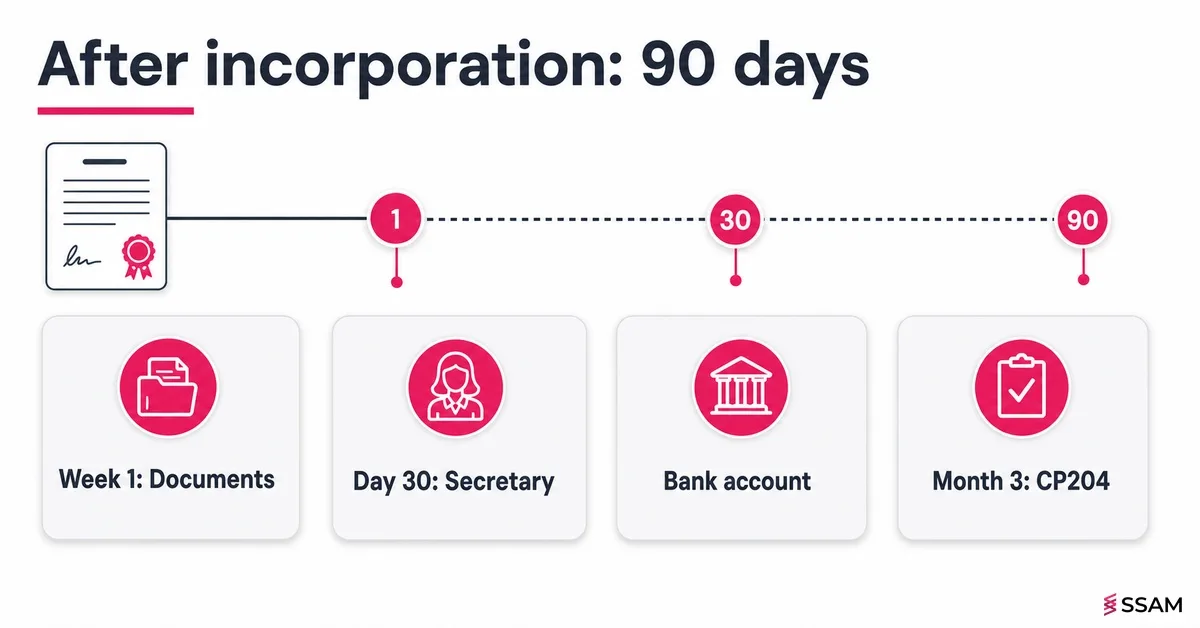
- Incorporation is just the start. The compliance clock starts straight away: appoint a licensed company secretary within 30 days, and submit your CP204 tax estimate within 3 months.
- Register your tax file with LHDN even at zero revenue. Dormant companies still file.
- Open the corporate bank account early because bank due diligence is the slowest workstream and runs on the bank's clock, not yours.
- Statutory registers and the beneficial ownership register are legal requirements, not paperwork extras.
After company incorporation in Malaysia, most founders feel done. The notice of registration is in hand, the company exists, and the hard part seems over. In reality, the first 90 days decide whether your new Sdn Bhd stays compliant for the rest of the year, and several legal clocks are already running.
This checklist sequences the work in the order it actually unblocks: documents first, then the mandatory appointments, then banking, tax, records and licences. For each item, you will see whether it is legally mandatory or operational, and who normally handles it.
What should you do after incorporating a Sdn Bhd?
After incorporating a Sdn Bhd in Malaysia, confirm your incorporation documents, appoint a licensed company secretary within 30 days, set up statutory and beneficial ownership registers, open a corporate bank account, register with LHDN, set a reminder for your CP204 estimate due within 3 months, set up accounting records, and check which business licences apply.
| Window | Task | Mandatory? | Who handles it |
|---|---|---|---|
| Week 1 | Confirm incorporation documents | Yes (records) | Founder + secretary |
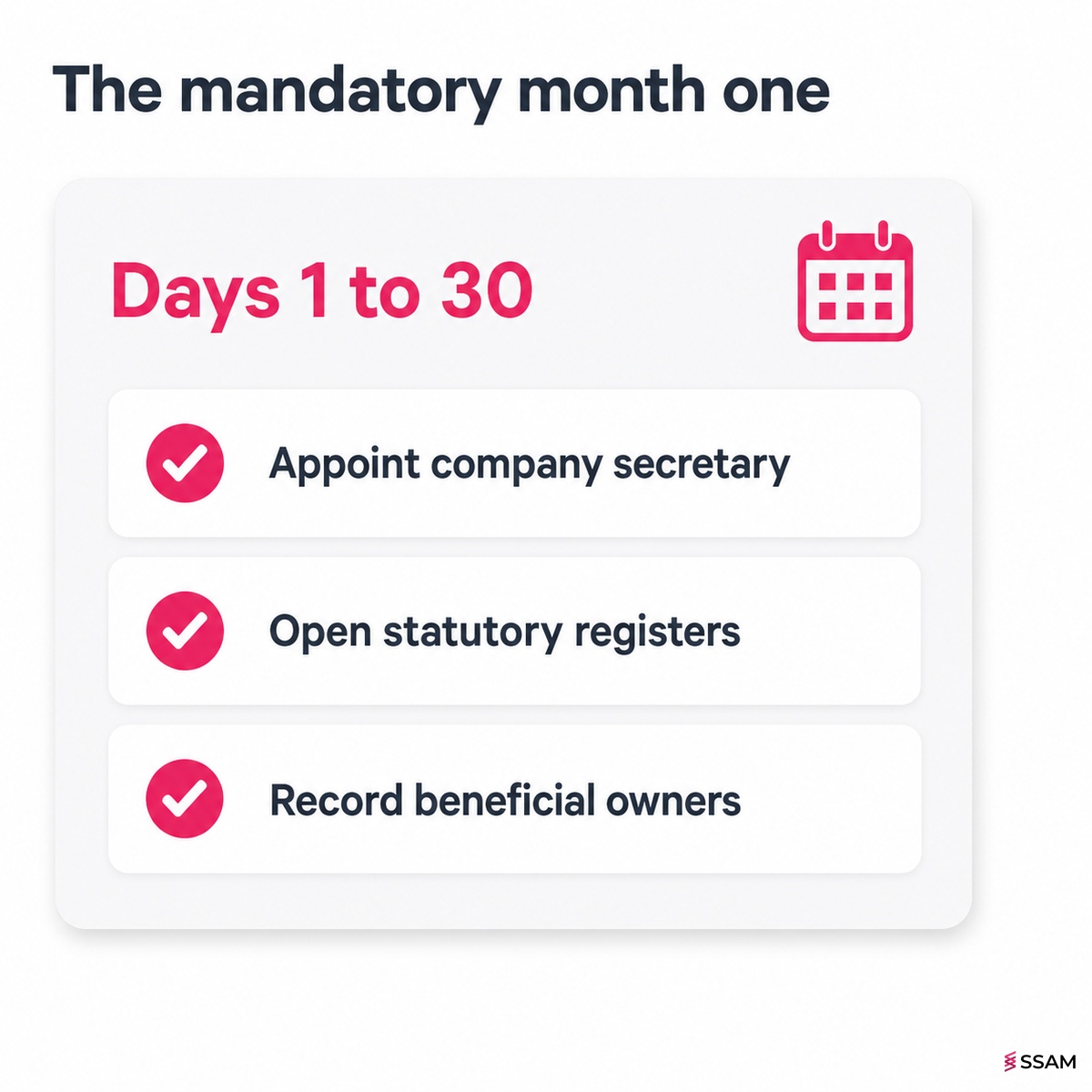
| Days 1 to 30 | Appoint company secretary | Yes (30-day legal clock) | Board |
| Days 1 to 30 | Statutory and beneficial ownership registers | Yes | Secretary |
| Weeks 2 to 6 | Corporate bank account | Operational necessity | Founder + bank |
| Month 1 to 3 | LHDN tax registration, CP204 estimate | Yes | Founder + tax agent |
| Month 1 to 3 | Accounting setup, e-invoicing readiness | Yes (records) | Founder + software provider |
| Before trading | Business licences where applicable | Conditional | Founder + secretary |
Week 1: confirm your incorporation documents
Start by making sure the paperwork proves what you think it proves:
- Notice of registration. This SSM email is conclusive evidence your company exists. Save it in more than one place.
- Certificate of incorporation. Obtainable from SSM on request with the prescribed fee. Banks and some counterparties ask for it.
- Company profile. Order a current company profile from SSM e-Info. Banks typically want a fresh copy, often dated within the last few weeks.
- Constitution decision. A constitution is optional for a company limited by shares under the Companies Act 2016. If you adopt one later, it must be lodged with SSM within 30 days of adoption.
Days 1 to 30: the mandatory legal appointments
The non-negotiable item is the company secretary. Section 236 of the Companies Act 2016 requires the first secretary to be appointed within 30 days of incorporation. If you engaged a firm to incorporate, this is usually already done. If you registered yourself, this is your first task. Our guide to choosing a company secretary in Malaysia covers what to look for.
Your secretary then establishes the compliance backbone:
- Statutory registers: the register of members, directors and other records the Act requires.
- Registered office records: statutory documents kept at your registered office address.
- Beneficial ownership register: under SSM's beneficial ownership reporting framework, every company must identify and record the natural persons who ultimately own or control it (broadly, those above a 25% ownership or control threshold). Most founders have never heard of this register. It is a legal requirement, not an optional extra.
Open your corporate bank account
The bank account is the slowest workstream because it runs on the bank's due-diligence clock, not yours. Start it in week two, not month two. Banks typically ask for:
- A current SSM e-Info company profile
- A board resolution authorising the account and naming signatories (your secretary prepares this)
- Identity documents for directors and signatories
- Proof of business address and, for some banks, evidence of actual business activity
One caution worth remembering. Some people get persuaded to open a Sdn Bhd bank account for someone else’s “business”, then let that person use the account. If the money is suspicious, the account can get flagged and you can end up dealing with the bank and LHDN. Keep your company’s banking under your own control from day one. Do not let a third party run transactions through your company account.
Register with LHDN and set a reminder for filing CP204
Two tax items matter in the first 90 days:
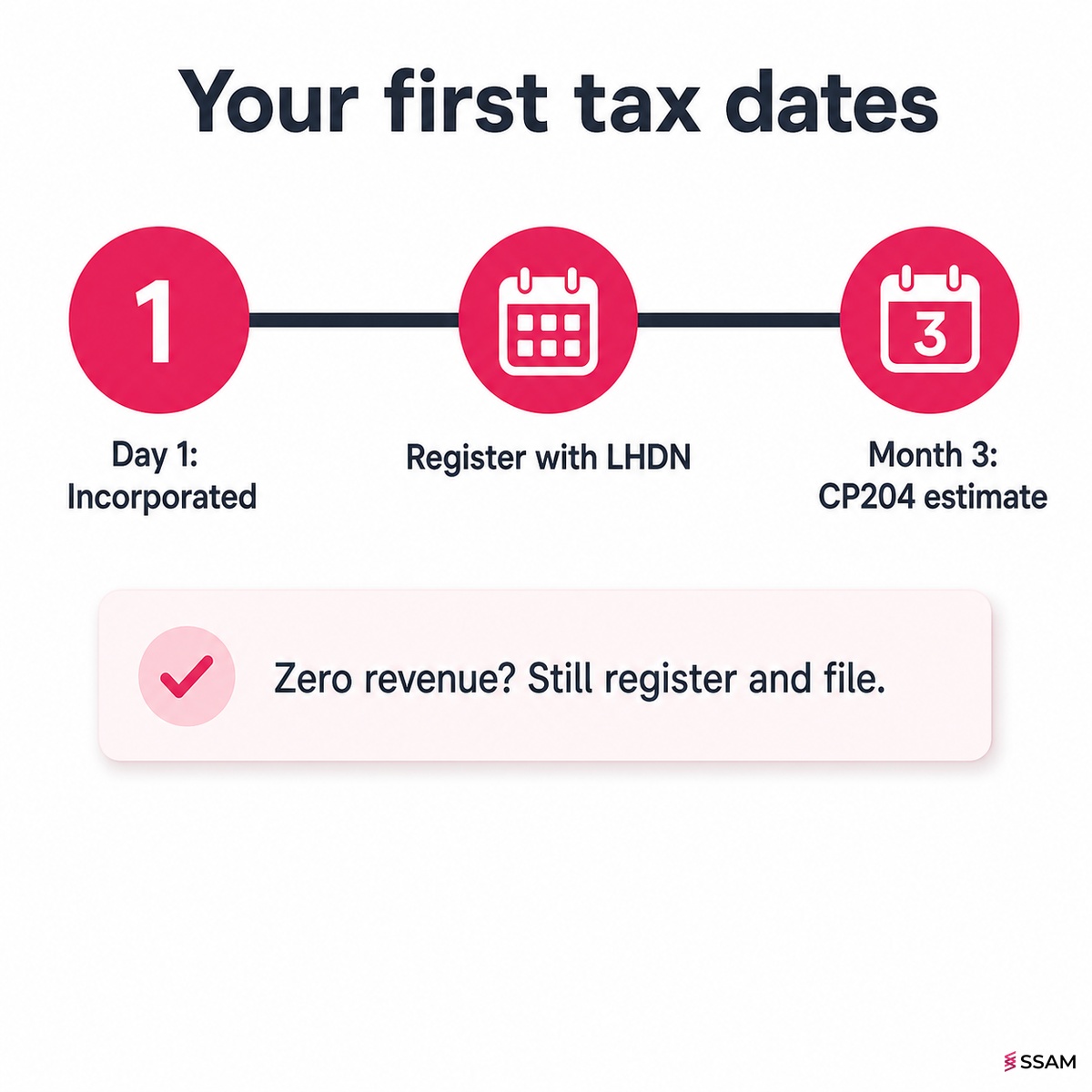
- Tax file registration. Register the company with LHDN even if you have zero revenue. New founders regularly ask whether registration can wait until money comes in, for example in this r/MalaysianPF thread, and the consistent answer is no. Registration is independent of revenue, and dormant companies still file nil returns.
- CP204 estimate. New companies submit their first estimated tax payable (Form CP204) within 3 months of incorporation. Miss it and the estimate system starts off on the wrong foot. Our Malaysia tax filing deadlines guide tracks the full calendar, and the tax compliance checklist for new Sdn Bhd companies goes deeper on the tax side.
If you are hiring, employer registrations with EPF, SOCSO and EIS apply from your first hire. No employees yet means this item waits.
Set up accounting records and e-invoicing early
The Companies Act 2016 requires companies to keep proper accounting records from the start, and LHDN's e-invoicing rollout makes digital records the practical default. The cleanest path is cloud accounting software configured at day one: chart of accounts, invoicing, and bank feeds set up before transactions pile up.
Retrofitting a year of receipts into software later is where new companies lose weekends and money. Set it up once, early, and your first financial year end becomes routine rather than archaeology.
Check which business licences apply to you
SSM's own incorporation guidance advises companies to obtain the necessary licences, permits or approvals from relevant authorities before commencing business. What applies depends on your activity and location:
- Local council licences (for example premises and signboard licences from your city or municipal council)
- Sector approvals for regulated activities such as education, healthcare, financial services or manufacturing
- Conditional registrations tied to your industry
Not every company needs a licence on day one, but every founder should confirm the answer rather than assume it. Your secretary can map this for your specific activity.
Your first-year compliance calendar at a glance
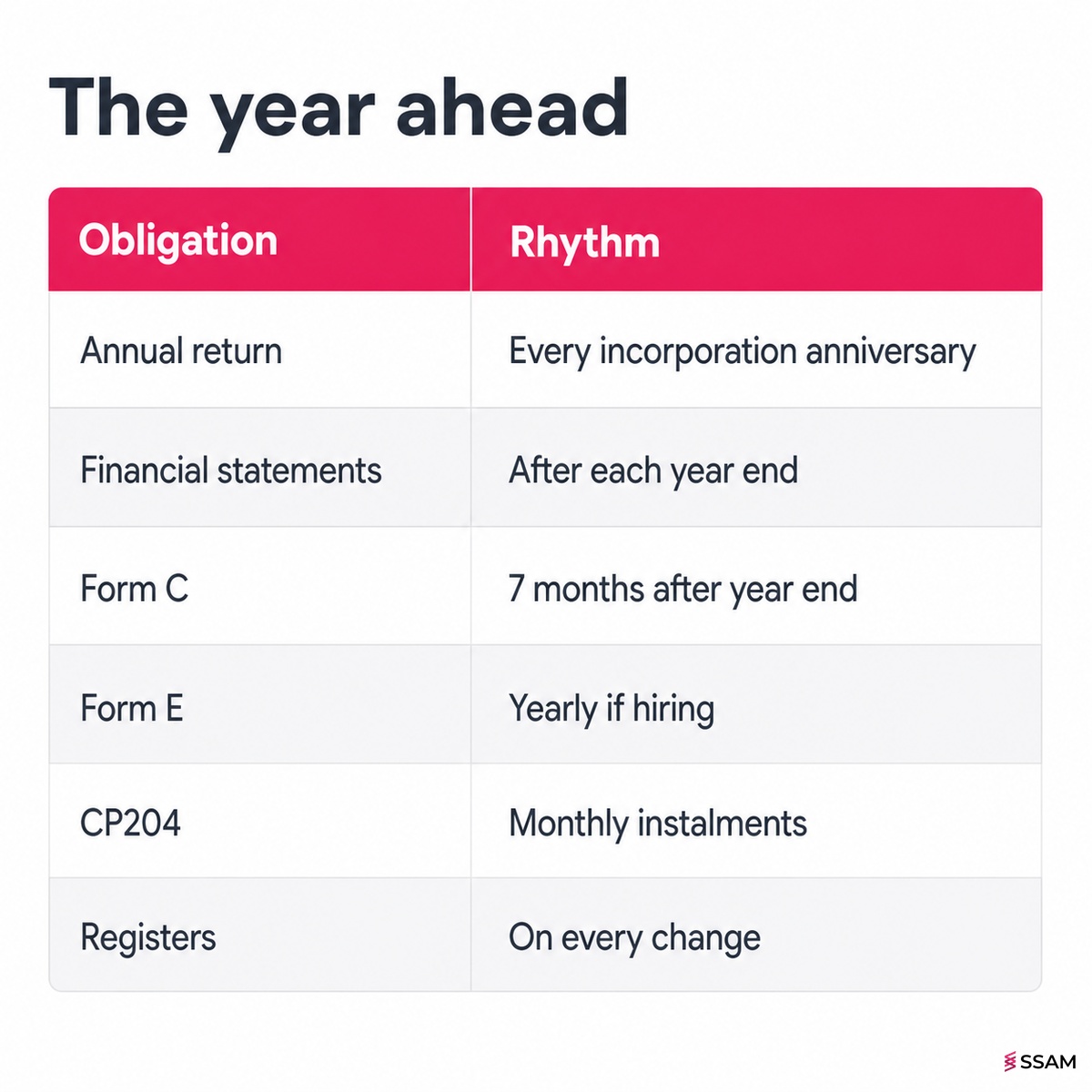
The 90-day setup feeds into a repeating annual cycle. Here is the year ahead in one view:
| Obligation | Rhythm |
|---|---|
| Annual return to SSM | Within 30 days of each incorporation anniversary |
| Financial statements | Circulated after each financial year end, then lodged |
| Form C (company tax return) | Within 7 months after financial year end |
| Form E (employer return) | Annually, if you have employees |
| CP204 instalments | Monthly, once the estimate cycle begins |
| Statutory register updates | Whenever particulars change |
For the annual cost side of this calendar, see the hidden costs of running a Sdn Bhd.
90 days to a clean-running company
The first 90 days after incorporation are not glamorous, but they are short. Confirm the documents, appoint the secretary inside 30 days, open the bank account early, register with LHDN, set a reminder for CP204, set up your accounting software, and check your licences. Do these in order and the rest of the year runs on rails.
If you want the entire post-incorporation sequence handled for you, SSAM Group's company incorporation and Sdn Bhd registration services in Kuala Lumpur cover the journey from name search through first-year compliance. With 40 years of experience, 1,000+ loyal customers and a 99% client satisfaction record, we keep the details on track so you can focus on growth. Speak to the SSAM team or WhatsApp us at +6011-6529 9879.
FAQs about post-incorporation compliance
Do I register with LHDN at zero revenue?
Yes. Tax registration is independent of revenue. A dormant or zero-revenue company still registers with LHDN and files nil returns.
When is my first CP204 due?
New companies submit their first CP204 estimated tax payable within 3 months of the incorporation date. After that, the estimate follows your basis period cycle.
What documents do banks ask for?
Typically a current SSM e-Info company profile, a board resolution naming the account signatories, director and signatory identity documents, and proof of business address. Requirements vary by bank, so confirm the list before visiting.
What is the beneficial ownership register?
A record of the natural persons who ultimately own or control your company, required under SSM's beneficial ownership reporting framework. Your company secretary sets it up and keeps it current.
What happens if I miss a compliance deadline?
Late filings attract SSM or LHDN penalties, and repeated misses escalate to compounds and possible strike-off action. The fix is always the same: file as soon as possible, then put the calendar on a system that warns you early.
Data sources and further references
- SSM: Guidelines for the Incorporation of Local Companies
- SSM: Beneficial Ownership Information
- LHDN: Tax Estimation (CP204)
- Companies Act 2016 (Laws of Malaysia), Section 236, via the federal gazette portal
The information in this article is provided for general informational purposes only and does not constitute tax, accounting, financial or legal advice. Tax laws change frequently and may not apply to your situation. Always consult a qualified professional before acting on any information here.